
Particle counters reveal the true cleanliness of your workspace by providing real-time data on airborne contamination levels that are invisible to the eye. They help you identify sources of pollution, such as ventilation issues or dust entry, and verify the effectiveness of cleaning protocols. By monitoring particle size and concentration, you can optimize environmental controls and stay compliant with regulations. If you keep exploring, you’ll discover how these tools can enhance safety and contamination management even further.
Key Takeaways
- Particle counters measure airborne particle concentrations to assess air cleanliness levels.
- They identify hidden contamination sources not visible to the naked eye.
- Elevated readings can indicate ventilation issues or filter malfunctions.
- They verify the effectiveness of cleaning protocols in reducing contaminants.
- Real-time data supports regulatory compliance and environmental control decisions.
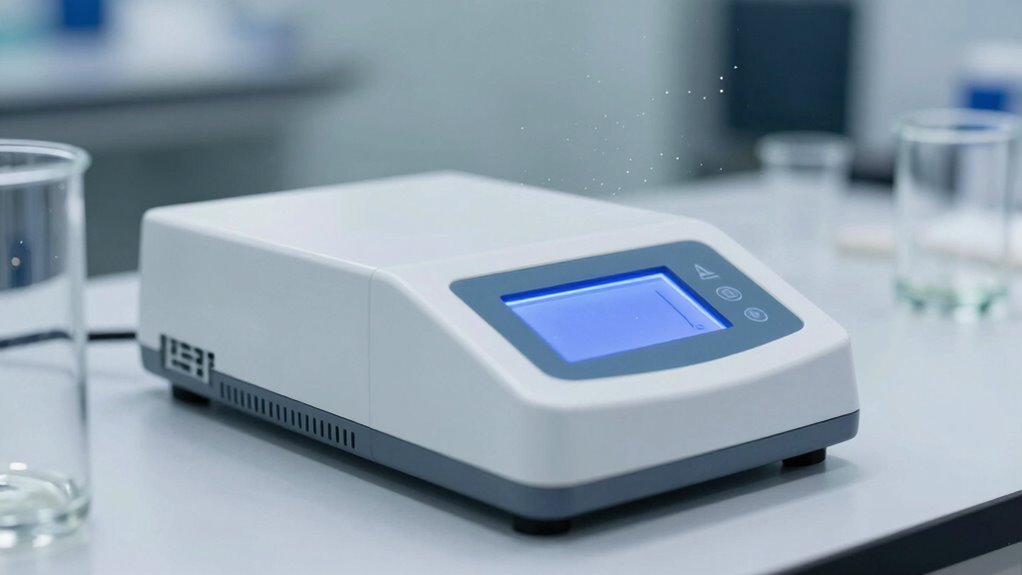
Particle counters have become essential tools for evaluating the cleanliness of workspaces, providing real-time data that can reveal hidden contamination levels. When you use a particle counter, you gain a clear picture of the air quality in your environment, which is vital for maintaining safety and compliance. These devices measure the concentration and size of airborne particles, offering insights that traditional visual inspections simply can’t provide. By analyzing this data, you can determine whether your workspace meets the necessary standards for contamination control, especially in environments like laboratories, healthcare facilities, or manufacturing plants where even tiny particles can cause big problems.
Particle counters provide real-time insights into air cleanliness, helping ensure safety and compliance in critical environments.
Understanding what particle counters reveal about air quality helps you identify sources of contamination that might otherwise go unnoticed. For instance, elevated particle counts can indicate issues with ventilation, such as improper airflow or filter malfunction. If you notice a sudden increase in particles, it could be a sign that dust, skin flakes, or other contaminants are entering the environment, potentially compromising product quality or safety. By continuously monitoring these levels, you can respond quickly to contamination risks and take corrective actions before problems escalate. This proactive approach is essential for maintaining a clean workspace and guaranteeing contamination control measures are effective. Additionally, understanding airborne particle sizes helps you better evaluate which filtration methods are most suitable for your environment. Regularly reviewing contamination sources can help prevent recurring issues and improve overall air quality. Moreover, knowing how to interpret particle data effectively allows for more targeted and efficient cleaning protocols. Implementing proper testing procedures can also ensure that your measurements remain accurate and reliable.
Particle counters also help you verify the effectiveness of your cleaning protocols. If your cleaning procedures aren’t reducing particle counts as expected, you’ll know immediately, allowing you to adjust methods or improve equipment. This ongoing monitoring ensures that your environment stays within acceptable limits, minimizing the chances of contamination spreading or causing damage. Additionally, in regulated industries, maintaining documented records of particle levels becomes a legal requirement, and particle counters make it easy to collect and store this data for audits or inspections. Incorporating continuous monitoring into your contamination control plan further enhances your ability to maintain a consistently clean environment.
With real-time feedback, you can make informed decisions about airflow management, filtration systems, and other environmental controls. For example, if particle counts spike during certain activities, you might need to modify operational procedures or upgrade your air filtration systems. This continuous insight into air quality enables you to optimize contamination control strategies, creating a safer, cleaner workspace for everyone involved. Ultimately, the data provided by particle counters not only reveals the current state of your environment but also guides you toward maintaining higher standards of cleanliness, reducing risks, and guaranteeing compliance with industry regulations.

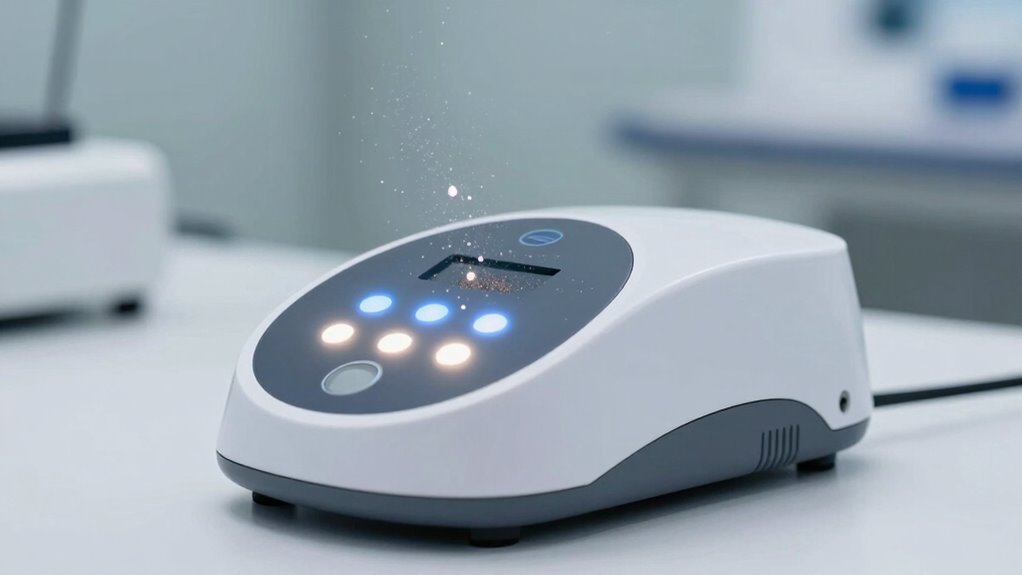
Temtop Handheld Particle Counter 0.3µm, 0.5µm, 1.0µm Particulate Monitor PM2.5, PM10, TSP, Temp & Humidity Detector
Advanced Monitoring Capabilities: Offers precise measurement of various particulate sizes 0.3µm, 0.5µm, 1.0µm and key air quality indices…
As an affiliate, we earn on qualifying purchases.
As an affiliate, we earn on qualifying purchases.
Frequently Asked Questions
How Often Should Particle Counters Be Calibrated for Accurate Readings?
You should calibrate particle counters regularly, typically every six to twelve months, to guarantee measurement accuracy. Calibration frequency depends on usage, environmental conditions, and manufacturer recommendations. If you notice inconsistent readings or significant deviations, recalibrate sooner. Regular calibration helps maintain reliable data, making sure your workspace stays compliant with cleanliness standards. Staying proactive with calibration keeps your particle counter functioning properly, providing precise measurements vital for a clean and safe environment.
Can Particle Counters Detect Specific Types of Contaminants?
Yes, particle counters can help with contaminant identification through particle specificity, but they don’t directly identify specific contaminants like bacteria or chemicals. Instead, they measure the size and concentration of particles, which can suggest potential contaminants. For precise contaminant identification, you’d need additional testing methods. Particle counters are valuable for monitoring cleanliness levels and detecting particle spikes, but they’re not a standalone solution for detailed contaminant analysis.
Are Portable Particle Counters Suitable for All Industrial Environments?
Portable sensors are generally suitable for many industrial environments, but their effectiveness depends on the specific conditions. You should consider industrial compatibility, like temperature, humidity, and dust levels, which can affect performance. While these particle counters offer flexibility and ease of use, make certain they meet industry standards for accuracy and durability. For complex or extreme environments, specialized or stationary sensors might be a better choice.
What Are the Limitations of Using Particle Counters in Cleanroom Assessments?
Using particle counters in cleanroom assessments isn’t perfect; they can miss tiny contamination sources or give misleading data if not used correctly. You might think you’re catching everything, but flaws in data interpretation can lead to overlooked risks. Limitations include sensitivity to environmental factors and the need for skilled operators. To maintain spotless standards, recognize these constraints and combine particle counts with other testing methods for a complete picture.
How Do Temperature and Humidity Affect Particle Counter Accuracy?
Temperature and humidity impact particle counter accuracy by affecting airflow patterns and particle behavior. Fluctuations can cause particles to settle or disperse unpredictably, skewing readings. To guarantee reliable results, you need proper calibration procedures that account for environmental conditions. Regularly monitor and adjust your particle counters in response to temperature and humidity changes, maintaining ideal calibration and ensuring accurate assessments of your clean workspace.

Temtop PMD331 Professional Particle Counter, 7-Channel Handheld Laser Dust Monitor (0.3-10μm), ISO 21501-4 Certified for Cleanroom, Laboratory & HVAC, 2M+ Data Logger with RS485 Modbus
Industry-Leading Accuracy & ISO Compliance: Engineered for high-stakes environments, the PMD331 meets ISO 21501-4 standards. Every unit undergoes…
As an affiliate, we earn on qualifying purchases.
As an affiliate, we earn on qualifying purchases.
Conclusion
Particle counters reveal the hidden truth about cleanliness: they show the levels, they highlight the risks, and they guide the improvements. By monitoring particles, you see where cleanliness is compromised, where contamination lurks, and where standards are maintained. They turn invisible threats into visible data, empowering you to act, to refine, and to guarantee safety. With particle counters, you don’t just clean—you understand, you control, and you create a safer workspace.

Air Quality Monitor Indoor, 10 in 1 Portable Smart Air Quality Tester for CO2 | TVOC | HCHO | Temp | AQI | PM0.3-1 Detection Suitable for Home, Cars, Plants, Pets and Hotels -Black
【10-in-1 Smart Air Quality Monitor: Your All-Round Environmental Guardian】 This portable intelligent air quality tester delivers ultra-precise multi-gas…
As an affiliate, we earn on qualifying purchases.
As an affiliate, we earn on qualifying purchases.
Temtop PMD331 Professional Particle Counter, 7-Channel Handheld Laser Dust Monitor (0.3-10μm), ISO 21501-4 Certified for Cleanroom, Laboratory & HVAC, 2M+ Data Logger with RS485 Modbus
Industry-Leading Accuracy & ISO Compliance: Engineered for high-stakes environments, the PMD331 meets ISO 21501-4 standards. Every unit undergoes…
As an affiliate, we earn on qualifying purchases.
As an affiliate, we earn on qualifying purchases.