
TL;DR
Anthropic’s $65 billion raise at a $965 billion valuation signals a shift from model development to infrastructure investment. The focus is on securing chips, memory, and cloud capacity to power AI’s next leap. This makes AI scaling more about hardware than algorithms.
When a startup claims a nearly trillion-dollar valuation, it grabs headlines. But behind the numbers lies a different story — one about the future of AI as a hardware-intensive industry. Anthropic’s latest $65 billion raise isn’t just about funding; it’s a clear signal that AI’s bottleneck isn’t just clever algorithms anymore. It’s about the chips, the memory, and the cloud capacity to run them at scale.
This article unpacks what makes this funding round unique, why the focus on compute marks a turning point, and what it all means for the AI race. Think of it as moving from software to infrastructure — the new battleground for AI dominance. Learn more about AI’s compute-heavy future.
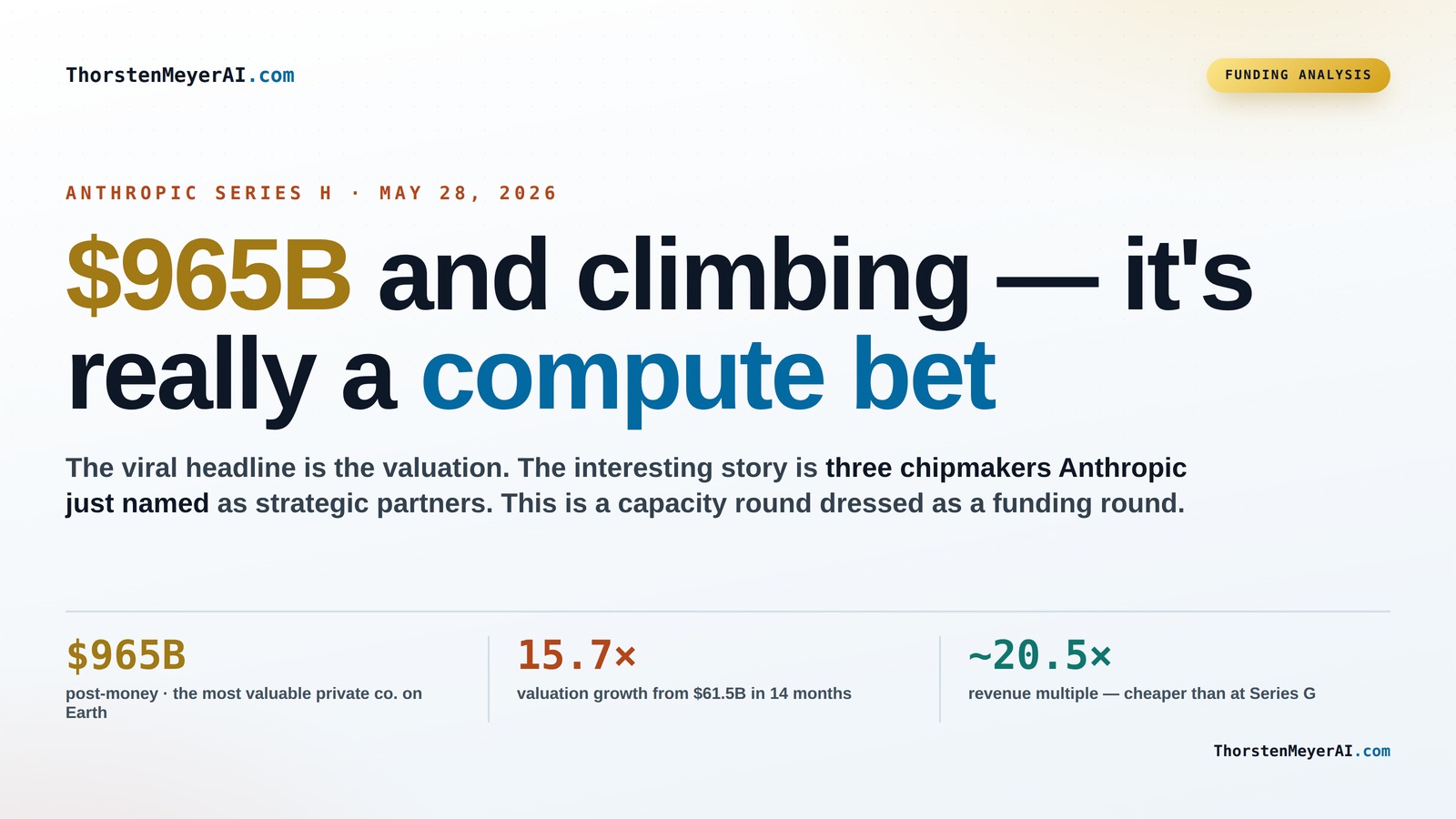
$965B and climbing — it’s really a compute bet
The viral headline is the valuation. The interesting story is in the press release’s middle paragraphs — and in three chipmakers Anthropic just named as strategic partners. This is a capacity round dressed as a funding round.
The numbers nobody can quite parse in sequence
Read together they describe a trajectory with no precedent in enterprise software. Read individually, each looks like a typo.
From $61.5B to $965B in fourteen months
Salesforce took roughly two decades to reach revenue numbers Anthropic just blew past. The sequence below is the part most coverage skips — it’s not the size, it’s the shape.
Anthropic’s valuation ladder · Mar 2025 → May 2026
Five rounds, fourteen months. Bar height is the valuation; the climb itself is the story. Tap any milestone for context.
The multiple actually got cheaper
Bubbles look like multiples expanding while revenue lags. Anthropic’s pattern is the inverse — the valuation tripled, but revenue grew faster, and the multiple compressed.
Revenue-to-valuation multiple · Series G → Series H
Same company, three months apart. The denominator (revenue) is outrunning the numerator (valuation) — exactly the opposite of what a bubble narrative predicts.
10+ gigawatts and three chipmakers
When you name Micron, Samsung & SK hynix alongside your equity backers, you’re saying the binding constraint isn’t demand or model quality — it’s the physical supply of memory chips. The Series H is a capacity round.
Compute commitments backing Anthropic’s capacity bet
$200B+ in announced compute spend across multi-year contracts. The $65B Series H raise has to be read against that bill, not against operating losses.
A genuinely durable bet — or a structural exposure?
Both readings can be true at once. The answer arrives over the next 18–24 months as the gigawatts come online and either fill with paying demand or don’t.
Revenue growth has no precedent in B2B software ($1B → $47B in 17 months). The multiple is compressing, not expanding. Claude is the only frontier model on all 3 major clouds. Enterprise AI spend share went from ~10% to >65% in a year. Compute commitments are tied to specific contracts with capacity dates.
20× revenue is not cheap by any historical software-investing standard. Revenue is reported gross of cloud-reseller pass-throughs, which inflates the top line. Profitability is 2 years out. Amodei’s own warning: a 12-month delay in AI progress “would make him bankrupt” — the compute commitments are a structural exposure to demand persistence.
The valuation race — and the IPO context
Anthropic shipped Opus 4.8 the same morning as Series H — not a coincidence. One week after OpenAI filed confidentially for IPO. The late-2026 frame is set: two frontier AI companies racing to public markets, each pitching durability.
Key Takeaways
- Anthropic’s $65 billion raise is primarily a capacity deal focused on securing AI hardware and infrastructure.
- The company’s revenue is exploding — over $47 billion in run-rate — showing AI demand is outpacing traditional funding models.
- The valuation-to-revenue multiple is actually shrinking, signaling fast revenue growth and a focus on infrastructure rather than bubble-like speculation.
- Hardware partnerships with chipmakers and cloud giants are now central to AI scaling, making supply chain resilience a strategic priority.
- Future AI growth depends more on building and controlling infrastructure than just developing better models.
As an affiliate, we earn on qualifying purchases.
Why $965B and a $65B Raise Are About Infrastructure, Not Just Money
Anthropic’s valuation skyrocketed to $965 billion with a $65 billion infusion — but the real story isn’t just the number. It’s about the infrastructure needed to fuel AI growth. This isn’t a typical startup raising money to build features; it’s a race to secure chips, storage, and cloud capacity at a scale that’s never been seen before.
Imagine trying to build a city — the money isn’t just for roads or buildings, but the raw materials and utilities to keep everything running. This round is about locking in those utilities for AI: gigawatts of compute, strategic hardware partnerships, and supply chain commitments from giants like Micron, Samsung, and SK hynix. Read about Anthropic’s compute bet.
Without enough chips or enough cloud capacity, even the smartest models can’t operate. This round signals that AI’s future depends on hardware supply chains, not just algorithms. Unpack the compute-driven future.


AI Chip Design: From Transistors to Neural Networks
As an affiliate, we earn on qualifying purchases.
As an affiliate, we earn on qualifying purchases.
The Real Money: $47 Billion in Run-Rate Revenue and Growing Fast
Anthropic’s reported revenue hit over $47 billion in early 2026. That’s a 5.4× jump from just a few months earlier. To put it plainly: this company is generating revenue faster than its valuation is growing.
For comparison, OpenAI’s valuation is around 30× revenue, while Anthropic’s is now at approximately 20.5×. That’s a sign of its accelerating growth and the massive demand for AI services.
Picture a rocket: the faster it accelerates, the more fuel it needs. For Anthropic, that fuel is compute capacity. The company’s revenue surge is a clear indicator that AI demand is exploding, but so is the need for hardware to keep up.


Understanding Data Centers: A Beginner's Guide to the Infrastructure Powering Artificial Intelligence, Cloud Computing, and the Digital World
As an affiliate, we earn on qualifying purchases.
As an affiliate, we earn on qualifying purchases.
Why This Round Is a Compute Deal in Disguise
The headline $965 billion valuation makes it sound like a typical funding event. But look deeper, and it’s clear this is a capacity round. Most of the money is earmarked for chips, servers, and cloud infrastructure — the physical backbone of AI.
Imagine buying a fleet of supercomputers, not just hiring more developers. Anthropic is locking in the hardware resources needed to train and run models at a scale that could redefine AI capabilities.
This focus on hardware is why Silicon Valley is calling it a ‘compute deal’ — because the real asset being bought isn’t just equity, but capacity.


A-Tech 256GB Kit (8x32GB) DDR4 3200MHz PC4-25600 ECC RDIMM 2Rx4 Dual Rank 1.2V ECC Registered DIMM 288-Pin Server & Workstation RAM Memory Upgrade Modules (A-Tech Enterprise Series)
- Compatibility: For select DDR4 servers and workstations only
- Capacity: 256GB kit with 8 x 32GB modules
- Speed: Up to 3200MHz DDR4
As an affiliate, we earn on qualifying purchases.
As an affiliate, we earn on qualifying purchases.
Who Are the Real Players? Chipmakers and Cloud Giants Stepping Up
The deal highlights strategic partnerships with giants like Amazon, Microsoft, Nvidia, and leading memory chipmakers. These aren’t just investors — they’re enablers of AI’s hardware future.
Strikingly, three memory chip giants — Micron, Samsung, and SK hynix — are named as ‘strategic partners.’ They’re crucial because AI models need massive amounts of high-speed memory and storage to function efficiently. See how Anthropic’s funding reflects a computation-first AI strategy.
Think of it as an industrial buildout: without enough chips or cloud capacity, AI models can’t scale. These partnerships signal that the hardware supply chain is now a strategic battlefield.
The Future of AI: Capital-Intensive, Hardware-Dependent, and Growing Fast
This isn’t just about building better models; it’s about building the infrastructure to run them. As AI models grow larger and more complex, the need for compute resources becomes a bottleneck. Discover Anthropic’s massive bet on computing power.
Anthropic’s rapid revenue growth and massive funding suggest AI is entering a phase where hardware costs and supply chain constraints will shape the industry’s future. It’s no longer just a software race — it’s a hardware arms race.
Picture AI as an electric grid: the more power it needs, the more infrastructure you must install and maintain. This shift could redefine who leads in AI — not just the smartest algorithms, but those who control the hardware supply chain.

What This Means for You, the Business, and the Industry
For enterprise customers, this signals a future where AI capabilities will depend heavily on hardware access. Companies will need to think about their AI infrastructure strategies. Explore more about trustworthy AI and technology.
Investors should watch hardware partnerships and supply chain commitments — these will determine who can scale AI fastest.
Chipmakers and cloud providers hold the keys. Their ability to meet demand will shape the next decade of AI innovation.
For the broader industry, this marks a shift from model-centric to infrastructure-centric competition. It’s no longer just about creating smarter models, but about building the backbone that powers them.
Frequently Asked Questions
Why is this round called a ‘compute’ deal instead of a regular funding round?
It’s because most of the money is dedicated to securing chips, servers, and cloud capacity needed to scale AI models. The focus is on infrastructure, not just equity or revenue growth.How can Anthropic justify a $965 billion valuation?
The valuation reflects investor confidence in AI’s explosive growth and the strategic importance of infrastructure. It’s based on future potential, not just current revenue.Will Anthropic really outpace OpenAI now?
In private valuation, yes. Anthropic’s $965 billion tops OpenAI’s $852 billion. But real competitive strength depends on execution, infrastructure, and actual revenue growth.What will Anthropic do with all this money?
Most will go toward securing chips, memory, and cloud infrastructure to support larger, faster AI models, and to dominate the hardware supply chain.Does this mean AI is now a hardware arms race?
Absolutely. The focus is shifting from algorithm innovation alone to controlling the physical resources needed for AI’s future scale.Conclusion
This isn’t just another big funding round — it’s a signal that AI is becoming a hardware game. The real wealth isn’t just in algorithms, but in the chips, servers, and supply chains that make AI possible.
If you want a glimpse of what’s next, watch the infrastructure giants and chipmakers. They’re the new gatekeepers of AI’s future — and the stakes have never been higher.