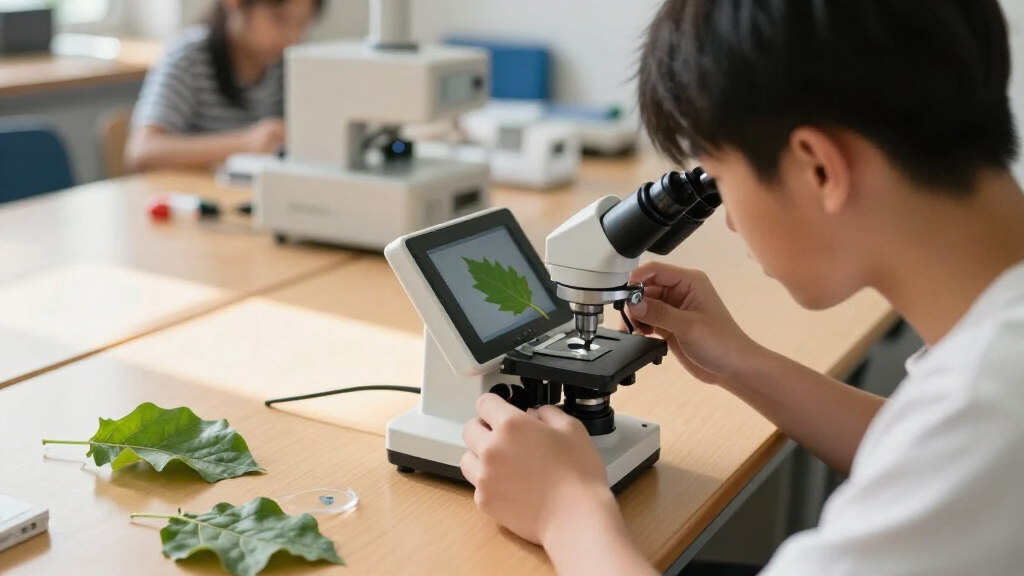
For students who want a flexible mix of viewing, sharing, and classroom use, I’d make the TOMLOV DM301 Pro my best overall pick because its 7-inch screen offers a more comfortable group-viewing experience than tiny handheld displays. The Skybasic Wireless Digital Microscope is a simpler choice for students who value portability, while the Woehrsh Trinocular Compound Microscope suits more advanced work with prepared slides. The main tradeoff is between easy, self-contained viewing and the greater control of a compound or HDMI-connected setup. Screen size, focusing stability, lighting, and whether students need to capture or share images can matter more than a headline magnification figure. Continue reading for the full breakdown and guidance on matching a microscope to a student’s age and projects.

Prime made for students and young adults
- Fast, free delivery for dorm and study essentials
- Prime Video and Amazon Music included
- Member-only deals
Key Takeaways
- The TOMLOV DM301 Pro’s 7-inch screen makes it a strong shared-viewing pick; handheld models with 2-inch screens favor portability over group visibility.
- Handheld models serve different ages and habits: the BMDSAE, Hayve, ASPOVEN, Temodu, Odatay, BEAVERLAB Finder, and Darwin M2C put compact exploration ahead of a traditional slide-work setup.
- Compound and multi-lens systems offer a different learning path: the Woehrsh, Andonstar AD266S, and AD246S-M are better suited to structured slide work or varied viewing setups than simple handheld picks.
- Magnification claims alone do not settle image quality. Stable focusing, useful illumination, a screen students can see, and the intended specimen type all affect whether magnification helps.
- Included accessories shape the learning experience: the STEM Kit and Odatay’s included memory card point toward ready-to-start activities or image capture, while buyers should check what each package actually contains.
| Skybasic Wireless Digital Microscope, 50X–1000X, with Adjustable Stand |  | Best for Phone-Based Exploration | Magnification: 50X–1000X | Sensor: 2 MP HD CMOS | Image resolution: 1920 × 1080 for smartphones; 720P for computers | VIEW LATEST PRICE | See Our Full Breakdown |
| TOMLOV DM301 Pro Digital Microscope with 7-Inch Screen |  | Best Overall for Group Learning | Model: DM301 Pro | Display: 7-inch IPS screen | Magnification: Up to 1200× | VIEW LATEST PRICE | See Our Full Breakdown |
| BMDSAE 1000x Handheld Digital Microscope for Kids with 2.0-Inch Screen |  | Best Compact Handheld | Brand and model: BMDSAE 382 | Magnification: Up to 1000× | Camera resolution: 2 MP | VIEW LATEST PRICE | See Our Full Breakdown |
| Thames & Kosmos Digital Microscope with HD Imaging and LCD Display |  | Best for Guided Slide Activities | Magnification: 10×–150× | Digital zoom: Up to 2.5× | Display: 2.8-inch LCD | VIEW LATEST PRICE | See Our Full Breakdown |
| Woehrsh Trinocular Compound Microscope with USB Camera, Mechanical Stage, and 40X–5000X Magnification |  | Best for Traditional Lab Skills | Magnification: 40X–5000X | Eyepieces: 2 WF10x and 2 WF25x | Objective: 195 achromatic objective lens | VIEW LATEST PRICE | See Our Full Breakdown |
| Hayve CM4 Handheld Digital Microscope for Kids |  | Best for Flexible Handheld Exploration | Magnification: 100x–1000x | Camera: 16MP, 1080p | Display: 2-inch IPS | VIEW LATEST PRICE | See Our Full Breakdown |
| ASPOVEN 4K Handheld Digital Microscope for Kids with 2.0″ IPS Screen (Blue) |  | Best for Young Students Starting with 4K Capture | Magnification: 200x–1000x | Camera: 4K HD | Display: 2-inch IPS | VIEW LATEST PRICE | See Our Full Breakdown |
| Temodu Kids Digital Microscope with 2-Inch Screen, 1000× Magnification, Purple |  | Best for Simple Computer-Connected Lessons | Maximum magnification: 1000x | Screen: 2-inch IPS color | Zoom adjustment: 4x | VIEW LATEST PRICE | See Our Full Breakdown |
| Andonstar AD266S 20x–5000x 2160P UHD HDMI Digital Microscope with 5 Lenses |  | Best for Advanced Student Lab Work | Magnification: Up to 5000x; varies by lens and setup | Lenses: 5 | Video resolution: 2160P UHD | VIEW LATEST PRICE | See Our Full Breakdown |
| Odatay 4K Digital Microscope for Kids with 32GB Card and 2.4″ Screen |  | Best Value Kit for Classroom Activities | Magnification: 200x–1000x across 4 levels | Camera: 4K HD | Display: 2.4 inches | VIEW LATEST PRICE | See Our Full Breakdown |
| BEAVERLAB Finder 4.0-Inch Digital Microscope for Kids |  | Best for On-Screen Exploration | Display: 4.0-inch IPS | Magnification: 100×–1600× | Camera: 2 MP CMOS | VIEW LATEST PRICE | See Our Full Breakdown |
| Kids Digital Microscope STEM Kit |  | Best Starter Kit | Magnification: 200×–1000× across five levels | Storage: 32GB memory card included | Prepared slides: 5 glass specimens | VIEW LATEST PRICE | See Our Full Breakdown |
| BEAVERLAB Darwin M2C Portable Digital Microscope for Kids with 4-Inch IPS Screen |  | Best for Device Sharing | Model: DDL-M2C | Screen: 4-inch IPS | Magnification: 100×–1600× hybrid | VIEW LATEST PRICE | See Our Full Breakdown |
| Andonstar AD246S-M 3-Lens 2160P HDMI Digital Microscope |  | Best for Advanced Projects | Model: AD246S-M | Lenses: 3 interchangeable lenses: A, D, and L | Video resolution: 2160P | VIEW LATEST PRICE | See Our Full Breakdown |
| digital microscopes for student | Magnification | Lighting | Display |
|---|---|---|---|
| Skybasic Wireless Digital Micr | 50X–1000X | 8 adjustable LED lights | — |
| TOMLOV DM301 Pro Digital Micro | Up to 1200× | Adjustable dual LED lights | 7-inch IPS screen |
| BMDSAE 1000x Handheld Digital | Up to 1000× | 8 adjustable LEDs with 3 brightness modes | 2.0-inch IPS screen |
| Thames & Kosmos Digital Micros | 10×–150× | — | 2.8-inch LCD |
| Woehrsh Trinocular Compound Mi | 40X–5000X | LED | — |
| Hayve CM4 Handheld Digital Mic | 100x–1000x | 8 adjustable LEDs, 4 brightness modes | 2-inch IPS |
| ASPOVEN 4K Handheld Digital Mi | 200x–1000x | 8 built-in LEDs, 3 brightness levels | 2-inch IPS |
| Temodu Kids Digital Microscope | — | 8 adjustable LED sources | — |
| Andonstar AD266S 20x–5000x 216 | Up to 5000x; varies by lens and setup | — | 7-inch LCD IPS |
| Odatay 4K Digital Microscope f | 200x–1000x across 4 levels | — | 2.4 inches |
| BEAVERLAB Finder 4.0-Inch Digi | 100×–1600× | 8 adjustable lights | 4.0-inch IPS |
| Kids Digital Microscope STEM K | 200×–1000× across five levels | — | — |
| BEAVERLAB Darwin M2C Portable | 100×–1600× hybrid | — | — |
| Andonstar AD246S-M 3-Lens 2160 | — | Adjustable LED lights with 8 intensity levels | — |
More Details on Our Top Picks
Skybasic Wireless Digital Microscope, 50X–1000X, with Adjustable Stand
For students who want to view specimens on a phone or computer, the Skybasic’s Wi-Fi and USB connections offer more flexibility than the self-contained BMDSAE 382, which has its own small screen. Its adjustable stand and LED lighting can help with casual observations of leaves, fabric, and other nearby objects, while photo and video capture make it easier to save findings for a class project. The listed 50X–1000X range sounds broad, but the fixed-focus design makes it a casual inspection tool rather than a substitute for a compound microscope. Computer setup may take extra fiddling, and a USB adapter is not included. I’d choose it for students who already have a compatible device and value sharing a live view; those who want a ready-to-use screen should look at the TOMLOV DM301 Pro instead.
Pros:- Connects to Android and iOS devices over Wi-Fi and to Windows or Mac computers by USB
- Adjustable LED lighting helps illuminate objects in different settings
- Captures photos and videos for documenting observations
- Portable design includes an adjustable stand
Cons:- Fixed focus limits control over sharpness and makes it unsuitable for professional microscopy
- USB adapter is not included, and some computer setups may need configuration
- Computer image resolution is listed as 720P, below the smartphone output
Best for: Students who want to inspect everyday objects on a compatible phone or computer and save images for school projects
Not ideal for: Students who need precise focusing for prepared slides or want a complete standalone setup with its own display
- Magnification:50X–1000X
- Sensor:2 MP HD CMOS
- Image resolution:1920 × 1080 for smartphones; 720P for computers
- Lighting:8 adjustable LED lights
- Connectivity:Wi-Fi for Android and iOS; USB for Windows and Mac
- Focal length range:3–60 mm
- Included accessories:USB cable, bracket, base, and user manual
- Warranty:One-year replacement service for quality problems
Our verdict“Choose the Skybasic if you want a portable microscope that shares views with a phone or computer and can accept the setup tradeoffs.”
TOMLOV DM301 Pro Digital Microscope with 7-Inch Screen
The 7-inch IPS screen gives students a shared view without crowding around a phone, making the DM301 Pro a strong fit for home lessons or small group demonstrations. Compared with the Skybasic, it is a more self-contained teaching setup: it includes prepared and blank slides, a carrying case, and connections for a TV, computer, or projector. Its app support and capture tools also let students save observations, while the built-in measurement scale can add context to images. The tradeoff is that the device is less pocketable than the BMDSAE 382, and its battery lasts up to 3 hours per charge. Although the magnification reaches 1200×, the supplied information does not establish suitability for advanced lab work. I’d rank it first for students who benefit from a large shared display and ready-to-start accessories.
Pros:- Large, adjustable-angle 7-inch IPS display makes shared viewing easier
- Connects to TVs, computers, and projectors as well as supporting app viewing
- Includes prepared and blank slides, a carrying case, and other starter accessories
- Captures 8 MP photos and 1080p videos with a built-in measurement scale
Cons:- Battery life is limited to up to 3 hours per charge
- Larger screen and accessory kit make it less compact than handheld options
- Listed magnification and imaging features may not meet advanced laboratory needs
Best for: Students learning with a parent, tutor, or small group who want a built-in display and included slides
Not ideal for: Students who need a lightweight pocket microscope or extended sessions far from a power source
- Model:DM301 Pro
- Display:7-inch IPS screen
- Magnification:Up to 1200×
- Camera:8 MP photos; 1080p videos
- Lighting:Adjustable dual LED lights
- Connectivity:Wi-Fi app support; USB and HD output
- Battery life:Up to 3 hours
- Included accessories:Carrying case, microSD card, power cable, TV cable, power adapter, 5 prepared slides, and 5 blank slides
- Warranty:One year
Our verdict“Pick the DM301 Pro for student sessions where a large shared screen and included slide kit matter more than compact size.”
BMDSAE 1000x Handheld Digital Microscope for Kids with 2.0-Inch Screen
The BMDSAE 382 is the easiest pick here to carry between a desk, classroom, and backyard: it has a built-in 2-inch screen, a lanyard, and USB-C transfer to a computer. Unlike the Skybasic, it does not depend on a phone to show an image, and its manual focus gives students some hands-on control over sharpness. That control takes practice, though, and the small display is less useful for group viewing than the TOMLOV DM301 Pro’s 7-inch screen. The 2 MP camera and storage for photos or AVI video suit simple records of observations, but the up-to-2-hour battery life can interrupt longer activities. I’d favor it for young students who want a portable, self-contained tool; slide-based lessons or longer sessions call for a larger setup.
Pros:- Portable design has its own screen and includes a lanyard
- Manual focus lets students adjust the image directly
- Eight adjustable LEDs offer three brightness modes
- Stores photos and videos and transfers them to Windows or Mac computers by USB-C
Cons:- Battery life is up to 2 hours per charge
- Manual focusing may take practice
- Small 2-inch screen is less suited to group viewing than the TOMLOV DM301 Pro
Best for: Young students who want a lightweight, self-contained microscope for short observations at home or outdoors
Not ideal for: Students who need a large shared screen, long battery runtime, or effortless focusing from the start
- Brand and model:BMDSAE 382
- Magnification:Up to 1000×
- Camera resolution:2 MP
- Display:2.0-inch IPS screen
- Lighting:8 adjustable LEDs with 3 brightness modes
- Battery:600 mAh; up to 2 hours
- Storage:32M; supports 200+ photos or AVI videos
- Connectivity and compatibility:USB-C; Windows XP/Vista/7/8/10/11 and Mac 11.0+
- Included items:Microscope, lanyard, USB-C data cable, and instruction manual
Our verdict“Choose the BMDSAE for portable, short study sessions where a built-in screen matters more than runtime or group viewing.”
Thames & Kosmos Digital Microscope with HD Imaging and LCD Display
Thames & Kosmos takes a more lesson-oriented approach than the BMDSAE handheld: its prepared and blank slides, coverslips, specimen tools, and illustrated manual help students move from viewing to making their own samples. The 2.8-inch LCD keeps observations on the microscope, while photo and video capture provide a record of what they find. Its 10×–150× magnification is far below the headline ranges on the Skybasic and TOMLOV DM301 Pro, but that simpler range is paired with a defined starter set for slide activities. The tradeoffs are practical: a microSD card is not included, and USB Type-C connectivity does not include a computer for larger-screen viewing. I’d pick this for a student who benefits from guided, hands-on specimen work more than extreme magnification claims.
Pros:- Includes prepared and blank slides plus coverslips and specimen tools
- Illustrated manual supports guided activities
- Built-in LCD displays specimens without eyepieces
- Captures photos up to 5 MP and video up to 1080p
Cons:- Magnification tops out at 150×, well below the listed ranges of the Skybasic and TOMLOV DM301 Pro
- microSD card is required for storage but not included
- Computer for larger-screen viewing is not included
Best for: Students who want structured slide-making activities with prepared samples, tools, and an illustrated manual
Not ideal for: Students who need high magnification, a large display for group viewing, or included storage media
- Magnification:10×–150×
- Digital zoom:Up to 2.5×
- Display:2.8-inch LCD
- Photo and video:Up to 5 MP photos; up to 1080p video
- Illumination:Adjustable-brightness LED
- Connectivity:USB Type-C
- Storage:microSD card slot; card not included
- Included accessories:4 prepared slides, 4 blank slides, 8 coverslips, 8 slide labels, 2 specimen vials, tweezers, dropper, stirring rod, and 16-page illustrated manual
- Model and brand:678010; Thames & Kosmos
Our verdict“Choose Thames & Kosmos for guided slide-based learning if its modest magnification and separately sourced storage fit your needs.”
Woehrsh Trinocular Compound Microscope with USB Camera, Mechanical Stage, and 40X–5000X Magnification
Among these five, the Woehrsh is the clear choice for students who want to practice with a traditional compound microscope rather than rely on a handheld digital viewer. Its coarse and fine coaxial focus and dual-layer mechanical stage offer more hands-on control than the fixed-focus Skybasic or the small-screen BMDSAE. The trinocular head and phone holder also suggest options for sharing or recording a view, while the supplied slides, coverslips, and specimens give students material to work with. That breadth comes with a steeper learning curve and a bulkier setup than the TOMLOV DM301 Pro. The 40X–5000X claim is not explained by specific lens combinations, and the included electronic camera’s specifications are unclear. I’d choose it for lab-style practice, while buyers prioritizing straightforward digital viewing should favor a screen-first model.
Pros:- Coaxial coarse and fine focus supports hands-on adjustment
- Dual-layer mechanical stage helps position specimens
- Trinocular head and included phone holder provide sharing options
- Includes slides, coverslips, specimens, and other educational accessories
Cons:- Included electronic eyepiece camera specifications are unclear
- The 40X–5000X magnification range is not tied to specific objective and eyepiece combinations
- Traditional microscope controls are less immediate than a handheld digital viewer
Best for: Students ready to practice traditional focusing and slide handling with a compound microscope and mechanical stage
Not ideal for: Younger beginners or students who want a compact, clearly specified digital camera and simple all-in-one viewing
- Magnification:40X–5000X
- Eyepieces:2 WF10x and 2 WF25x
- Objective:195 achromatic objective lens
- Lighting:LED
- Focusing:Coaxial coarse and fine focus
- Stage:Dual-layer mechanical stage
- Head:306° swivel trinocular head
- Included accessories:Slides, coverslips, specimens, cell phone holder, and other tools
- Brand and model:Woehrsh RM
Our verdict“Pick the Woehrsh for traditional lab-style practice if you can accept unclear camera details and magnification combinations.”
Hayve CM4 Handheld Digital Microscope for Kids
The Hayve CM4 suits students who want a self-contained microscope they can carry from a desk to the garden. Its built-in 2-inch screen and camera let them inspect and save observations without a computer, while USB connectivity adds a larger-screen option for later viewing. Compared with the ASPOVEN 4K Handheld Digital Microscope, the Hayve starts at a lower stated magnification and lists a 16MP camera rather than 4K; its wider 100x–1000x range and four lighting modes give students flexibility when examining varied objects. The 8GB card is ready for basic photo storage, but the battery lasts up to three hours, so longer sessions may need a recharge. I’d also check the age guidance with the seller, since the supplied description gives two different ranges.
Pros:- Built-in screen supports immediate viewing without a computer
- 100x–1000x range accommodates a variety of small objects
- Eight LEDs with four brightness modes help adapt illumination
- Includes an 8GB microSD card and USB computer connectivity
Cons:- Battery life is limited to up to three hours
- Age guidance is inconsistent in the product description
Best for: Students ages 8–12 who want to examine and save close-up observations away from a computer
Not ideal for: Students who need a full day of battery use or a consistently specified age recommendation
- Magnification:100x–1000x
- Camera:16MP, 1080p
- Display:2-inch IPS
- Lighting:8 adjustable LEDs, 4 brightness modes
- Battery life:Up to 3 hours
- Storage:8GB microSD card
- Connectivity:USB; Windows and Mac compatible
- Weight:226 g
Our verdict“Choose the Hayve CM4 for portable, screen-based exploration and basic recording, provided its short battery life fits your student’s sessions.”
ASPOVEN 4K Handheld Digital Microscope for Kids with 2.0″ IPS Screen (Blue)
The ASPOVEN inskam382 puts photo and video capture at the center of a child’s first microscope activities. Its stated 4K HD camera, built-in screen, and PC file transfer can help students save observations to revisit for class projects, while the neck strap supports quick outdoor use. Compared with the Hayve CM4, ASPOVEN is described for ages 3–12 and has a two-year warranty, but its 200x starting magnification offers less low-end flexibility than Hayve’s 100x range. The 2-inch display is useful for checking a subject on the spot, though it limits group viewing and fine inspection. This is a straightforward portable learning tool, not a replacement for a stand-mounted microscope or software with measurement features.
Pros:- Stated 4K HD camera supports photo and video capture
- Lightweight handheld design includes a neck strap
- Eight LEDs with three brightness levels adjust illumination
- Type-C charging cable and PC file transfer support basic sharing
Cons:- 2-inch screen is small for detailed or group viewing
- Functions are limited to basic photo and video capture
- Magnification starts at 200x, above the Hayve CM4’s stated 100x
Best for: Young students ages 3–12 who want to capture simple observations at home, outdoors, or in class
Not ideal for: Students who need a larger shared display, low magnification below 200x, or analysis tools
- Magnification:200x–1000x
- Camera:4K HD
- Display:2-inch IPS
- Lighting:8 built-in LEDs, 3 brightness levels
- Connectivity:Type-C charging; PC file transfer
- Age range:3–12 years
- Weight:0.5 lb
- Warranty:2 years
Our verdict“Pick the ASPOVEN for a young student who values portable 4K capture over a larger display or more advanced microscope controls.”
Temodu Kids Digital Microscope with 2-Inch Screen, 1000× Magnification, Purple
The Temodu Kids Digital Microscope is a simple fit for students who want to view a specimen on the device and then connect it to a compatible computer for photo or video work. Its USB Type-C charging, lanyard, and adjustable LEDs make it easy to carry and use in different settings. Unlike the Odatay 4K Digital Microscope, Temodu’s supplied details do not specify a high-resolution camera or include a prepared-slide kit; its advantage is a clearly stated computer compatibility range and charging time. The built-in storage holds about 200 photos, which should cover short activities, but additional capacity requires a memory card. Computer mode also disables the device buttons, so students should expect to control their workflow through the computer rather than the microscope.
Pros:- 2-inch IPS screen provides on-device viewing
- Stores approximately 200 photos before extra storage is needed
- USB Type-C charging and a stated two-hour full-charge time
- Compatible with Windows 10/11 and Mac OS X 11.0 or later
Cons:- Memory card is required for additional storage
- Power adapter is not included
- Microscope buttons cannot be used in computer mode
Best for: Students doing short observation assignments who will transfer images to a Windows 10/11 or recent Mac computer
Not ideal for: Students who need abundant included storage, a prepared-slide bundle, or direct button control while connected to a computer
- Maximum magnification:1000x
- Screen:2-inch IPS color
- Zoom adjustment:4x
- Lighting:8 adjustable LED sources
- Battery:600 mAh lithium
- Charging:USB Type-C; full charge in 2 hours
- Photo storage:Approximately 200 photos
- Computer compatibility:Windows 10/11; Mac OS X 11.0 and later
Our verdict“Choose Temodu for straightforward computer-connected lessons if its built-in photo capacity is enough for the student’s projects.”
Andonstar AD266S 20x–5000x 2160P UHD HDMI Digital Microscope with 5 Lenses
The Andonstar AD266S is the most lab-oriented option in this group: five lenses, an X-Y movable stage, and a 7-inch monitor support deliberate specimen positioning and longer observation sessions. Its different microscope functions make it better suited to students moving between biology, coins, and electronics than handheld picks such as the Odatay 4K Digital Microscope, which is designed for portable exploration. The larger display and HDMI output also make it easier to share live views. That versatility brings setup complexity: the stated magnification can reach 5000x, but it varies with lens and viewing configuration, so the number alone does not guarantee useful detail. Measurement software is specified for Windows PCs, which narrows computer workflows for Mac households.
Pros:- Five lenses support different observation tasks
- 7-inch monitor and HDMI output make viewing and sharing easier
- Metal stand and X-Y stage help position specimens precisely
- Includes a 32GB microSD card and prepared slides
Cons:- Actual magnification depends on lens and viewing setup
- Measurement software is specified for Windows PCs
- Stationary stand-based design is less portable than handheld student models
Best for: Older students or school clubs that need a stationary setup for varied specimens and electronics projects
Not ideal for: Young students who need a lightweight handheld device or Mac users relying on the included measurement software
- Magnification:Up to 5000x; varies by lens and setup
- Lenses:5
- Video resolution:2160P UHD
- Display:7-inch LCD IPS
- Stage:X-Y movable
- Stand:Metal
- Storage:32GB microSD card
- PC software:Windows-compatible measurement, photo, and video capture
- Warranty:2 years
Our verdict“Choose the AD266S for a student who needs a versatile, stationary microscope setup and can work within its lens-specific magnification and Windows software limits.”
Odatay 4K Digital Microscope for Kids with 32GB Card and 2.4″ Screen
The Odatay inskam386 makes a practical classroom or home activity kit because it pairs a handheld microscope with a 32GB card, 12 prepared slides, and a protective case. That gives students a ready set of specimens and room to save observations, while its 2.4-inch display is a little larger than the 2-inch screens on the ASPOVEN and Temodu. The stated 4K camera and four magnification levels suit students who want to capture and compare everyday finds without setting up a stand. In contrast with the more lab-focused Andonstar AD266S, Odatay is easier to carry but lacks its movable stage and multi-lens setup. The main uncertainty is power: the provided details give no battery life or charging time, and the plastic construction may need careful handling.
Pros:- Includes 12 prepared slides for immediate classroom activities
- 32GB TF card provides included storage for captured work
- 2.4-inch display is larger than the 2-inch screens on ASPOVEN and Temodu
- Lightweight handheld design includes a protective silicone case
Cons:- Battery life and charging time are not specified
- Plastic construction may not suit rough handling
- Handheld format lacks the Andonstar AD266S’s movable stage
Best for: Teachers and families seeking a portable starter kit with slides, storage, and a case for guided student activities
Not ideal for: Students who need a durable lab instrument, measured-stage positioning, or clearly stated battery runtime
- Magnification:200x–1000x across 4 levels
- Camera:4K HD
- Display:2.4 inches
- Storage:32GB TF card
- Included learning materials:12 prepared slides
- Weight:0.5 lb
- Target age:3–12 years
- Warranty:5 years
Our verdict“Pick Odatay for a portable student kit with slides and storage, as long as the buyer can accept unspecified battery performance and careful handling.”
BEAVERLAB Finder 4.0-Inch Digital Microscope for Kids
The 4-inch IPS display gives students a roomy view without requiring a phone or computer, making this a straightforward pick for independent specimen exploration. Its 100×–1600× range covers a broad set of viewing needs, while eight adjustable lights help adapt illumination to different objects. Compared with the Kids Digital Microscope STEM Kit, the Finder offers a larger built-in screen and higher stated maximum magnification, but the kit includes prepared slides, a carrying case, and specified storage. The Finder can capture 1080p photos and video and share through its built-in hotspot, though the description does not state battery life or storage capacity. That leaves students with flexible viewing and sharing, but less clarity about how long they can explore or how much they can save.
Pros:- 4-inch IPS display supports direct viewing without a separate device
- 100×–1600× stated magnification range covers varied exploration
- Captures photos and videos at 1920 × 1080
- Eight adjustable lights help illuminate different specimens
Cons:- Battery life is not specified
- Storage capacity is not specified
Best for: Students who want a larger built-in screen for viewing specimens without connecting a separate display
Not ideal for: Students who need known battery runtime, included storage, or prepared slides to start exploring
- Display:4.0-inch IPS
- Magnification:100×–1600×
- Camera:2 MP CMOS
- Photo and video resolution:1920 × 1080
- Lighting:8 adjustable lights
- Connectivity:Built-in hotspot
- Design:Portable handheld
Our verdict“Choose the Finder for its larger built-in display and broad magnification range if unspecified battery life and storage are acceptable.”
Kids Digital Microscope STEM Kit
For students who need the pieces to begin exploring as soon as they open the case, this starter bundle is the most classroom-ready choice in this group. The included five prepared glass slides give beginners clear starting subjects, and the 32GB memory card provides room to save photos and videos. At 0.34 lb, the microscope is easy to carry, while its five magnification levels from 200× to 1000× simplify choosing a setting. Compared with the BEAVERLAB Finder, it has a smaller stated magnification ceiling and no listed built-in display size, but its included storage and accessories are more explicit. Its roughly 2.5-hour battery life limits longer field sessions, and students may need to adjust focus, distance, and lighting to get a clear image.
Pros:- 32GB memory card included for saving photos and videos
- Five prepared glass slides provide ready-to-view subjects
- Lightweight 0.34 lb design comes with an EVA carrying case
- Rechargeable battery provides approximately 2.5 hours of use
Cons:- Approximately 2.5 hours of battery life may constrain extended sessions
- Image clarity depends on adjusting focus, distance, and LED lighting
Best for: Young students who want prepared specimens, included storage, and a lightweight microscope for guided activities
Not ideal for: Students planning long sessions away from charging or expecting consistently clear images without manual adjustment
- Magnification:200×–1000× across five levels
- Storage:32GB memory card included
- Prepared slides:5 glass specimens
- Battery life:Approximately 2.5 hours
- Charging:Type-C cable included
- Weight:0.34 lb
- Included accessories:EVA case, neck strap, user manual
Our verdict“Pick this kit for an easy-to-carry first microscope with slides and storage included, provided its runtime suits the planned sessions.”
BEAVERLAB Darwin M2C Portable Digital Microscope for Kids with 4-Inch IPS Screen
The Darwin M2C pairs a 4-inch IPS screen with connections for smartphones, tablets, and computers, giving students options for solo viewing or sharing observations on another device. Its 100×–1600× hybrid magnification and 2 MP camera support broad exploration and 1080p capture, while eight adjustable LEDs help students change illumination as specimens vary. Compared with the BEAVERLAB Finder, its listed compatibility with several device types makes its sharing setup more explicit; both have a 4-inch screen, similar magnification, and 1080p capture. The tradeoff is that the M2C’s description does not specify battery life, and its magnification depends on screen size and camera-to-object distance. Students should treat the large maximum as setup-dependent rather than a guarantee of useful detail on every display.
Pros:- Built-in 4-inch IPS screen allows direct viewing
- Compatible with personal computers, smartphones, and tablets
- Captures photos and 1080p video with a 2.0 MP CMOS camera
- Eight adjustable LED lights support varied specimens
Cons:- Battery life is not specified
- Actual magnification varies with display size and camera-to-object distance
Best for: Students who want a built-in screen and the option to connect the microscope to a phone, tablet, or computer
Not ideal for: Buyers who need a clearly stated battery runtime or fixed magnification independent of display and working distance
- Model:DDL-M2C
- Screen:4-inch IPS
- Magnification:100×–1600× hybrid
- Camera:2.0 MP CMOS
- Photo and video resolution:1920 × 1080
- Light source:8 adjustable LED lights
- Compatible devices:Personal computer, smartphone, tablet
- Power:Battery powered; 5 V
Our verdict“Choose the Darwin M2C if students will switch between its built-in screen and compatible external devices and can work with setup-dependent magnification.”
Andonstar AD246S-M 3-Lens 2160P HDMI Digital Microscope
For students moving from simple specimen viewing into electronics repair or more varied projects, the AD246S-M offers the most adaptable setup here. Its three interchangeable lenses cover soldering and repairs, coins and specimens, and biological slides; the boom arm keeps the camera positioned above the work. It also records 2160P video, connects over HDMI, and includes a 32GB microSD card for saving observations. Compared with the handheld BEAVERLAB Darwin M2C, this model is a more substantial bench setup with broader lens-specific tasks, but it takes more space and setup. Magnification changes sharply by lens and display: the stated maximum of 2040× requires HDMI output and digital zoom, so that figure is not a universal view. Its Windows-specific measurement software may also limit students using other computer systems.
Pros:- Three interchangeable lenses suit biological slides, coins, and repair work
- Records 2160P video and supports HDMI output
- Boom-arm stand and eight-level LED brightness adjustment support controlled positioning
- Includes a 32GB microSD card and a range of project accessories
Cons:- Stand dimensions of 7 × 7.8 × 13 inches require a dedicated workspace
- Magnification varies substantially by lens and display setup
- Measurement software is specified for Windows PC
Best for: Students working on a desk who want one microscope setup for biological slides, coins, and electronics projects
Not ideal for: Students who need a compact handheld microscope, simple fixed magnification, or measurement software for a non-Windows computer
- Model:AD246S-M
- Lenses:3 interchangeable lenses: A, D, and L
- Video resolution:2160P
- Maximum magnification:Up to 2040× with HDMI output and digital zoom
- Magnification by lens on microscope screen:A: 4.5–180×; D: 450–510×; L: 15–60×
- Magnification by lens with HDMI output:A: 18–720×; D: 1800–2040×; L: 60–240×
- Stand dimensions:7 × 7.8 × 13 inches
- Lighting:Adjustable LED lights with 8 intensity levels
- Connectivity and storage:HDMI and USB; 32GB microSD card included
Our verdict“Choose the AD246S-M for varied desk-based student projects that benefit from interchangeable lenses, if its footprint and setup-specific magnification fit the workspace.”

How We Picked
I ranked these microscopes around student use: how quickly a learner can get a clear view, how comfortable the screen and controls are, how steady focusing feels in the intended setup, and whether the design supports the kinds of specimens students are likely to examine. I also weighed portability, image capture and sharing options, included accessories, and the added setup demands of compound and multi-lens systems. A large magnification number did not earn a higher place by itself; it matters only when the optics, lighting, and focus make the resulting view useful.
The ranking favors versatile, approachable options first, then separates compact beginner devices from equipment aimed at more structured study. The TOMLOV leads for its larger built-in display; the Skybasic earns a place for accessible handheld use; and the Woehrsh and Andonstar models serve students ready for more involved slide or lens-based work. Smaller-screen handhelds can still be a better fit for younger learners or field use, while bundled kits may appeal when guided activities matter most. Product details and package contents can vary by listing, so I treat specific included accessories as a reason to verify the current configuration.
Factors to Consider When Choosing Digital Microscopes For Students
Before choosing, I’d start with the student’s actual projects and where they’ll use the microscope. A device for looking at leaves at a kitchen table has different needs from one for prepared slides, classroom demonstrations, or saving images for assignments. These factors help separate useful capabilities from specifications that may not improve the learning experience.
Match the microscope to the specimens
Students examining coins, fabric, insects, or plant surfaces can often work well with a handheld digital microscope, since these objects are easier to bring to the lens than to mount on a slide. Prepared slides and transparent samples call for a setup that can hold the specimen steady and provide light from below. A common mistake is choosing based on the largest magnification claim without checking whether the instrument is designed for the samples the student wants to see. For a mixed science curriculum, prioritize flexible focus and useful lighting over a single impressive number. If the class centers on cells or thin sections, a compound microscope may be the more appropriate tool even if it takes longer to learn.
Choose a screen students can actually share
A built-in screen makes a microscope self-contained, which can help students work without first setting up a computer or phone. Larger displays are easier for a group to gather around, while compact screens keep handheld devices portable and personal. HDMI output or computer connections can support demonstrations and saved work, but they add cables, compatible-device questions, and setup steps. Decide whether microscope time is mostly individual exploration, partner work, or teacher-led demonstration before paying extra for display connections. For a shared classroom, a smaller screen can become a bottleneck even when the microscope itself is capable.
Treat stability and focusing as learning features
At higher magnification, a small movement can shift the specimen out of view, so a stable stand or stage can matter more than a bigger advertised number. Handheld models are convenient for large objects, but students may need to steady both the microscope and the sample at once. A stand, mechanical stage, or well-supported slide platform can make it easier to compare details and repeat an observation. For younger learners, simple controls may be worth more than fine adjustment options they are not ready to use. When comparing designs, consider how the student will keep the image still while focusing, rather than assuming every setup works equally well at every magnification.
Check lighting for the samples you plan to view
Lighting determines whether details are visible, and different specimens benefit from different directions of light. Opaque objects are usually viewed with light falling onto their surface, while transparent slides often need light passing up through the sample. Some systems provide more than one lighting approach; others are designed around a narrower use. Buyers can overlook this distinction when comparing screen resolution or magnification first. Think through the actual materials for a school project, including whether the student will examine both solid objects and slides. If the setup cannot illuminate a specimen properly, extra magnification will not make that observation easier.
Decide whether image capture matters
Saving photos or video can help students document changes, add evidence to a report, or share a discovery with classmates. The useful question is not just whether a microscope can capture images, but how those files move to the device or platform the student uses. Memory cards, USB connections, and wireless features each bring different compatibility and organization needs. A student who only wants to inspect objects may prefer fewer setup steps, while project work can benefit from straightforward capture and transfer. Check what storage is included and whether the workflow depends on an app, computer, or separate card reader.
Pay for learning needs, not complexity alone
A more advanced microscope makes sense when a student will use its extra control regularly, such as working through prepared slides or sharing a live image with a class. For occasional home exploration, added lenses, cables, and adjustment mechanisms can create setup work without improving the activities the student actually does. Accessories can help a beginner get started, but a kit is useful only when its contents match the planned lessons and are of practical quality. Consider who will set up, focus, store, and maintain the device after each session. The best fit is the one the student can use often, not the one with the longest feature list.
Frequently Asked Questions
Should I choose a handheld microscope or a compound microscope for schoolwork?
I’d choose based on the samples in the student’s assignments. Handheld microscopes are convenient for examining solid objects such as leaves, coins, and fabric without preparing slides. Compound models are better suited to prepared slides and more structured study of small, thin specimens, though their setup and focusing may take more practice. If the student’s projects include both kinds of work, compare the lighting and stage design carefully rather than assuming one format handles every sample equally well. The Woehrsh represents the more involved compound route in this roundup, while the handheld options favor quick inspection.
Is a large built-in screen worth choosing over a portable model?
A larger screen can make a real difference when two or more students need to view the same specimen or when a teacher is leading a demonstration. The TOMLOV DM301 Pro’s 7-inch display is more suited to shared viewing than the 2-inch screens on several handheld picks. Smaller screens are easier to carry and can work well for individual exploration, especially outside a classroom. If students will often present findings, also check whether the microscope supports external display or easy file transfer. Screen size is only one part of the decision; stable focus and the way the microscope handles the intended samples still matter.
Can students rely on the advertised magnification when comparing models?
I would treat magnification as a starting point, not a direct measure of which microscope will show more useful detail. Digital zoom can enlarge an image without revealing additional optical detail, and high magnification can make focusing and keeping a specimen in view harder. Illumination, stability, the lens system, and the sample itself all affect the result. For student work, a clear and repeatable view is usually more valuable than a headline figure. Check the intended use and available focusing controls before letting magnification decide between two models.
What should I check before buying a microscope for a classroom or sibling group?
For shared use, I’d check display visibility, how easily students can take turns focusing, and whether the device can save or share observations. A larger screen or an HDMI connection may help a group follow along, while a very compact handheld model may be better passed between students during individual activities. Also review what comes in the package, since the number and type of slides, tools, storage, or power accessories affect how quickly a class can start. Consider durability and storage as well: equipment that is easy to pack away is more likely to stay ready for the next lesson. The right balance depends on whether the group will observe together or rotate through short individual sessions.
When is it worth choosing an HDMI or multi-lens microscope?
An HDMI or multi-lens model is a stronger fit when students need to show observations on a larger display, switch among different viewing setups, or work through more structured projects. The Andonstar AD266S and AD246S-M offer a more involved route than a basic handheld device, but that flexibility comes with extra setup and equipment to manage. Before choosing one, confirm which lenses are included and whether the display connection fits the classroom or home setup. For quick, casual exploration, a simpler self-contained microscope can be easier to pick up and use. Pay for these features when the student has a clear use for them, such as presentations or repeated slide work.
Conclusion
For the best overall student fit, I’d start with the TOMLOV DM301 Pro and its more comfortable 7-inch screen. The best value in everyday convenience is the Skybasic Wireless Digital Microscope for learners who want a portable handheld option, while the best beginner direction is a straightforward small-screen model such as the BMDSAE or Hayve when simple exploration matters most. Students ready for prepared-slide work should look toward the Woehrsh compound microscope; those who need display connections or multiple lens options can compare the Andonstar models as the premium, project-focused choices. For younger students, field activities, or a ready-to-start activity bundle, consider the compact handheld picks and STEM Kit, then choose by sample type, screen needs, and how often the student will use the added features.