
TL;DR

Prime made for students and young adults
- Fast, free delivery for dorm and study essentials
- Prime Video and Amazon Music included
- Member-only deals
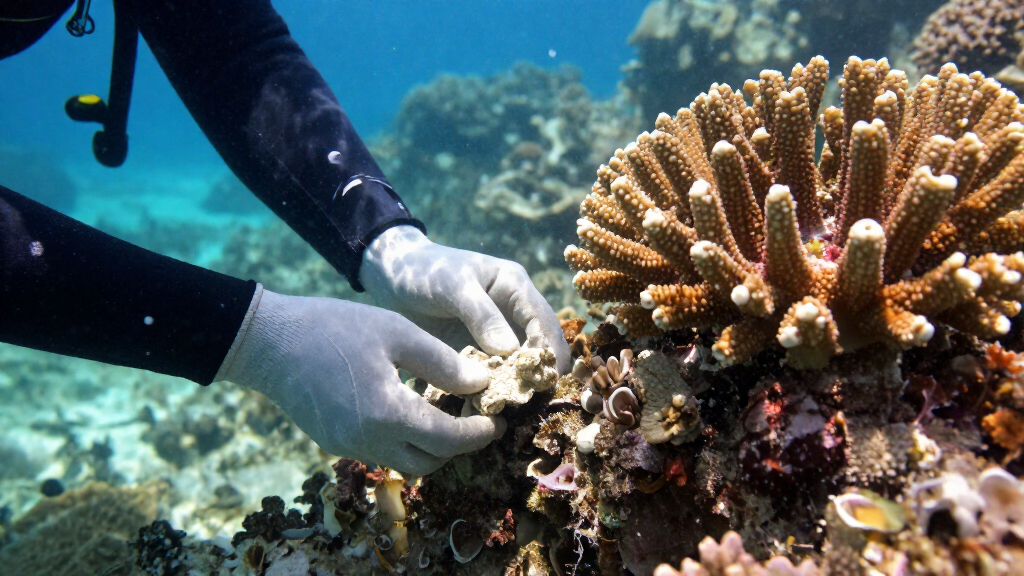
Researchers reported that bleached fragments of staghorn coral recovered after touching healthy fragments from the same genet. The laboratory study, published in Science Advances on October 14, found that contact enabled a tissue bridge and transfer of symbiotic algae; separated fragments died during the experiment.
Bleached fragments of Pocillopora damicornis recovered in a laboratory after touching healthy fragments from the same genet, researchers reported in a study published October 14 in Science Advances. The findings suggest that direct contact can transfer symbiotic algae between compatible coral tissue, but the experiment does not establish whether the technique can restore reefs in the wild.
In the experiment, researchers prepared 10 pairs of fragments from the same coral individual, with one bleached fragment and one healthy fragment in each pair. Five pairs were placed in contact; the other five were kept a few millimetres apart. Bleached fragments in the touching pairs recovered within eight weeks, while the separated fragments died after 20 weeks.
The team observed that a tissue bridge formed between the touching fragments, allowing symbiotic algae to move from the healthy coral into the bleached fragment. These algae, known as Symbiodiniaceae, provide corals with much of their nutrition. After one week of contact, a bleached branch could continue recovering even when separated from its healthy partner. By the second week, the symbiont population was doubling every four days, the researchers reported.
The recovery depended on genetic compatibility. Fragments from different species, and fragments from different animals of the same species, did not fuse and did not show the same recovery. The study therefore describes a specific laboratory result, not a general treatment shown to work across coral species or reef settings.
A Contact-Based Route to Coral Recovery
Coral bleaching occurs when heat stress prompts corals to lose the symbiotic algae that give them colour and supply much of their nutrition. Severe or prolonged bleaching can leave corals vulnerable to starvation and death. A method that helps restore those algae could offer researchers another avenue to investigate alongside efforts to reduce heat stress and protect reefs.
The study’s practical significance remains limited by its design. It tested a small number of fragment pairs from one coral species under laboratory conditions, and successful recovery required fragments with the same genetic make-up. The results do not show that placing coral fragments together would reverse bleaching across a reef, nor that the approach could be deployed at a scale that offsets warming-driven losses.
As an affiliate, we earn on qualifying purchases.
How Researchers Traced Algae Transfer
The research began after marine scientist Stephen Palumbi noticed in early 2025 that a healthy and a bleached fragment had accidentally touched in a laboratory tank. Colour appeared to be spreading into the bleached branch. Danny Collins, then a Stanford PhD student studying how disease spreads through coral contact, investigated whether the same contact could transfer symbiotic algae.
The team compared fragments that touched with fragments separated by a few millimetres, then used high-powered microscopy to examine what happened. The observed tissue bridge offered a mechanism for the transfer. The researchers’ report was published in Science Advances on October 14; the account of the work was also reported by Nature.
“This incredible new result — that fast and full recovery is possible in bleached coral — can inspire solutions that eventually may be scalable.”
— Fiorenza Micheli, marine ecologist at Stanford University’s Center for Ocean Solutions and study co-author
As an affiliate, we earn on qualifying purchases.
Limits Beyond the Laboratory
It is not clear whether the contact-driven recovery would work in natural reef conditions, where temperature stress, currents, disease and other pressures differ from a controlled tank. The experiment involved one coral species and fragments from the same genet; the reported results do not show how common successful fusion is across other coral types or how reliably it would occur outside the laboratory.
The study also does not establish a practical restoration method or show that recovered fragments would survive future marine heat waves. Researchers have described scalability as a possibility, but the source material provides no field trial, deployment plan or evidence of reef-scale benefits.
As an affiliate, we earn on qualifying purchases.
Testing Recovery Beyond Coral Tanks
The immediate next step is to determine whether the observed transfer can be reproduced across more coral genets and species, and under conditions closer to those on reefs. Any assessment of restoration value would also need to measure whether recovered corals remain healthy and withstand subsequent heat stress.
The supplied report does not identify a scheduled field trial or a specific next milestone. Until further testing is reported, the finding remains a laboratory demonstration of recovery through contact between genetically matched coral fragments.
As an affiliate, we earn on qualifying purchases.
Key Questions
How did the bleached coral recover?
Researchers observed a tissue bridge forming between touching fragments from the same genet. Symbiotic algae then moved from the healthy fragment into the bleached one.
How quickly did recovery happen?
The bleached fragments in the touching pairs recovered within eight weeks. The algae population was doubling every four days by the second week, according to the study.
Would the method work with any healthy coral?
The reported experiment found recovery only when fragments came from the same genet. Fragments from other animals, including of the same species, did not fuse in the tests.
Has this been shown to restore wild reefs?
No. The reported work was a laboratory experiment. Whether the process works in natural reef conditions or can be scaled up remains unknown.
Source: hn
Fall Picks
fall essentials
As an affiliate, we earn on qualifying purchases.