

You discover that Mendeleev revolutionized chemistry by creating the first periodic table, organizing elements based on recurring properties and atomic weights. His systematic approach revealed patterns and trends, allowing him to predict elements that hadn’t yet been discovered. By grouping similar elements into columns and leaving gaps for unknown ones, he proved that elements follow a predictable order. If you keep exploring, you’ll see how his work laid the foundation for modern atomic theory and the periodic table today.
Key Takeaways
- Dmitri Mendeleev organized elements by atomic weight and properties, revealing recurring periodic trends.
- He left gaps for undiscovered elements, predicting their properties based on observed patterns.
- Mendeleev’s table grouped elements into vertical columns called groups with similar chemical behaviors.
- The periodic table demonstrated that element properties follow specific, predictable trends linked to atomic structure.
- His systematic arrangement laid the foundation for the modern periodic table based on atomic number.

Have you ever wondered how scientists organized the elements we comprehend today? It’s a fascinating story that begins with the search for a logical system to categorize the building blocks of matter. Before the periodic table, scientists struggled with element classification because elements seemed random and lacked a clear pattern. Dmitri Mendeleev changed that by creating a table that arranged elements according to their atomic weights and properties. This arrangement revealed periodic trends—patterns in properties like melting points, reactivity, and atomic size that repeated at regular intervals. Recognizing these trends allowed Mendeleev to predict the existence and properties of yet undiscovered elements, showcasing the power of organizing elements systematically.
Scientists’ quest for a logical system led to Mendeleev’s periodic table and the discovery of recurring element patterns.
Mendeleev’s approach was revolutionary because he didn’t just list elements in order of increasing atomic weight; he arranged them to highlight periodic trends. For example, elements with similar chemical behaviors appeared in the same vertical columns, called groups. This grouping made it easier to understand why elements behaved the way they did and provided clues about their atomic structure. His periodic table was not perfect—some elements seemed out of place, and he even left gaps where he believed undiscovered elements belonged. These gaps weren’t random; they represented predicted elements that fit the recurring patterns he observed. This predictive power demonstrated how a systematic arrangement could unveil understanding of the natural order of elements.
The significance of Mendeleev’s periodic table lies in its ability to unify diverse elements under a common framework. It showed that element properties are not random but follow specific periodic trends based on atomic structure. This insight helped scientists move beyond mere element classification and into deeper theories about atomic theory itself. As more elements were discovered, they fit neatly into Mendeleev’s framework, confirming its accuracy and utility. His work paved the way for the modern periodic table, which now arranges elements by atomic number—another key periodic trend—further refining our understanding.
In essence, Mendeleev’s contribution was more than just a table; it was a tool that revealed the underlying order of the universe’s fundamental components. By recognizing periodic trends and organizing elements accordingly, he transformed the way we perceive matter. His periodic table remains a cornerstone of chemistry, illustrating how systematic classification can reveal nature’s secrets and guide scientific discovery. It’s a testament to the power of pattern recognition and logical organization in advancing human knowledge.
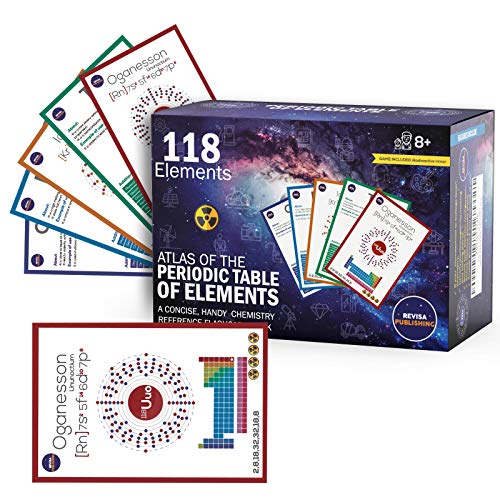
Periodic Table of Elements Laminated Flashcard Science kit| Quick Element Study Aid|Chemistry Flash Card Game for Teachers, Students, Homeschool Kids, Classroom| Educational Chart Reference Guide
- Complete Colorful Flashcard Deck: Visualize atomic structures and concepts
- Suitable for All Learning Levels: 118 laminated cards for all ages
- Durable Matte Laminated Cards: Resist dirt, dust, and fingerprints
As an affiliate, we earn on qualifying purchases.
As an affiliate, we earn on qualifying purchases.
Frequently Asked Questions
How Did Mendeleev Predict Undiscovered Elements?
You see, Mendeleev predicted undiscovered elements by analyzing periodic gaps in his table. He noticed patterns in the properties of known elements and used these to forecast the characteristics of elements yet to be found. By placing these elements in the correct periodic gaps, he accurately predicted their atomic weights and properties. His method relied on recognizing recurring trends, which enabled him to foresee elements before their actual discovery.
What Challenges Did Mendeleev Face When Creating the Table?
When creating the table, you face challenges like data organization, which is tricky with inconsistent data. For example, arranging elements by atomic weight led to conflicts, making some skeptics doubt its accuracy. Scientific skepticism meant you had to defend your pattern, especially as new elements emerged. Balancing accurate data while convincing others of your system’s validity required persistence and clear reasoning amidst doubts.
How Has the Periodic Table Evolved Since Mendeleev’s Time?
Since Mendeleev’s time, the periodic table has evolved markedly. You now see elements arranged by atomic numbers, not just atomic weights, which helps explain chemical properties more accurately. Advances in technology allow you to discover new elements and understand atomic structures better. The table has expanded, improved its organization, and incorporated noble gases and transition metals, making it a powerful tool for predicting element behavior based on chemical properties.
Did Mendeleev Face Any Criticism for His Periodic Table?
You might imagine gentle clouds of scientific skepticism drifting around Mendeev’s table, subtly questioning its arrangement. While he faced some peer review doubts, his innovative approach ultimately gained respect. Critics initially viewed his predictions with cautious optimism, but as evidence grew, they recognized his genius. His periodic table, like a sunrise breaking through fog, transformed chemistry by inspiring confidence and advancing understanding, despite early doubts.
How Did Mendeleev’s Periodic Table Influence Modern Chemistry?
Your understanding of elemental organization and chemical properties deepens thanks to Mendeleev’s periodic table. It influences modern chemistry by providing a systematic way to predict elements’ behaviors, even before their discovery. His arrangement highlights periodic trends, helping you grasp elemental relationships. Today’s periodic table still follows his principles, guiding research and education, making it an essential tool for understanding chemical properties and advancing scientific knowledge.
As an affiliate, we earn on qualifying purchases.
Conclusion
So, after all your efforts, it’s ironic that Mendeleev’s ordered chaos now guides scientists daily. His periodic table, once a daring guess, becomes the backbone of chemistry, yet it’s still a puzzle with gaps waiting to be filled. Imagine him, arranging elements like a master chef, only to realize his “recipe” would serve a universe of discoveries. Ironically, what started as a simple chart now underpins the entire world of science.
As an affiliate, we earn on qualifying purchases.

118 Chemical Elements Flash Cards with Bullet Dotted Journal Style Background
- Concise periodic table flash cards: Essential info for chemistry exams
- Bullet journal style background: Write additional notes easily
- Front details: Element name and electron configuration
As an affiliate, we earn on qualifying purchases.
As an affiliate, we earn on qualifying purchases.