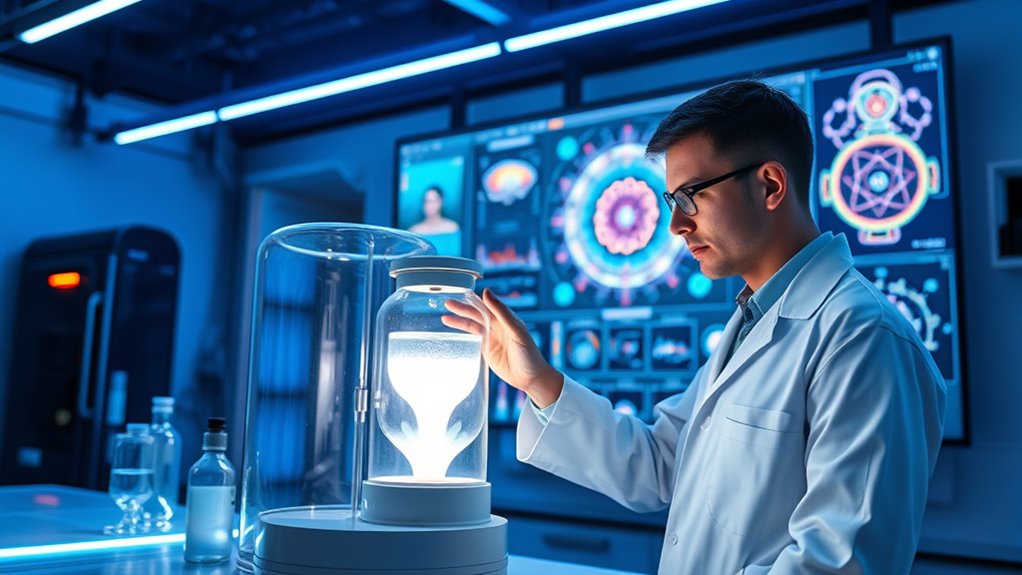

AI-powered fusion diagnostics help you fill critical data gaps in plasma research by integrating sensor data, experiments, and models for a complete view of plasma behavior. It automates complex analysis, detects subtle changes, and predicts plasma responses, making your research more accurate and efficient. These systems continuously learn and improve, guiding better decisions and accelerating progress toward fusion energy. Keep exploring to discover how AI transforms plasma research and moves us closer to practical fusion power.

Get school and study supplies delivered free — and shop member deals
- Fast, free delivery on millions of items
- Access to Prime Big Deal Days deals on October 6–7
- Prime Video, Amazon Music and more included
Key Takeaways
- AI accelerates plasma diagnostics by integrating real-time sensor data with historical records to identify subtle shifts and anomalies.
- Fusion modeling uses AI algorithms to simulate plasma behavior, reducing reliance on costly experimental trials.
- Machine learning enables pattern recognition in large datasets, improving predictions of plasma performance and stability.
- AI-driven data fusion creates comprehensive views of plasma dynamics, enhancing understanding and decision-making.
- Continuous AI learning refines models over time, filling data gaps and advancing predictive capabilities in fusion research.

Artificial intelligence is transforming medical diagnostics by enabling faster, more accurate detection of diseases. When it comes to plasma research, AI-powered fusion diagnostics are breaking new ground by filling critical data gaps. You might not realize it, but fusion modeling plays a pivotal role here. By simulating plasma behavior through sophisticated algorithms, fusion modeling helps you understand complex interactions within fusion devices. These models synthesize vast amounts of data, enabling you to predict plasma responses under various conditions without relying solely on experimental trials. This approach not only accelerates research but also enhances the precision of your findings.
Data integration is at the heart of this transformation. Instead of analyzing isolated datasets, AI systems combine information from multiple sources—diagnostic sensors, experimental results, and computational models—creating a complete picture of plasma dynamics. This seamless data fusion allows you to identify patterns and anomalies that might otherwise go unnoticed. For instance, integrating real-time sensor data with historical records can help you detect subtle shifts in plasma stability, leading to more timely interventions. The ability to merge diverse datasets guarantees that no critical detail slips through the cracks, sharpening your understanding of plasma behavior.
Seamless data fusion reveals hidden plasma patterns, enabling timely interventions and deeper understanding of plasma stability.
AI-driven fusion diagnostics also streamline the process of interpreting complex data. Traditional methods often require significant manual effort and expertise, which can introduce delays and potential errors. AI tools automate data analysis, rapidly sifting through enormous datasets to extract relevant insights. This means you spend less time on tedious calculations and more on developing innovative solutions. Advanced machine learning algorithms can recognize intricate patterns, making predictions about plasma performance with remarkable accuracy. As a result, you gain a clearer window into the plasma’s state, enabling more precise control and optimization of fusion experiments.
Furthermore, these AI systems facilitate adaptive learning. As you gather more data, the models continuously improve, becoming smarter and more reliable. This iterative process helps you refine your understanding of plasma phenomena, leading to more resilient and efficient fusion designs. Whether you’re optimizing magnetic confinement or diagnosing instabilities, fusion modeling combined with robust data integration empowers you to make data-driven decisions swiftly. It transforms plasma research from a slow, trial-and-error process into a dynamic, predictive science.
Ultimately, AI-powered fusion diagnostics elevate your ability to explore plasma physics with unprecedented depth and accuracy. By harnessing fusion modeling and integrating data intelligently, you’re not just filling data gaps—you’re opening new avenues for discovery. This technology accelerates the path toward viable fusion energy, bringing you closer to unblocking the power of the stars here on Earth. Additionally, addressing AI vulnerabilities ensures the robustness and safety of these advanced diagnostic systems as they become integral to fusion research.
plasma diagnostics sensor data analysis tools
As an affiliate, we earn on qualifying purchases.
As an affiliate, we earn on qualifying purchases.
Frequently Asked Questions
How Does AI Improve the Accuracy of Plasma Diagnostics?
AI improves the accuracy of plasma diagnostics by leveraging machine learning and data analytics to analyze complex data patterns. You can identify subtle anomalies and predict issues more precisely, reducing human error. This technology constantly learns from new data, enhancing diagnostic reliability. As a result, you gain faster, more accurate insights into plasma behavior, enabling better decision-making and improved outcomes in plasma research and fusion energy development.
What Are the Limitations of Current Fusion Diagnostic Techniques?
You face limitations in current fusion diagnostic techniques due to data scarcity and instrument sensitivity issues. Insufficient data makes it difficult to accurately interpret plasma behavior, while the sensitivity of instruments often prevents you from detecting weak signals or subtle changes. These challenges hinder precise measurements and diagnostics, complicating your efforts to understand and control fusion processes. Overcoming these limitations requires advancements in data collection and more sensitive, reliable diagnostic tools.
How Scalable Are Ai-Powered Fusion Diagnostic Tools?
AI-powered fusion diagnostic tools are highly scalable because they enhance resource scalability and streamline data integration. You can expand these systems to handle increasing data volumes from multiple plasma experiments efficiently. As you incorporate more data sources, the tools adapt seamlessly, enabling thorough analysis without significant performance drops. This scalability ensures that your diagnostics grow with your research needs, making them a crucial asset for advancing plasma research and fusion energy development.
What Safety Concerns Exist With AI Integration in Plasma Research?
You should be aware that safety concerns with AI integration in plasma research include data privacy issues and algorithm bias. If you don’t safeguard data privacy, sensitive information could be compromised. Additionally, algorithm bias may lead to inaccurate diagnostics or flawed results, risking safety and reliability. To guarantee safe AI use, you need proper data security measures and ongoing monitoring to detect and correct biases, maintaining research integrity.
How Cost-Effective Are Ai-Driven Diagnostics Compared to Traditional Methods?
You’ll find AI-driven diagnostics often more cost-effective than traditional methods because their cost analysis reveals lower long-term expenses and quicker results. While initial investment benefits might seem high, they pay off through reduced labor, faster data processing, and increased accuracy. This efficiency minimizes costly errors and accelerates research progress, making AI-powered solutions a smart, budget-friendly choice that enhances plasma research without draining resources.
fusion modeling software for plasma research
As an affiliate, we earn on qualifying purchases.
As an affiliate, we earn on qualifying purchases.
Conclusion
By leveraging AI-powered diagnostics, you can bridge critical data gaps in plasma research, unblocking new insights and improving fusion outcomes. These tools act like a lighthouse guiding ships through foggy waters, providing clarity where uncertainty once prevailed. As you adopt this technology, you’ll find it transforms complex data into actionable knowledge, accelerating progress in fusion energy. Embrace these innovations, and you’ll navigate the future of plasma research with confidence and precision.
machine learning tools for plasma stability prediction
As an affiliate, we earn on qualifying purchases.
As an affiliate, we earn on qualifying purchases.
AI-powered data fusion systems for fusion research
As an affiliate, we earn on qualifying purchases.
As an affiliate, we earn on qualifying purchases.
Halloween Picks
halloween
As an affiliate, we earn on qualifying purchases.





![Competitive Programmer's Handbook (2018) [Pdf]](https://varietychem.com/wp-content/uploads/2026/10/competitive-programmer-s-handbook-2018-pdf-featured-260x140.jpg)