

Titanium dioxide started as a popular white pigment used in paints, cosmetics, and coatings for its bright, durable, and safe qualities. Today, it also serves in photocatalytic processes, breaking down pollution when exposed to UV light. While its environmental benefits are promising, concerns about nanoparticle release and potential toxicity exist. By exploring further, you’ll discover how this versatile material balances its helpful uses with ongoing safety considerations.
Key Takeaways
- Titanium dioxide is widely used as a bright, durable white pigment in paints, coatings, and cosmetics.
- It serves as a photocatalyst under UV light, breaking down pollutants and disinfecting surfaces.
- Its small particles pose environmental and health risks, including respiratory and aquatic toxicity.
- Proper regulation and advanced formulations help minimize nanoparticle release and environmental impact.
- Balancing its pollution-fighting benefits with safety concerns is essential for sustainable applications.
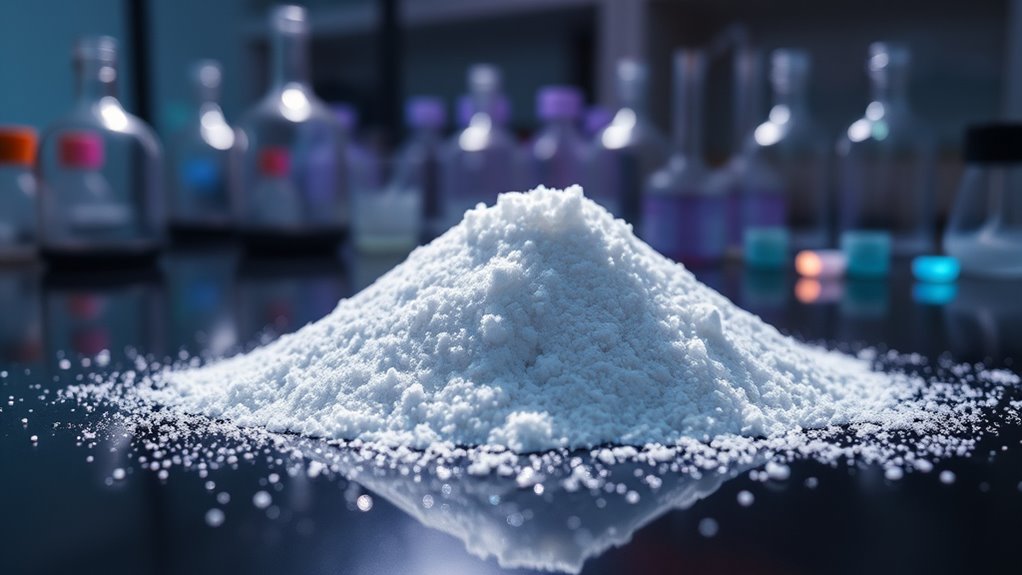
Titanium dioxide is a widely used white pigment known for its brightness and opacity. You’ve likely encountered it in paints, coatings, and cosmetics, where it provides vibrant whiteness and durability. But beyond its role as a pigment, titanium dioxide has gained prominence in photocatalytic applications, showcasing its versatility and potential for environmental benefits. When exposed to ultraviolet (UV) light, titanium dioxide acts as a catalyst, breaking down organic pollutants and disinfecting surfaces. This property makes it valuable in air and water purification systems, where it helps reduce harmful contaminants without the need for harsh chemicals. Its ability to generate reactive oxygen species under UV irradiation enables it to degrade pollutants efficiently, offering a sustainable approach to environmental cleanup.
However, as you explore its photocatalytic applications, it’s important to consider the environmental impact of titanium dioxide itself. While it’s lauded for aiding pollution control, concerns have emerged regarding its safety and ecological effects. Fine particles of titanium dioxide can become airborne, potentially contributing to respiratory issues if inhaled in large quantities. Furthermore, when nanoparticles are released into water bodies, they might affect aquatic life, as their small size allows for easy uptake by organisms, possibly leading to toxicity. Research continues to investigate how to optimize the use of titanium dioxide in photocatalytic systems while minimizing any adverse environmental effects. This includes developing coatings and formulations that limit nanoparticle release and improve stability. Additionally, understanding the environmental impact of nanoparticles is crucial for developing safe and effective applications.
You should also know that the environmental impact isn’t solely negative. Titanium dioxide’s photocatalytic properties can help mitigate pollution when used responsibly. Its ability to break down VOCs (volatile organic compounds), bacteria, and other pollutants in air and water treatment processes demonstrates its potential for promoting cleaner environments. Still, balancing its benefits with environmental safety requires ongoing research and regulation. You might also consider that advances in nanotechnology could lead to safer, more efficient applications of titanium dioxide, reducing any risks associated with nanoparticle exposure. As you learn more about its uses, it’s clear that titanium dioxide’s environmental impact is complex—while it offers promising solutions for pollution control, careful management is essential to prevent unintended consequences.
Frequently Asked Questions
Is Titanium Dioxide Safe for Human Consumption?
Titanium dioxide is generally considered safe for human consumption when used as a food additive within regulated limits. You should be aware, though, that some studies raise concerns about potential health risks, especially if ingested in large amounts. Consumer safety agencies, like the FDA and EFSA, have set guidelines to guarantee its safe use. Always check product labels and adhere to recommended intake levels to protect your health.
How Does Titanium Dioxide Enhance Photocatalytic Reactions?
Titanium dioxide enhances photocatalytic reactions by increasing surface activity, which provides more active sites for reactions to occur. When exposed to light, it facilitates electron transfer, generating reactive species like free radicals. These radicals break down pollutants or organic compounds efficiently. Your goal is to maximize surface activity and electron transfer, which improves the catalyst’s efficiency in breaking down contaminants or producing useful chemical reactions.
What Are the Environmental Impacts of Titanium Dioxide Production?
You should be aware that titanium dioxide production impacts the environment through waste management issues and environmental regulation challenges. The process can generate hazardous waste, which requires careful handling to prevent pollution. Stricter regulations aim to reduce emissions and waste, but improper waste disposal can harm ecosystems. As a consumer or producer, supporting sustainable practices helps minimize these environmental impacts and promotes responsible waste management and regulatory compliance.
Can Titanium Dioxide Be Used in Solar Energy Applications?
Imagine harnessing sunlight’s dance, turning it into a clean energy symphony. Titanium dioxide can indeed be a star performer in solar energy applications, thanks to its high photocatalytic efficiency. It helps in solar energy conversion by breaking down pollutants and generating reactive species under sunlight. You can leverage this material to develop innovative solar cells or photocatalytic systems, transforming ordinary sunlight into powerful, sustainable energy solutions that brighten our future.
How Does Particle Size Affect Titanium Dioxide’s Properties?
You’ll notice that smaller titanium dioxide particles exhibit different behavior because their surface area increases dramatically. This heightened surface area enhances reactivity and improves properties like photocatalysis, making them more effective in applications such as environmental cleanup or solar energy. Conversely, larger particles tend to have lower reactivity due to reduced surface interactions. So, particle size directly influences how titanium dioxide interacts with its environment and determines its overall effectiveness in various uses.
Conclusion
Now, titanium dioxide shines both as a vibrant pigment and a powerful photocatalyst. Its versatility bridges beauty and innovation, transforming from a simple white pigment to a catalyst that cleans air and purifies water. While its use in paints beautifies surfaces, its role in environmental applications actively fights pollution. This duality reminds you that materials, like titanium dioxide, can serve as both art and science—proving that beauty and function often go hand in hand.