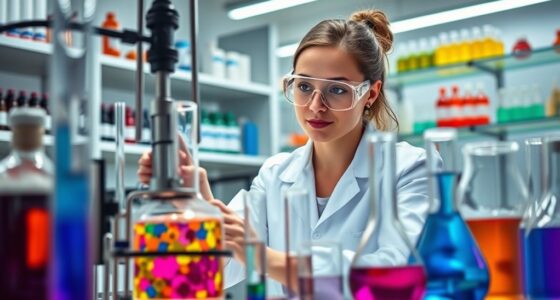
To succeed as an aspiring chemist, you need to develop strong laboratory skills, including precise techniques and attention to detail, along with solid analytical abilities to interpret data. Following safety protocols, mastering equipment, and preparing samples accurately are essential tasks. Enhancing your skills through hands-on practice and critical thinking will build your confidence and competence. Keep exploring, because honing these core abilities is key to making meaningful contributions in chemistry.
Key Takeaways
- Proficiency in laboratory techniques such as titration, calibration, and sample preparation ensures accurate and reliable experimental results.
- Strong analytical skills enable critical interpretation of data and identification of meaningful patterns.
- Attention to detail and adherence to safety protocols are essential for effective and safe laboratory work.
- Continuous practice and seeking feedback help refine technical abilities and build confidence.
- Combining technical proficiency with critical thinking fosters innovation and informed decision-making in chemistry research.
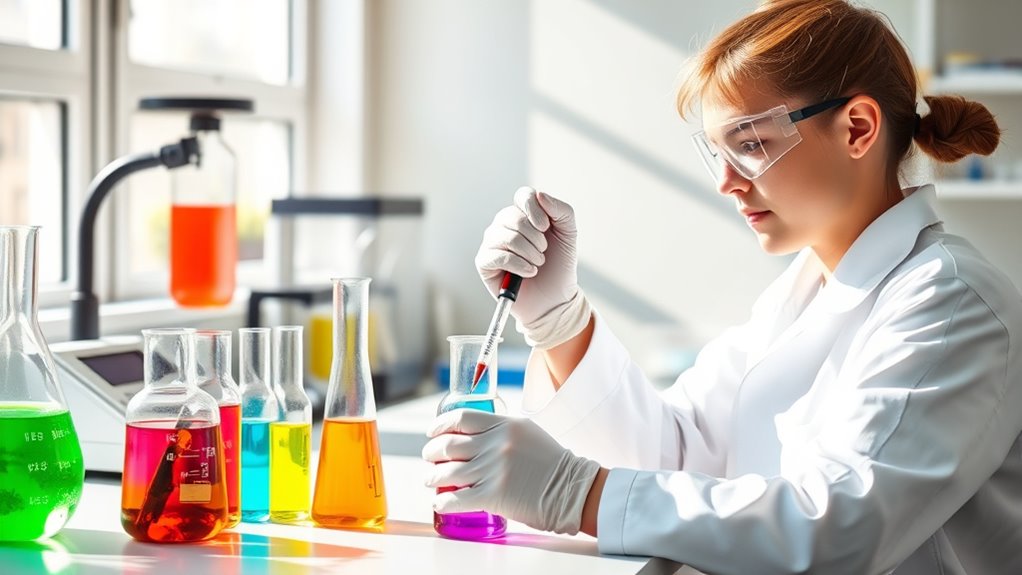
Have you ever wondered what skills are essential for success in chemistry? If you’re aiming to excel in this field, developing strong laboratory techniques and honing your analytical skills are crucial. These abilities form the foundation that allows you to conduct experiments accurately, interpret data effectively, and solve complex problems. Laboratory techniques involve more than just following instructions; they require precision, attention to detail, and a thorough understanding of the equipment and procedures. Whether you’re titrating solutions, calibrating instruments, or preparing samples, your ability to execute these techniques confidently ensures the reliability of your results. Mastering these skills takes practice, but once you do, you’ll notice how much smoother your experiments become and how much more trustworthy your data is. Building a solid understanding of vetted methods enhances your capacity to perform experiments effectively and safely.
Alongside laboratory techniques, analytical skills are vital for a chemist. You need to be able to analyze data critically, spot patterns, and draw meaningful conclusions. This means going beyond just collecting numbers—you interpret what those numbers mean in the context of your experiment or research question. Strong analytical skills also help you troubleshoot when experiments don’t go as planned. For instance, if a measurement seems off, your ability to analyze the data can help you identify potential errors or variables affecting your results. This skill set is essential for making informed decisions and advancing scientific understanding. It involves not just understanding the data but also communicating your findings clearly and convincingly, whether through reports, presentations, or publications.
Developing these skills requires a proactive approach. Practice regularly in the lab to refine your techniques, paying close attention to detail and safety protocols. Seek feedback from mentors or colleagues to improve your methods. Simultaneously, challenge yourself with data analysis exercises—using software tools or manual calculations—to strengthen your ability to interpret experimental results. Combining hands-on practice with critical thinking enhances your capacity to perform complex tasks with confidence.
Ultimately, success in chemistry hinges on your ability to integrate technical skills with analytical thinking. As you gain experience, you’ll start to see how these skills complement each other—precise laboratory techniques generate reliable data, which you then analyze to uncover new insights. This synergy is what drives innovation and discovery. So, dedicate time to mastering your laboratory skills and sharpening your analytical mindset. Doing so will prepare you to tackle the challenges of a chemical career and make meaningful contributions to the field.
Frequently Asked Questions
What Are the Best Undergraduate Degrees for Aspiring Chemists?
You should pursue a chemistry or biochemistry degree to become a chemist. These programs teach you essential laboratory techniques and enhance your analytical skills. You’ll gain hands-on experience with experiments, data analysis, and safety protocols, which are critical in the field. Additionally, degrees in chemical engineering or materials science can also be valuable, offering broader knowledge and practical skills that prepare you for diverse career paths in chemistry.
How Important Are Internships in a Chemistry Career?
Internships are your golden ticket into the chemistry world, opening doors with industry networking and hands-on laboratory skills. They’re like a bridge from classroom theory to real-world application, giving you invaluable experience. By immersing yourself in professional environments, you build confidence, learn industry standards, and make connections that can propel your career forward. Don’t underestimate their importance—they’re essential for transforming your passion into a thriving chemistry career.
What Certifications Can Enhance a Chemist’s Employability?
You can enhance your employability by obtaining professional certifications and industry credentials, which demonstrate your expertise and commitment. Certifications like the Certified Chemist or specialized training in laboratory techniques boost your credibility and make you stand out. These credentials show employers you’re dedicated to staying current in the field, increasing your chances of landing desirable roles. Keep updating your certifications to remain competitive and open new career opportunities.
How Do Chemists Stay Updated With Industry Advancements?
You stay updated with industry advancements by regularly reading research journals and attending industry conferences. These resources keep you informed about the latest discoveries, techniques, and trends. Networking at conferences also allows you to exchange ideas with peers and experts. Subscribing to newsletters and participating in professional organizations further guarantees you remain current. Staying proactive in learning helps you adapt quickly and maintain a competitive edge in the evolving field of chemistry.
What Soft Skills Are Crucial Alongside Technical Expertise?
You need strong communication skills to clearly share your ideas and findings with colleagues and clients. Teamwork abilities are equally essential, enabling you to collaborate effectively on projects and solve complex problems together. These soft skills help you build professional relationships, adapt to different situations, and foster a positive work environment. By honing your communication and teamwork abilities, you’ll enhance your technical expertise and succeed in the dynamic field of chemistry.
Conclusion
So, after all this, mastering lab techniques and data analysis might seem like the keys to success, but don’t forget—the real magic lies in patience and curiosity. Ironically, the more you chase perfect results, the more you realize that mistakes teach you the most. As an aspiring chemist, embrace the setbacks—they’re just stepping stones in disguise. After all, if you think it’s all about precision, remember: science is beautifully unpredictable.