

To identify ionic versus covalent compounds quickly, focus on their structure, bonding, and elemental makeup. Ionic compounds usually form crystalline lattices and involve metal-nonmetal pairs, with electron transfer creating charged ions. Covalent compounds tend to consist of individual molecules, often between nonmetals, with shared electrons. You can also use electronegativity differences—values above 1.7 favor ionic bonds. Keep these clues in mind, and you’ll get better at distinguishing them swiftly as you explore further.
Key Takeaways
- Check if the compound is formed between a metal and a nonmetal; metals typically form ionic bonds.
- Observe the structure: crystalline lattices suggest ionic, while discrete molecules indicate covalent.
- Use electronegativity differences: >1.7 usually means ionic; smaller differences suggest covalent.
- Identify if electrons are transferred (ionic) or shared (covalent) through electron behavior clues.
- Consider melting points: high melting points often indicate ionic compounds, lower melting points suggest covalent.
Ever wonder how to quickly tell if a compound is ionic or covalent? The key lies in understanding the fundamental differences in their electron transfer and molecular structure. Ionic compounds form when electrons are transferred from one atom to another, typically between metals and nonmetals. This transfer creates ions—charged particles that attract each other through electrostatic forces. Covalent compounds, on the other hand, involve atoms sharing electrons, usually between nonmetals, resulting in molecules held together by shared electron pairs. Recognizing these core distinctions helps you rapidly identify the type of bond present.
Identify ionic or covalent bonds by understanding electron transfer versus sharing.
When examining a compound’s molecular structure, look for clues that indicate electron transfer or sharing. Ionic compounds tend to form crystalline lattices with a high melting point, reflecting the strong electrostatic attractions between ions. These structures are usually rigid and orderly, which makes it easier to distinguish them from covalent molecules. Covalent compounds often exist as individual molecules or clusters with lower melting points, and their structures can be more flexible or varied. If you see a compound with a defined, repeating pattern in a crystal, it’s likely ionic. If it appears as discrete, separate molecules, it’s probably covalent.
Another quick trick involves considering the elements involved. Metals typically lose electrons and form cations, while nonmetals gain electrons to become anions. When you see a combination of metals and nonmetals, expect an ionic bond. Conversely, bonds between nonmetals usually involve shared electrons, indicating covalent bonding. This elemental logic provides an immediate way to predict the type of bonding in a compound without complex calculations.
You can also use electronegativity differences as a guide. A large difference (greater than 1.7 on the Pauling scale) suggests a significant electron transfer, characteristic of ionic bonds. Smaller differences imply electron sharing, indicating covalent bonds. This numerical approach offers a quick, quantitative way to distinguish between the two types of compounds.
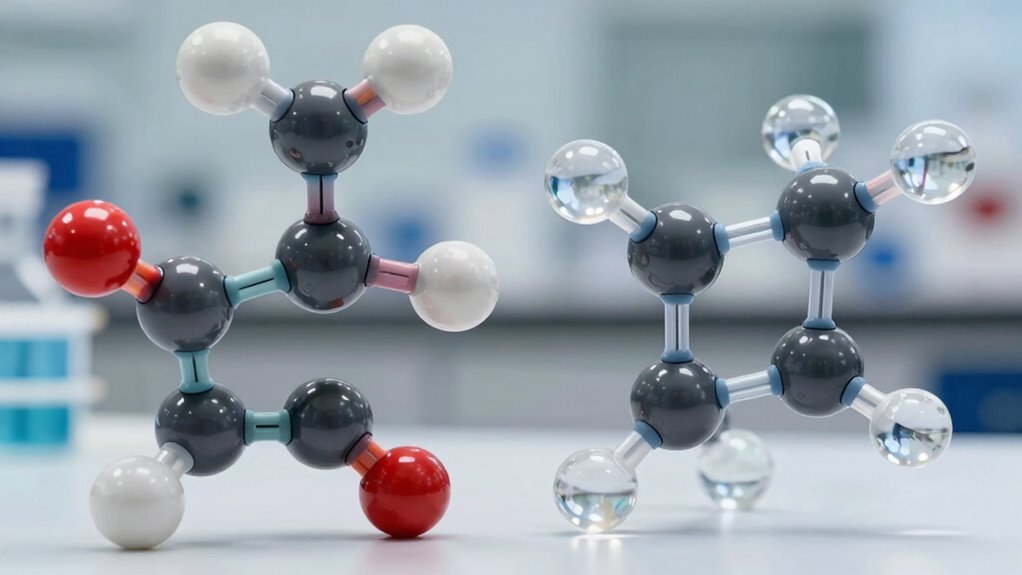
ionic and covalent compound models
As an affiliate, we earn on qualifying purchases.
As an affiliate, we earn on qualifying purchases.
Frequently Asked Questions
Can Ionic and Covalent Compounds Coexist in the Same Structure?
Yes, ionic and covalent bonds can coexist in the same structure, forming what’s called a compound with mixed bonding. You’ll see this in structures like salts combined with organic molecules. Bond formation between different atoms influences the overall structural stability. Recognizing these mixed bonds helps you understand how the compound maintains stability through a combination of ionic and covalent interactions, leading to unique properties and complex structures.
Do All Metals Form Ionic Bonds?
You might think all metals form ionic bonds, but that’s not the case; some prefer metal bonding with other metals or nonmetal interactions. Think of metals as versatile players—they can engage in ionic bonds when they interact with nonmetals, releasing electrons, but some metals also form covalent or metallic bonds. So, not every metal is set in stone for ionic bonding, making the scene more of a mixed bag.
How Does Electronegativity Affect Bond Type?
Electronegativity differences directly influence bond type by determining bond polarity. When the difference is large (above 1.7), you’re likely looking at an ionic bond, where electrons transfer from one atom to another. Smaller differences result in covalent bonds, with shared electrons. As you examine electronegativity, you’ll quickly see whether a bond is polar or nonpolar, helping you identify if it’s ionic or covalent.
Are There Exceptions to Typical Bond Identification Rules?
Yes, there are exceptions to typical bond identification rules. Sometimes, bond polarity can be ambiguous, especially with elements that have similar electronegativities, leading to polar covalent bonds instead of purely ionic or covalent. You might also encounter molecules where electron sharing isn’t equal, making bond classification tricky. These exceptions remind you to take into account the overall context, electronegativity differences, and electron sharing patterns when accurately identifying the bond type.
Can Molecular Shape Indicate Bond Type?
Molecular shape alone doesn’t definitively indicate bond type, but it helps infer bond polarity through molecular geometry. For example, a linear shape with polar bonds suggests a polar covalent compound, while a symmetrical shape with nonpolar bonds indicates nonpolar covalent. Ionic compounds typically form crystalline structures, but their molecular shape isn’t as relevant. Focus on bond polarity and electron sharing to accurately distinguish between ionic and covalent bonds.

YCHOULEK Molecular Model Kit, 444 Pcs Organic Molecular Chemistry Set, Atom Element Model Kit for Lessons in Chemistry, Molecular Structures Building kit, Ochem Science Gift for Teachers and Students
Visualize Molecular: The molecular model kit simplifies complex chemistry concepts into tangible 3D structures improve learning efficiency, suitable…
As an affiliate, we earn on qualifying purchases.
As an affiliate, we earn on qualifying purchases.
Conclusion
Think of distinguishing ionic from covalent compounds like spotting differences in a dance. Ionic bonds are the strong, steady steps—crystalline and solid—while covalent bonds are more like a fluid, shared dance. Once you recognize the signs—metal and nonmetal pairing for ionic, or two nonmetals sharing for covalent—you’ll dance through chemistry problems faster. Just remember, mastering these clues is like becoming a dance pro—confidence makes all the difference!

KAIWEETS Electrical Test Kit, Non-Contact Voltage Tester and GFCI Outlet Tester with LCD Display, Wiring Fault Checker, Outlet Tester Kit for Electrician, DIY, 2-Piece
COMPLETE OUTLET TESTER TOOL: Get two essential tools in one cost-effective set — a Non-Contact Voltage Tester and…
As an affiliate, we earn on qualifying purchases.
As an affiliate, we earn on qualifying purchases.

Chemical Hygiene Officer Study Guide Flashcards
Pass the Chemical Hygiene Officer with updated flashcards packed with detailed content aligned to the latest exam blueprint….
As an affiliate, we earn on qualifying purchases.
As an affiliate, we earn on qualifying purchases.