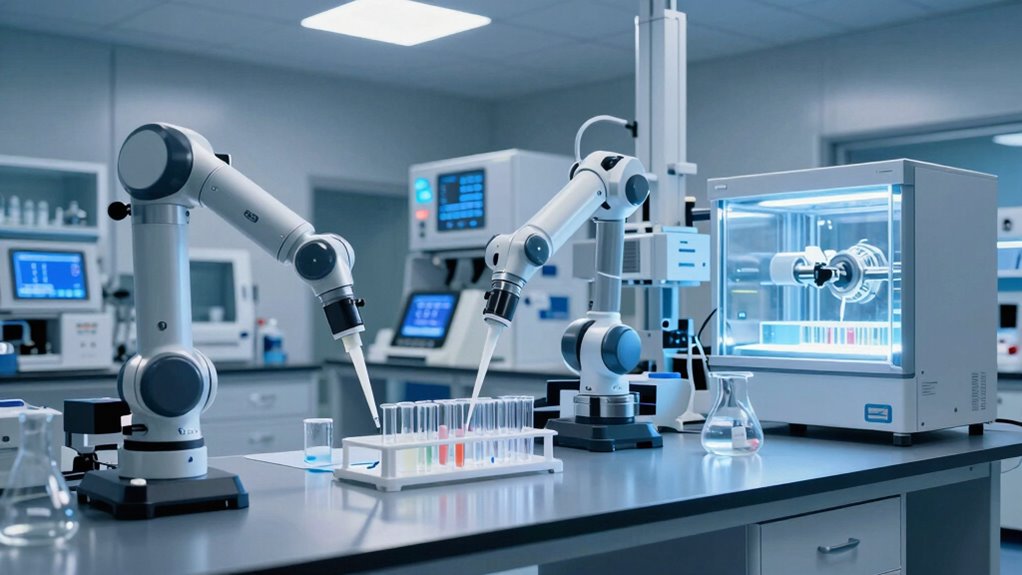

Lab automation is transforming research by boosting precision, speed, and throughput. Automated sample handling reduces manual errors and speeds up processing, freeing you to focus on analysis. AI-driven data analysis quickly identifies patterns and flags anomalies, making results more reliable. Integrating robotic systems with AI creates seamless workflows, enabling real-time monitoring and auto-corrections. If you want to see how these trends are shaping the future of science, explore how automation continues to evolve.

Prime made for students and young adults
- Fast, free delivery for dorm and study essentials
- Prime Video and Amazon Music included
- Member-only deals
Key Takeaways
- Increasing adoption of robotic sample handling enhances throughput, precision, and reduces human error in research workflows.
- Integration of AI-driven data analysis accelerates pattern recognition, anomaly detection, and predictive modeling.
- Workflow automation minimizes manual intervention, enabling real-time monitoring and adaptive experiment adjustments.
- High-throughput automation expands dataset sizes, supporting comprehensive and rapid scientific discoveries.
- Evolving robotic and AI technologies continuously expand lab capabilities, fostering faster, more precise research outcomes.
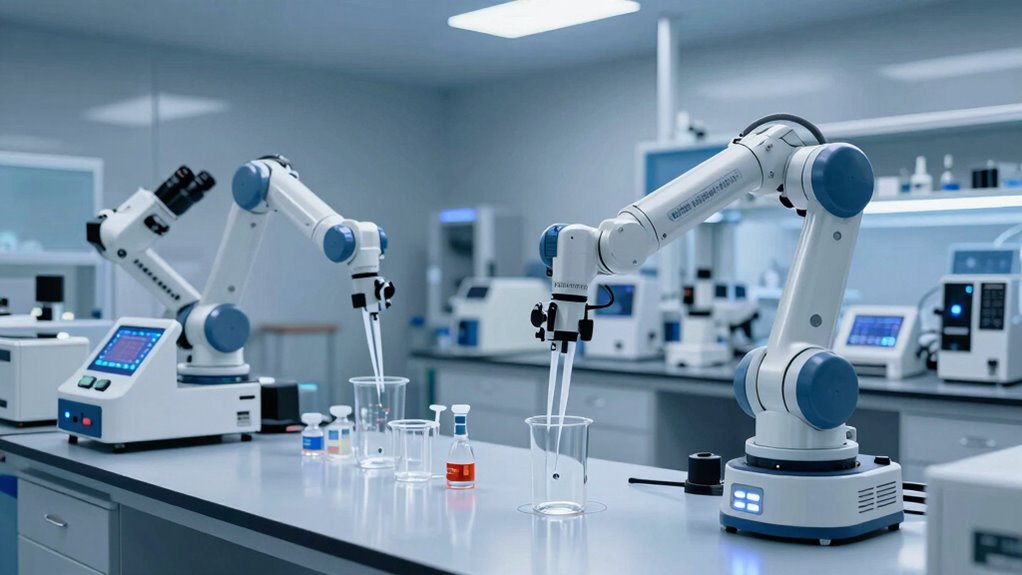
Lab automation is rapidly transforming the way scientific research and testing are conducted, enabling labs to operate more efficiently and accurately. You find yourself at the forefront of these innovations, where robotic sample handling is becoming a standard tool. Instead of manual pipetting or sample sorting, you now use robotic systems that can handle thousands of samples with precision and speed. These robots reduce human error, increase throughput, and free up your time for more complex analytical tasks. As a result, your lab can process larger datasets in less time, accelerating research timelines and improving reproducibility. With robotic sample handling, you gain automation efficiencies in sample preparation, which is critical for reliable results in drug development, genomics, and diagnostics.
Alongside robotic handling, AI-driven data analysis is reshaping how you interpret experimental results. Advanced algorithms sift through vast amounts of data, identify patterns, and flag anomalies faster than you could manually. This automation means you spend less time on tedious data curation and more on interpreting meaningful insights. AI-driven analysis also enhances predictive modeling, enabling you to forecast outcomes and optimize experimental conditions before running costly tests. As machine learning models improve, your ability to make data-driven decisions becomes increasingly precise, helping to reduce errors and increase confidence in your findings. Additionally, the integration of robotic systems with AI tools creates a cohesive and efficient workflow that minimizes manual intervention throughout your research process. Incorporating automation in data analysis further streamlines your workflow, reducing manual data handling and increasing overall productivity.
AI-driven analysis accelerates data interpretation, improves predictive modeling, and enhances decision-making accuracy in modern labs.
These trends are not isolated but interconnected, creating a seamless workflow from sample collection to data interpretation. You can automate the entire process, from robotic sample handling for preparation to AI-powered analysis for results. This integration minimizes delays, reduces human intervention, and enhances overall lab productivity. You also benefit from real-time monitoring and adaptive workflows, where systems automatically adjust based on ongoing results. For instance, if an anomaly is detected during sample processing, the system can alert you immediately or even correct itself, saving time and resources.
Embracing these lab automation trends means staying ahead in a competitive research environment. You’re empowered to perform high-throughput experiments, generate more comprehensive datasets, and derive insights faster than ever before. As robotic systems become more sophisticated and AI algorithms more refined, your lab’s capabilities will continue to expand, pushing the boundaries of what’s scientifically possible. Ultimately, these innovations are transforming your work, making research more precise, faster, and more innovative—shaping the future of science itself.
As an affiliate, we earn on qualifying purchases.
Frequently Asked Questions
How Cost-Effective Is Lab Automation for Small Research Labs?
Lab automation is quite cost-effective for small research labs because it boosts experimental efficiency and leads to significant cost savings over time. You’ll reduce labor costs and minimize errors, saving money on repeat experiments. Automation also speeds up data collection, allowing you to progress faster. While initial investments can be high, the long-term benefits make automation a smart choice, especially for small labs aiming to maximize output without overspending.
What Skills Are Required to Implement Lab Automation Systems?
You need a mix of technical and analytical skills to implement lab automation systems. Proficiency in robotic integration is vital so you can set up and troubleshoot automated equipment. Strong data management skills help you handle the large data sets generated, ensuring accuracy and security. Additionally, understanding software interfaces, programming basics, and maintenance routines is fundamental for seamless operation and integration within your research lab.
How Does Automation Impact Research Data Accuracy?
Automation greatly enhances research data accuracy by improving data integrity through consistent, precise handling of samples and measurements. It minimizes human errors, ensuring more reliable results. However, human oversight remains essential to monitor automated processes, identify anomalies, and validate data. By combining automation’s precision with your vigilance, you ensure high-quality, accurate research data, ultimately leading to more trustworthy scientific conclusions.
Are There Any Regulatory Challenges With Automated Labs?
Stepping into the future, you might find regulatory challenges with automated labs, much like steering through the wild west of research. You face legal hurdles around regulatory compliance, especially as new technologies outpace existing regulations. Ensuring your automation systems meet strict standards is vital, but it can be complex and time-consuming. Staying ahead of evolving regulations and maintaining thorough documentation helps you avoid legal issues and keeps your research compliant and trustworthy.
What Future Innovations Are Expected in Lab Automation Technology?
You can expect future innovations in lab automation technology to heavily feature AI integration and robotic handling advancements. These improvements will make workflows more efficient, accurate, and autonomous, reducing human error and speeding up research processes. You’ll see smarter systems that adapt to complex tasks, enhance data analysis, and improve sample management. As AI and robotics evolve, they’ll transform your lab into a more seamless, high-throughput environment, pushing research faster than ever before.
AI data analysis software for labs
As an affiliate, we earn on qualifying purchases.
As an affiliate, we earn on qualifying purchases.
Conclusion
As you navigate the evolving landscape of lab automation, you’re gently guided toward a future where efficiency seamlessly intertwines with innovation. Embracing these trends subtly elevates your research, allowing you to focus on discovery while technology quietly handles the routine. With each advancement, you’re subtly reshaping the way science progresses, fostering an environment where precision and productivity harmoniously coexist. Ultimately, these gentle shifts promise to enrich your scientific journey, opening doors to horizons yet to be fully imagined.
laboratory robotic sample handler
As an affiliate, we earn on qualifying purchases.
As an affiliate, we earn on qualifying purchases.
As an affiliate, we earn on qualifying purchases.
Halloween Picks
halloween
As an affiliate, we earn on qualifying purchases.