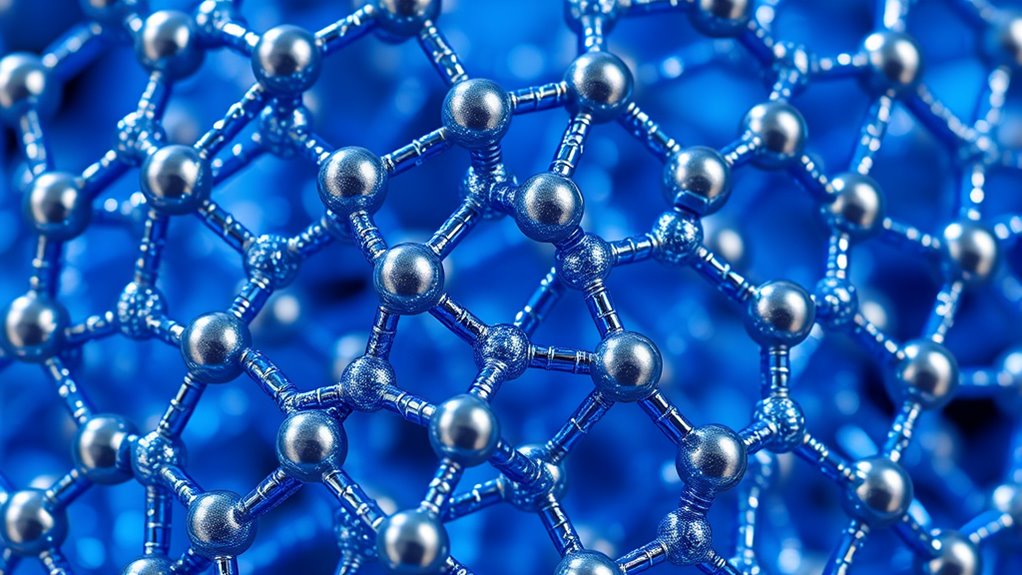

Metal-organic frameworks (MOFs) are transforming gas storage and catalysis by offering highly porous, customizable structures that efficiently trap gases like CO₂, hydrogen, and methane. Their extensive internal surfaces and tunable pore sizes allow you to select specific gases and optimize performance for energy, environment, and industrial applications. Their versatility in design makes them key to innovative solutions—continue exploring to discover how MOFs are leading this breakthrough wave.
Key Takeaways
- MOFs’ high porosity and large surface area enable efficient gas storage and capture, transforming energy and environmental applications.
- Their structural tunability allows customization for specific gases, enhancing selectivity and adsorption capacity.
- MOFs facilitate advanced catalysis by providing accessible active sites within their porous frameworks.
- The modular synthesis of MOFs supports scalable production for industrial gas separation and environmental remediation.
- Their unique properties position MOFs as key materials in developing sustainable energy solutions and pollution control technologies.
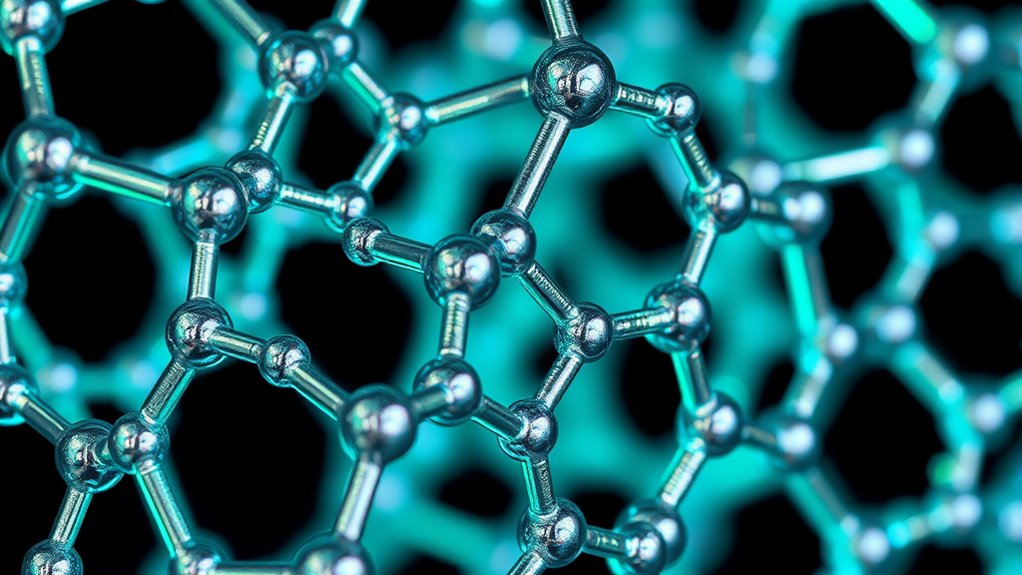
Metal–Organic Frameworks (MOFs) are transforming the fields of gas storage and catalysis thanks to their unique combination of high porosity and tunable structure. When you work with MOFs, you’ll notice that their extensive surface area and customizable pores make them ideal for gas adsorption applications. These frameworks are composed of metal ions or clusters connected by organic linkers, forming a crystalline network with vast internal surfaces. This structure allows MOFs to adsorb gases efficiently, making them highly effective for capturing and storing gases like hydrogen, methane, and carbon dioxide.
MOFs’ high porosity and tunable structures make them ideal for efficient gas storage and capture applications.
In practical terms, when you utilize MOFs for gas adsorption, you benefit from their ability to selectively trap specific molecules based on size, polarity, or chemical affinity. For example, if you’re looking to capture CO₂ from industrial emissions, MOFs can be tailored to enhance selectivity for carbon dioxide over other gases. Their porous architecture provides numerous binding sites, enabling high adsorption capacities even at low pressures. This is *fundamental* for applications like carbon capture, where maximizing adsorption while minimizing energy input is essential.
Moreover, the tunability of MOFs allows you to modify their pore sizes and surface chemistry to optimize gas interactions. By choosing different metal centers or organic linkers, you can design MOFs to target particular gases or improve stability under operational conditions. For instance, incorporating functional groups into the organic linkers can increase affinity for gases like ammonia or sulfur compounds, broadening the scope of potential applications. Additionally, understanding the spatial arrangement of the pores can help in designing frameworks with even greater selectivity and capacity.
You’ll also find that the rapid adsorption and desorption cycles of MOFs make them suitable for dynamic processes such as pressure swing adsorption or temperature swing adsorption. Their ability to quickly release stored gases when conditions change enhances efficiency in industrial settings. Additionally, MOFs’ modular synthesis means you can scale up production or customize frameworks for specific needs, from clean energy initiatives to environmental remediation.
In essence, understanding and leveraging Metal Organic Frameworks for gas adsorption opens up numerous possibilities. Their high surface area, tunable pores, and chemical versatility give you a powerful tool to address pressing challenges in gas storage and separation. Whether you’re aiming to develop better carbon capture technologies, improve gas storage tanks, or optimize catalytic processes, MOFs stand at the forefront of this revolution, offering precision and performance previously unattainable with traditional materials.
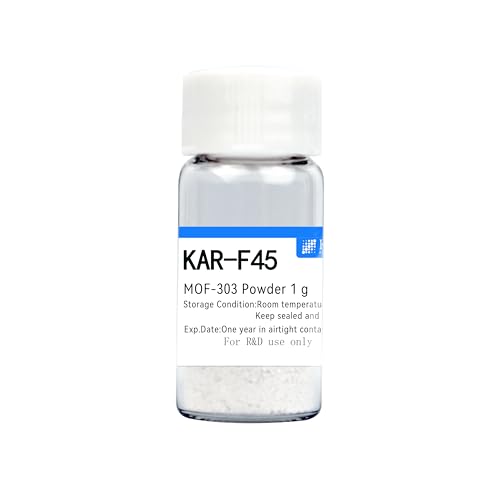
Metal Organic Frameworks MOFs MOF-303 (Al) White Powder KAR-F45 Ideal for Gas Storage, Separation, and Catalysis, CAS: 2050043-41-7 (10 Grams)
Product: MOF-303 (Al), Metal Organic Frameworks (MOFs), White Powder, CAS:2050043-41-7 , Particle Size: 50-200 nm, Pore Size: 0.3-0.5…
As an affiliate, we earn on qualifying purchases.
As an affiliate, we earn on qualifying purchases.
Frequently Asked Questions
How Sustainable Are MOFS for Large-Scale Industrial Use?
You might wonder if MOFs are sustainable for large-scale use. They can be, if you consider their life cycle and recycling methods. Properly designed, MOFs can be recycled and reused, reducing waste and environmental impact. Advances in synthesis and regeneration techniques make them more eco-friendly, but ongoing research is essential to optimize their sustainability. Overall, with proper management, MOFs hold promise for sustainable industrial applications.
Can MOFS Be Customized for Specific Gas Separation Tasks?
Think of MOFs as a tailor-made suit—designed just for your specific needs. You can customize them for gas separation by leveraging their functionalization potential and pore size tuning. This flexibility allows you to target particular gases, enhancing efficiency and selectivity. With precise adjustments, MOFs become highly specialized, making them ideal for various industrial separation tasks. Their adaptability guarantees they meet your unique gas separation challenges effectively.
What Are the Environmental Impacts of MOF Production?
You should know that MOF production can have notable environmental impacts, mainly due to recycling challenges and their ecological footprint. Manufacturing processes often involve energy-intensive steps and potentially toxic chemicals, which can harm ecosystems if not managed properly. While MOFs are promising for sustainability, minimizing waste and improving recycling methods are essential to lessen their environmental footprint and ensure eco-friendly development of these advanced materials.
Are MOFS Stable Under Extreme Temperature and Pressure Conditions?
You’ll find that MOFs generally exhibit good thermal stability and pressure endurance, but their stability varies depending on the specific structure and composition. Some MOFs can withstand high temperatures and pressures, making them suitable for demanding applications, while others may degrade under extreme conditions. Always check the individual MOF’s stability data, as factors like metal nodes and organic linkers influence their ability to perform reliably in extreme environments.
How Do MOFS Compare Cost-Wise to Traditional Materials?
You’ll find that MOFs tend to be more expensive than traditional materials due to higher manufacturing costs and complex synthesis processes. However, their superior performance in gas storage and catalysis can improve economic feasibility over time. While initial investment is higher, the long-term benefits—like efficiency and durability—may outweigh costs, making MOFs a cost-effective choice for specific high-performance applications.

Metal Organic Frameworks MOFs MOF-808 White Powder KAR-F31 300 nm Ideal for adsorption, Gas Storage, Separation, and Catalysis CAS 1579984-19-2(1 Gram)
Product: MOF-808, Metal-Organic Scaffolding Compounds (MOFs), White Powder, Model: KAR-F31, CAS: 1579984-19-2, Particle Size: 200 – 500 nm,…
As an affiliate, we earn on qualifying purchases.
As an affiliate, we earn on qualifying purchases.
Conclusion
You might think MOFs are just high-tech buzzwords, but their real potential is undeniable. They transform how we store gases and speed up reactions, making processes more efficient and eco-friendly. Sure, some worry about their stability, but ongoing research keeps improving their durability. So, don’t dismiss MOFs as mere science fiction—they’re actively shaping a cleaner, smarter future, and you’ll want to be part of this exciting revolution.
MOF catalysts for industrial use
As an affiliate, we earn on qualifying purchases.
As an affiliate, we earn on qualifying purchases.
Metal Organic Frameworks MOFs MOF-303 (Al) White Powder KAR-F45 Ideal for Gas Storage, Separation, and Catalysis, CAS: 2050043-41-7 (500 Grams)
Product: MOF-303 (Al), Metal Organic Frameworks (MOFs), White Powder, CAS:2050043-41-7 , Particle Size: 50-200 nm, Pore Size: 0.3-0.5…
As an affiliate, we earn on qualifying purchases.
As an affiliate, we earn on qualifying purchases.