
Ultrafast laser spectroscopy allows you to observe and understand rapid chemical reactions by using extremely short pulses like femtoseconds and picoseconds. These pulses enable you to track molecular motions, energy transfer, and phase relationships in real-time. By controlling laser parameters, you can capture transient states and reaction pathways with high precision. If you explore further, you’ll uncover how these techniques are shaping our understanding of molecular behavior at the fastest timescales.
Key Takeaways
- Ultrafast laser pulses capture rapid molecular movements, revealing detailed reaction pathways and transient intermediate states.
- Nonlinear interactions induced by intense pulses encode dynamic electronic and vibrational processes during reactions.
- Techniques like spectral shaping and quantum coherence enable control and observation of reaction mechanisms at femtosecond timescales.
- Combining high temporal and spatial resolution allows visualization of molecular energy redistribution and reaction intermediates.
- Machine learning enhances data analysis, providing deeper insights into complex reaction dynamics captured by ultrafast spectroscopy.
Top picks for "ultrafast laser spectroscopy"
Open Amazon search results for this keyword.
As an affiliate, we earn on qualifying purchases.
Principles of Ultrafast Laser Spectroscopy
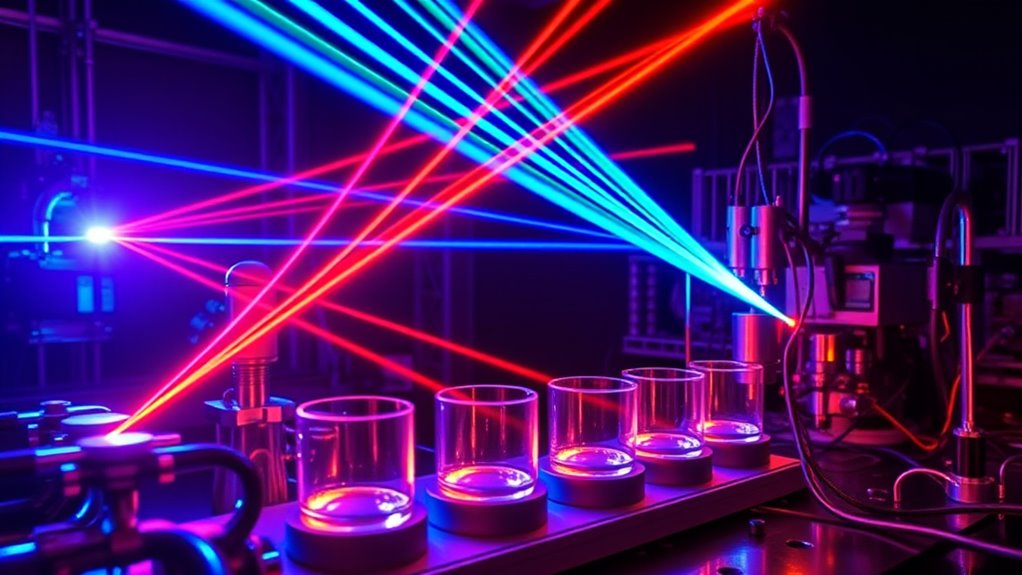
Ultrafast laser spectroscopy relies on extremely short laser pulses to study rapid processes at the molecular and atomic levels. These pulses enable you to observe quantum coherence, where particles maintain phase relationships over time, revealing how quantum states evolve during reactions. Nonlinear interactions occur when the intense laser fields induce changes in the sample’s electronic or vibrational states, producing signals that encode dynamic information. By manipulating pulse timing and properties, you can selectively excite specific states and monitor their evolution in real time. The core principle is capturing these ultrafast phenomena before they decay or dephase, allowing you to understand the fundamental mechanisms of molecular transformations. This approach provides a window into the fleeting, yet critical, events that drive chemical and physical processes. Understanding the importance of ultrafast processes is essential for advancing the development of new materials and chemical reactions. Recognizing these ultrafast events can also aid in designing more efficient energy conversion systems. Additionally, optimizing spectroscopic techniques enhances the sensitivity and resolution of measurements, making it possible to detect even subtle molecular changes.
Types of Ultrashort Laser Pulses and Their Applications
You’ll find that femtosecond pulses are essential for capturing ultrafast processes with incredible precision, while picosecond pulses suit applications requiring slightly longer timescales. Tunable laser techniques allow you to customize wavelengths for specific experiments, expanding your capabilities. Understanding these pulse types and their uses helps you optimize your ultrafast spectroscopy experiments effectively.
Femtosecond Pulse Generation
Femtosecond pulse generation involves producing laser pulses that last on the order of 10^-15 seconds, enabling incredibly high temporal resolution. These ultrashort pulses are vital for ultrafast imaging, allowing you to capture rapid molecular processes in real time. To generate such pulses, you use techniques like mode-locking and chirped pulse amplification, which refine the pulse duration and energy. Laser beam shaping plays an indispensable role, helping you to tailor the pulse’s spatial and temporal profiles for specific applications. This precision guarantees you can focus energy tightly and control the pulse’s characteristics. Femtosecond pulses open up new possibilities in studying reaction dynamics, providing insights into processes that occur on timescales previously inaccessible. They form the backbone of many advanced ultrafast spectroscopy experiments. Additionally, advances in pulse stabilization techniques further enhance the quality and reproducibility of these ultrashort pulses, expanding their applicability in scientific research. Incorporating advanced control methods can also improve the stability and customization of pulse parameters for diverse experimental needs. Moreover, the development of ultrafast laser sources continues to drive innovation in this field, enabling more complex and precise investigations.
Picosecond Pulse Applications
Building on femtosecond capabilities, picosecond laser pulses—lasting between 1 and 1000 picoseconds—bring unique advantages. They effectively explore quantum coherence, allowing you to observe ultrafast phenomena without overwhelming non-linear effects. These pulses are ideal for studying energy transfer and molecular dynamics, where slightly longer durations provide better control. The precise timing of picosecond pulses also enable precise manipulation of non-linear interactions, such as harmonic generation or multi-photon processes. The table below highlights different pulse types and their key applications:
| Pulse Type | Application |
|---|---|
| Chirped Picosecond | Coherent control, quantum coherence studies |
| Mode-Locked Pulses | High-resolution spectroscopy |
| Shaped Pulses | Non-linear optics, reaction dynamics |
Furthermore, understanding the subtopic of ultrashort laser pulses can enhance the development of tailored laser systems for specific research needs. Additionally, advances in pulse shaping techniques are expanding the possibilities for customizing pulse characteristics to optimize various applications.
Tunable Laser Techniques
Tunable laser techniques play a vital role in generating and manipulating ultrashort laser pulses with specific properties tailored to various applications. By adjusting the laser tuning, you can produce pulses with precise wavelengths, durations, and energies suited for different spectroscopy applications. This flexibility allows you to target specific molecular transitions and observe rapid reaction dynamics in real-time. Tunable lasers enable you to explore a broad spectral range, making them essential for detailed spectroscopic analysis. Their ability to deliver tailored pulses enhances resolution, sensitivity, and selectivity in ultrafast spectroscopy experiments. Ultimately, laser tuning empowers you to optimize experimental conditions, enabling deeper insights into molecular behavior and reaction mechanisms with high temporal and spectral precision. Additionally, sound healing science indicates that specific frequencies can influence biological processes, further expanding the potential applications of tunable laser techniques in biomedical research. Incorporating spectral selectivity into laser tuning strategies helps maximize experimental effectiveness and data clarity.
Techniques for Capturing Molecular Dynamics
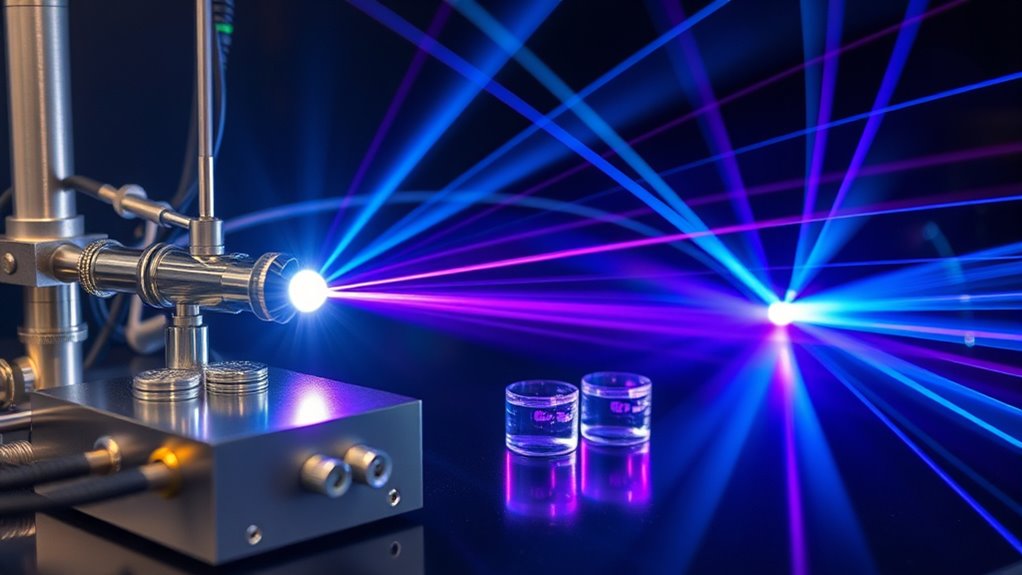
To effectively capture molecular dynamics, scientists employ specialized ultrafast laser techniques that can track events occurring on extremely short timescales. These methods often rely on maintaining laser stabilization, ensuring pulses are precise and consistent. Quantum coherence plays a pivotal role by allowing you to observe phase relationships between molecular states, revealing how molecules evolve during reactions. Techniques like pump-probe spectroscopy utilize synchronized laser pulses to monitor real-time changes, while advanced methods leverage quantum coherence to detect subtle electronic and vibrational motions. By controlling laser stability and harnessing quantum coherence, you can achieve high temporal resolution, capturing fleeting states and dynamic processes that are otherwise impossible to observe. Additionally, lab resources and tools can be used in laboratory settings to simulate and study specific environmental conditions, enhancing our understanding of molecular interactions. These capabilities provide deep insights into molecular behavior, advancing our understanding of reaction pathways.
Experimental Setup and Methodologies
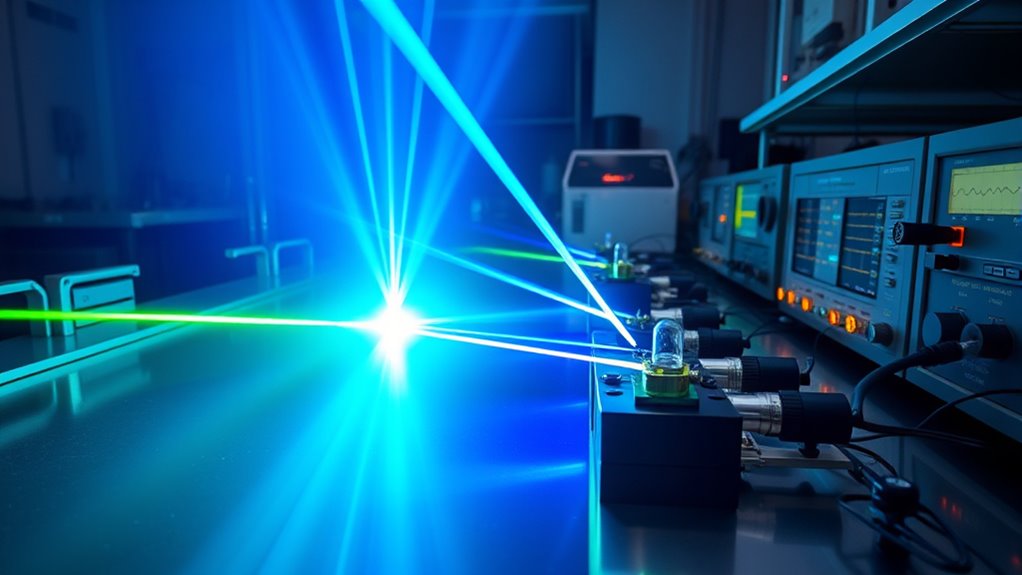
To establish ultrafast laser spectroscopy experiments, you need to comprehend laser pulse generation techniques that produce extremely short pulses. You’ll also want to focus on temporal resolution strategies that accurately capture rapid molecular changes. The choice of detection systems, such as fast photodetectors or spectrometers, is crucial for capturing transient signals with high fidelity. Finally, selecting appropriate detection and data acquisition methods ensures you collect precise, high-quality data for analysis. Incorporating best practices for equipment maintenance can further enhance experimental reliability and longevity.
Laser Pulse Generation Techniques
How do researchers generate the ultrashort laser pulses essential for spectroscopy experiments? They often start with mode-locked lasers that produce pulses lasting just femtoseconds. To stretch and then compress these pulses, they use a technique called a chirped pulse, which temporarily broadens the pulse duration before recompression. Laser stabilization is critical here; it ensures consistent pulse timing, energy, and phase, improving measurement accuracy. Precise control over the pulse shape and duration is achieved through adaptive optics and feedback systems. These techniques allow you to generate clean, stable ultrashort pulses, which are indispensable for capturing rapid reaction dynamics. Additionally, implementing Laser stabilization systems helps mitigate environmental disturbances, ensuring the reliability of measurements. By combining chirped pulse management with laser stabilization, you can produce the high-quality pulses needed for detailed ultrafast spectroscopy experiments. Incorporating goal setting and self-improvement techniques can further enhance your experimental precision and overall research effectiveness.
Temporal Resolution Strategies
Achieving high temporal resolution in ultrafast spectroscopy requires carefully designed experimental setups and methodologies. You focus on maintaining photonic coherence to preserve the phase relationships of ultrashort pulses, enabling precise timing measurements. Spectral shaping allows you to tailor pulse bandwidths and phases, improving temporal confinement and reducing pulse duration. By controlling the spectral components, you can generate pulses that are shorter and more coherent, which directly enhances your ability to resolve rapid reaction dynamics. Fine-tuning these parameters minimizes timing jitter and broadening effects, ensuring your measurements accurately reflect real-time processes. Combining advanced pulse shaping techniques with coherent control strategies lets you push the limits of temporal resolution, disentangle detailed insights into ultrafast phenomena.
Detection and Data Acquisition
Effective detection and data acquisition systems are vital for capturing ultrafast phenomena with high fidelity. You’ll need sensitive detectors to convert fleeting signals into measurable data, and advanced signal processing techniques to filter noise and extract meaningful information. High-speed digitizers record the signals in real time, ensuring no critical details are lost. Once collected, data visualization tools help you interpret complex datasets, revealing reaction dynamics that occur on femtosecond timescales. Proper synchronization between the laser pulses and detection hardware is essential to accurately correlate signals with specific reaction events. By optimizing your setup for efficient data acquisition and clear visualization, you can confidently analyze ultrafast processes and reveal deeper insights into molecular behavior. Incorporating high-quality educational toys into training can also enhance understanding of complex phenomena by fostering hands-on learning and problem-solving skills. Additionally, implementing encryption solutions can help safeguard sensitive experimental data from unauthorized access during transmission and storage. Leveraging AI-powered analysis can further improve the speed and accuracy of data interpretation in ultrafast spectroscopy experiments.
Case Studies in Chemical Reaction Analysis
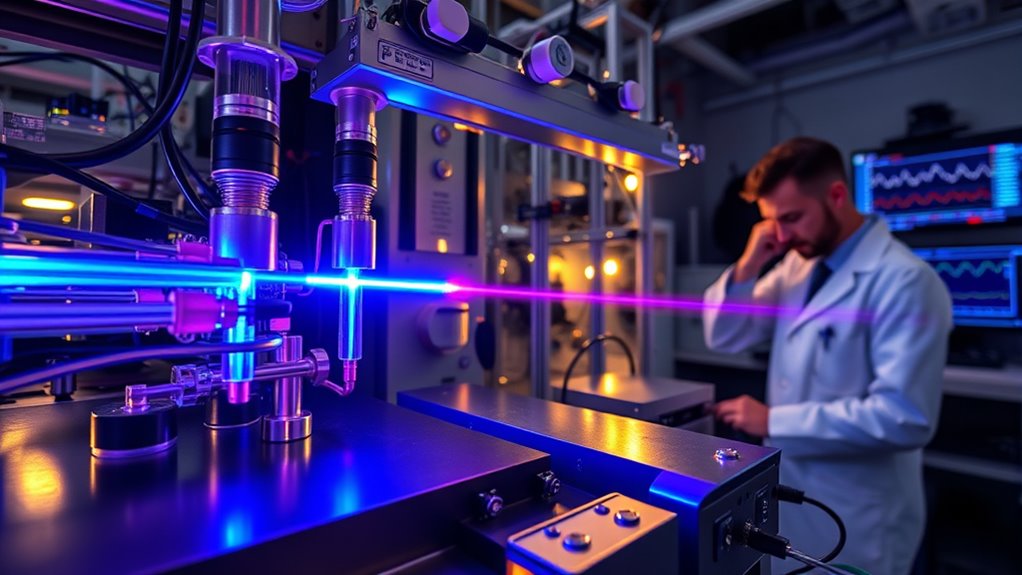
Case studies in chemical reaction analysis demonstrate how ultrafast laser spectroscopy provides detailed insights into reaction mechanisms that occur on femtosecond to picosecond timescales. By tracking changes in molecular energy, you can observe how molecules progress between quantum states during reactions. For instance, in photoisomerization, ultrafast techniques reveal how molecules move from excited to ground states, uncovering intermediate structures and energy pathways. These studies show how energy redistributes among vibrational and electronic states, clarifying complex reaction pathways. You see that understanding these quantum state transitions helps predict reaction outcomes and design better catalysts. Ultrafast spectroscopy therefore enables you to visualize the fleeting steps that define the course of chemical reactions, offering a window into the fundamental processes shaping molecular behavior. Recognizing the importance of continuous learning in advancing spectroscopic techniques allows researchers like you to stay at the forefront of molecular analysis. Additionally, staying updated on emerging technologies can lead to even more precise and insightful measurements in reaction dynamics. Exploring spectroscopic innovations offers opportunities to deepen your understanding of reaction mechanisms and enhance experimental capabilities.
Advances in Temporal and Spatial Resolution
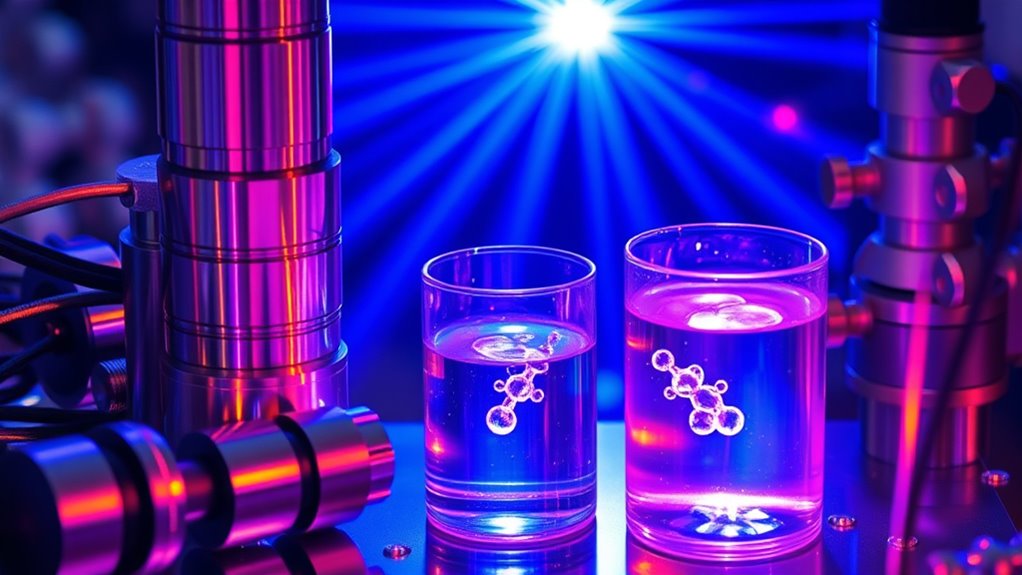
Building on how ultrafast laser spectroscopy reveals detailed reaction mechanisms, recent advances have markedly enhanced your ability to resolve events with greater precision in both time and space. Through ultrafast imaging, you can now capture molecular motions at femtosecond scales, revealing transient states previously hidden. Quantum control techniques allow you to manipulate reaction pathways precisely, improving spatial resolution to observe nanoscale dynamics. Visualize this with the following:
| Temporal Resolution | Spatial Resolution |
|---|---|
| Femtoseconds | Nanoscale imaging |
| Picoseconds | Atomic-level detail |
| Attoseconds | Controlled quantum states |
These innovations deepen your insight into reaction processes, enabling you to watch molecules dance and control their movements in real time.
Challenges and Limitations of Current Technologies
Despite significant advancements, ultrafast laser spectroscopy still faces formidable challenges that limit its full potential. One major obstacle is spatial resolution; techniques like scanning electron microscopy provide higher detail but lack the temporal speed needed for ultrafast processes. Conversely, nuclear magnetic resonance offers detailed chemical insights but cannot match the temporal resolution required to track rapid reactions. Additionally, laser equipment can be complex and costly, making widespread adoption difficult. Data interpretation remains a challenge, requiring sophisticated algorithms and expertise. Furthermore, sample damage from intense laser pulses can distort results or limit the types of materials studied. These limitations highlight the need for technological improvements to bridge the gap between spatial detail and ultrafast temporal measurements, enabling more exhaustive reaction dynamics analysis.
Future Directions and Emerging Innovations
Emerging innovations in ultrafast laser spectroscopy aim to overcome current limitations by developing new technologies that combine high spatial and temporal resolution. Quantum coherence plays a crucial role, enabling researchers to observe and manipulate electron and nuclear dynamics with greater precision. Leveraging quantum coherence helps capture complex reaction pathways that were previously inaccessible. Additionally, machine learning is transforming data analysis, allowing for real-time interpretation of vast datasets and improving experimental design. These advancements facilitate deeper insights into reaction mechanisms, pushing the boundaries of what ultrafast spectroscopy can achieve. By integrating quantum coherence and machine learning, you can unlock detailed reaction dynamics, paving the way for innovative applications in chemistry, material science, and biology. These emerging tools promise a future of more precise, efficient, and insightful spectroscopic investigations.
Frequently Asked Questions
How Does Ultrafast Spectroscopy Compare to Traditional Reaction Monitoring Methods?
You find that ultrafast spectroscopy offers a significant advantage over traditional reaction monitoring methods. It captures reaction mechanisms in real-time, providing detailed insights into rapid processes that older techniques might miss. With faster data acquisition, you can analyze transient states more effectively, leading to deeper understanding. This technique enhances your data analysis capabilities, revealing intricate details of reactions that are essential for advancing chemical research and development.
What Are the Key Factors Influencing the Choice of Laser Pulse Duration?
When choosing laser pulse duration, you need to consider the spectral bandwidth, which broadens as pulses become shorter. Shorter pulses, like femtoseconds, allow you to capture rapid reaction dynamics but require precise control of spectral bandwidth. Longer pulses are easier to manage but may miss fast events. Balance your needs for temporal resolution and spectral coverage to select the most suitable pulse duration for your experiment.
Can Ultrafast Laser Techniques Be Applied to Biological Systems?
You can definitely apply ultrafast laser techniques to biological systems. These methods allow you to explore photochemical pathways and energy transfer processes with exceptional temporal resolution. By capturing rapid molecular changes, you gain insights into complex biological reactions. This approach helps you understand how light influences biological functions, making ultrafast lasers powerful tools for studying everything from photosynthesis to DNA repair, advancing both fundamental research and medical applications.
How Do Environmental Conditions Affect Ultrafast Laser Spectroscopy Measurements?
You should consider how environmental conditions influence your measurements, as factors like sample contamination and temperature fluctuations can distort results. These conditions affect the stability and clarity of ultrafast laser spectroscopy data, leading to potential inaccuracies. Maintaining a clean sample environment and controlling temperature guarantees precise, reliable measurements. By minimizing contamination and fluctuations, you optimize the technique’s effectiveness and gain clearer insights into the reaction dynamics you aim to analyze.
What Are the Cost and Accessibility Considerations for Implementing These Technologies?
You should consider the cost barriers and equipment accessibility when implementing ultrafast laser spectroscopy. The technology involves expensive lasers, detectors, and specialized setups, making initial investment high. Additionally, access to advanced facilities or specialized training can be limited, affecting your ability to use these tools effectively. Balancing the benefits with these costs helps you determine if adopting ultrafast laser spectroscopy is feasible for your research needs.
Conclusion
You now hold the key to revealing molecular secrets with ultrafast laser spectroscopy. Picture slicing through time itself, capturing fleeting reactions like a photographer catching lightning in a jar. As technology advances, you’ll explore reactions at the speed of thought, revealing hidden worlds within molecules. Embrace these innovations, and you’ll unlock new frontiers in chemistry, turning tiny moments into grand discoveries—making the invisible, vividly real before your eyes.