An ultrapure water system improves your analytical work by providing highly consistent and contaminant-free water, which enhances the accuracy of your results. It reduces interference from ions, organics, bacteria, and particulates that can skew measurements or cause inconsistencies. This leads to more reliable data and better reproducibility, especially in sensitive experiments. Regular maintenance and monitoring guarantee ongoing performance, helping you meet industry standards. Keep exploring to discover how these systems can further elevate your analytical processes.

Prime made for students and young adults
- Fast, free delivery for dorm and study essentials
- Prime Video and Amazon Music included
- Member-only deals
Key Takeaways
- Enhances data accuracy by reducing contaminants that can interfere with sensitive analyses.
- Improves reliability and consistency of results across experiments and testing procedures.
- Supports reproducibility and quality control through stable, high-purity water standards.
- Minimizes contamination risks, ensuring experiment integrity and compliance with industry standards.
- Enables real-time monitoring and maintenance, optimizing system performance and ensuring ongoing purity.
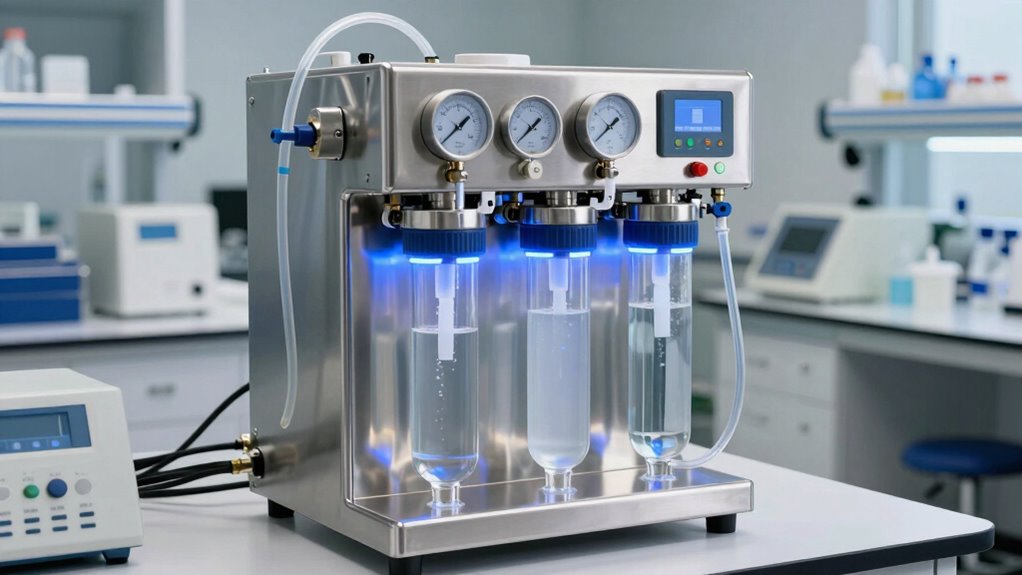
In analytical work, the quality of water used can substantially impact the accuracy and reliability of results. When you switch to an ultrapure water system, you’re making a significant improvement that directly influences your data’s integrity. These systems are designed to produce water with extremely low levels of contaminants, including ions, organic compounds, bacteria, and particulates. This level of purity is crucial because even tiny impurities can interfere with sensitive analytical techniques, skew measurements, or cause inconsistent results. By implementing ultrapure water, you reduce the risk of contamination, guaranteeing your experiments and tests are as precise as possible.
One of the major changes you’ll notice is how water purification becomes more dependable and consistent. Traditional methods might require frequent filtration or reagent-based purification, but ultrapure systems automate and streamline this process. They incorporate advanced filtration, reverse osmosis, deionization, and UV sterilization to continuously produce water that meets strict standards. This means you no longer have to worry about fluctuating water quality, and your analytical procedures can proceed without interruptions due to impurities. The consistency in water quality translates into more reproducible results, which is especially crucial in quality control labs, research settings, or pharmaceutical environments. Additionally, many ultrapure systems now include real-time monitoring features to ensure ongoing compliance and performance.
System maintenance is another key aspect that changes with the adoption of an ultrapure water system. These systems are designed for minimal upkeep, but regular maintenance remains essential to maintain their performance. You’ll need to routinely replace filters, monitor resistivity levels, and check for microbial growth. Proper maintenance protocols ensure the system continues to produce water at the desired purity levels and prevent bacterial contamination that could compromise your results. Keeping the system in peak condition means fewer surprises and less downtime, which ultimately boosts your productivity and confidence in your data. Additionally, understanding contaminant removal processes helps in optimizing system performance and ensuring ongoing compliance with industry standards. Regular monitoring of resistivity levels can also help detect potential issues early, maintaining the system’s effectiveness over time. Furthermore, staying informed about emerging water purification technologies can help you adapt your system for even better performance and compliance.
ultrapure water system for laboratory
As an affiliate, we earn on qualifying purchases.
As an affiliate, we earn on qualifying purchases.
Frequently Asked Questions
How Often Should the Ultrapure Water System Be Maintained?
You should maintain your ultrapure water system regularly, ideally every 3 to 6 months. During maintenance, check water filtration components to guarantee they’re functioning properly and replace filters as needed. Also, perform system calibration to ensure water quality remains consistent and meets analytical standards. Regular maintenance helps prevent contamination, preserves system efficiency, and guarantees your analytical work produces reliable results.
What Are the Common Contaminants in Ultrapure Water?
You’ll find that common contaminants in ultrapure water often come from contaminant sources like pipes, storage tanks, or even the environment, which can compromise purity standards. These include bacteria, organic compounds, metals, and particulates. To maintain ideal analytical results, you need to monitor and minimize these contaminants, ensuring your ultrapure water meets strict purity standards. Regular system maintenance and proper handling help prevent these common issues from affecting your work.
How Does Ultrapure Water Impact Analytical Accuracy?
Ultrapure water markedly enhances analytical accuracy by ensuring water purity, which minimizes contamination risks and interference in measurements. When you use ultrapure water, your analytical precision improves because impurities and contaminants are eliminated, leading to more reliable results. This high level of water purity helps you obtain consistent, accurate data, making your analyses more trustworthy. Ultimately, using ultrapure water is critical for achieving ideal analytical accuracy in sensitive tests.
What Are the Installation Requirements for an Ultrapure Water System?
Imagine installing a new ultrapure water system in your lab. You need proper water purification components, like high-grade filters and deionization units, placed in a clean, dedicated space. Guarantee all pipes are inert and corrosion-resistant to prevent contamination. Adequate system optimization involves maintaining temperature, pressure, and flow rates. Follow manufacturer instructions closely, and regularly validate the system to ensure consistent water quality, crucial for accurate analytical work.
Can Ultrapure Water Systems Be Customized for Specific Applications?
Yes, ultrapure water systems can be customized for specific applications. You can tailor system components, such as filters, purification stages, and storage tanks, to meet your unique application needs. This customization guarantees peak performance, reduces contamination risks, and aligns with your analytical requirements. By focusing on application specificity, you enhance the reliability and accuracy of your work, making the system more efficient and suited to your particular laboratory or industrial processes.
high purity water purification system
As an affiliate, we earn on qualifying purchases.
As an affiliate, we earn on qualifying purchases.
Conclusion
By incorporating an ultrapure water system into your analytical work, you might find that precision and accuracy suddenly become second nature. It’s almost as if the tiniest contaminants fade away, revealing clearer, more reliable results. Sometimes, it’s the quietest changes—like pure water—that make the biggest difference. In those moments of clarity, you realize how much trust you can place in your data. Truly, purity isn’t just a standard; it’s the foundation of confidence in your work.
laboratory ultrapure water filter
As an affiliate, we earn on qualifying purchases.
As an affiliate, we earn on qualifying purchases.
automated water purification system
As an affiliate, we earn on qualifying purchases.
As an affiliate, we earn on qualifying purchases.
Fall Picks
fall essentials
As an affiliate, we earn on qualifying purchases.