
TL;DR

Prime made for students and young adults
- Fast, free delivery for dorm and study essentials
- Prime Video and Amazon Music included
- Member-only deals
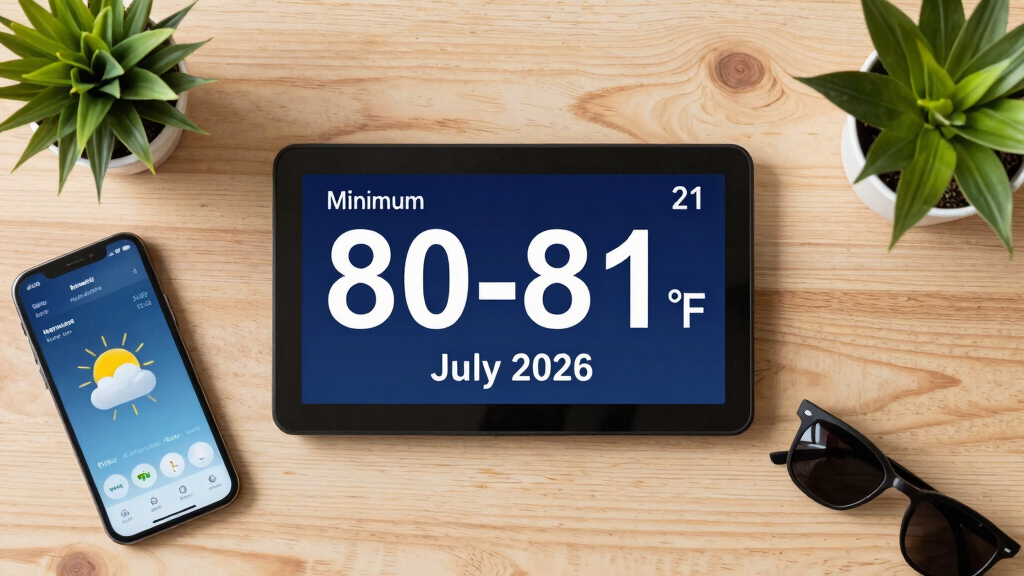
A trading market indicates speculation about the minimum temperature on July 21, 2026, possibly reaching 80-81°F. No official weather forecast confirms this prediction, and details remain uncertain.
Market activity on the trading platform Kalshi indicates speculation about whether the minimum temperature will be between 80 and 81 degrees Fahrenheit on July 21, 2026. No official weather agencies have issued forecasts or predictions for that specific date, and the event remains speculative based on market trading patterns.
According to recent trades on Kalshi, a platform for event-based trading, investors are betting on whether the minimum temperature on July 21, 2026, will fall within the 80-81°F range. The activity includes seven recent trades reflecting this speculation. However, these trades are based on market sentiment and do not represent official weather predictions.
Weather forecasting models currently do not extend reliably that far into the future, and no meteorological agency has issued forecasts or temperature predictions for that specific date. For more about weather predictions, see weather forecast predictions. The speculation appears to be driven by market participants rather than scientific data.
Implications of Market-Driven Temperature Speculation
This development illustrates how financial markets are increasingly used to speculate on long-term climate and weather events, even when scientific forecasts are unavailable. While the market activity does not predict actual weather, it reflects public interest and uncertainty about future climate conditions, which could influence economic or policy discussions.
For the public, understanding that such predictions are speculative and not scientifically verified is crucial. The actual weather on July 21, 2026, remains unpredictable at this stage, emphasizing the limitations of current forecasting technology for such a distant date.
As an affiliate, we earn on qualifying purchases.
Long-Term Weather Forecasting Challenges and Market Use
Weather forecasts typically extend up to 7-10 days with reasonable accuracy, but beyond that, predictions become highly uncertain. The use of markets like Kalshi to speculate on future temperatures is a relatively new phenomenon, reflecting growing interest in probabilistic predictions and climate risk management. Historically, no official forecasts have provided reliable data for specific days more than a few years in advance.
Recent market activity on Kalshi shows traders placing bets on temperature ranges for dates several years into the future, including July 21, 2026. These trades are driven by market dynamics and individual risk assessments rather than scientific consensus.
“Current climate models do not provide reliable forecasts for specific temperature ranges more than a few years ahead, making such market speculation highly uncertain.”
— Dr. Emily Carter, Climate Scientist
weather forecast station with humidity
As an affiliate, we earn on qualifying purchases.
As an affiliate, we earn on qualifying purchases.
Unconfirmed Nature of Long-Term Temperature Predictions
It remains unclear whether the market activity on Kalshi accurately reflects any underlying climate trend or is purely speculative. No official meteorological forecast or scientific model currently supports a specific prediction for the minimum temperature on July 21, 2026. The date is far enough in the future that weather conditions are highly unpredictable, and the trades may be driven by market sentiment rather than scientific data.
Experts caution against interpreting such market activity as an indication of actual weather outcomes.
As an affiliate, we earn on qualifying purchases.
Monitoring Future Market and Scientific Forecasts
In the coming months, weather agencies may release trend analyses or climate projections that could influence market activity. However, for the specific date of July 21, 2026, no reliable forecasts are expected until closer to the time. Market traders and the public should treat current activity as speculative, with actual weather conditions remaining uncertain.
Scientists continue to improve long-term climate models, but precise daily temperature predictions for specific days more than five years ahead remain beyond current capabilities.
As an affiliate, we earn on qualifying purchases.
Key Questions
Can the market accurately predict the weather for July 21, 2026?
No. Market activity reflects speculation and risk appetite rather than scientific weather predictions. Long-term weather forecasts are inherently uncertain beyond a few years.
What is the basis for the trades on Kalshi regarding this date?
Traders are betting on whether the minimum temperature will fall within the 80-81°F range, based on market sentiment and risk assessment, not on scientific forecasts.
Are there any official forecasts for July 21, 2026?
No. No meteorological agencies have issued forecasts or temperature predictions for that specific date, given the current limitations of climate modeling.
Why is there market activity around such a distant date?
Market speculation on distant dates can reflect broader climate risk perceptions, investor interest in climate futures, or betting on climate trend shifts, but do not provide reliable weather predictions.
Source: kalshi
Halloween Picks
halloween
As an affiliate, we earn on qualifying purchases.