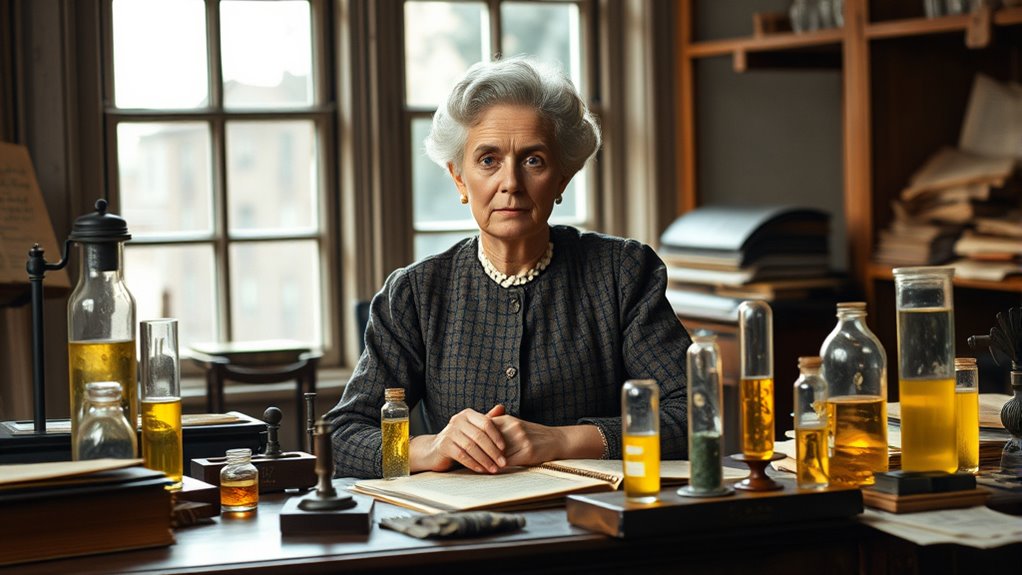

Marie Curie’s life, work, and legacy showcase inspiring dedication and groundbreaking discoveries. You’ll learn how she overcame gender barriers, identified new elements like polonium and radium, and proved radioactivity is an atomic property. Her contributions revolutionized science and medicine, earning her two Nobel Prizes. Despite challenges, her perseverance changed history and inspired women in science. If you continue exploring, you’ll uncover the incredible impact of her passion and resilience.
Key Takeaways
- Marie Curie was a pioneering scientist known for discovering radioactivity and isolating polonium and radium.
- She was the first woman to win Nobel Prizes in Physics and Chemistry, breaking gender barriers in science.
- Her research advanced understanding of atomic structure and led to medical applications like radiation therapy.
- Despite facing discrimination and health risks from radiation exposure, she remained dedicated to scientific discovery.
- Her legacy continues to inspire women in science and highlights the importance of curiosity, perseverance, and innovation.
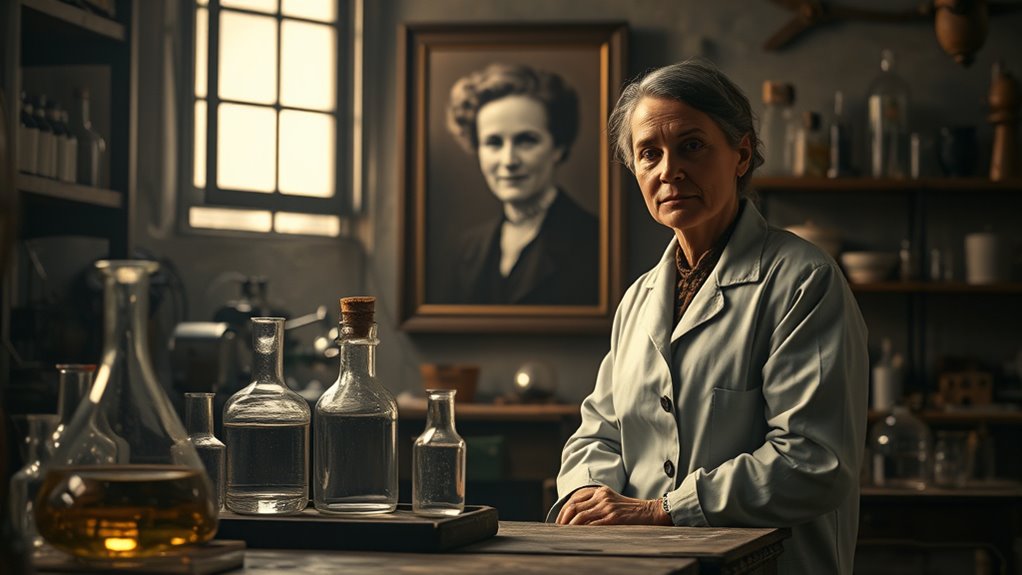
Have you ever wondered how a pioneering scientist changed our understanding of radioactivity? Marie Curie’s story begins with her relentless curiosity and determination to uncover the secrets hidden within the atom. As a young woman from Poland, she moved to France to pursue her education at a time when women faced considerable obstacles in science. Her dedication paid off when she, along with her husband Pierre Curie, set out on a groundbreaking journey to explore the mysterious phenomenon of radioactivity. This marked the radioactivity discovery that would shake the foundations of physics and chemistry. Marie Curie’s work was groundbreaking, not just because she identified and isolated new radioactive elements like polonium and radium, but because she proved that radioactivity was an inherent property of certain elements. Her experiments showed that radioactivity wasn’t caused by chemical reactions but was rooted in the atom itself, challenging existing scientific theories. In doing so, she became one of the pioneering women in science, breaking gender barriers and inspiring future generations of women to pursue careers in research and discovery.
Throughout her career, Marie Curie’s research was meticulous and often risky. She worked tirelessly in makeshift laboratories, exposing herself to dangerous levels of radiation without fully understanding its effects. Her discoveries opened new fields of study, leading to medical advancements like radiation therapy for cancer treatment. Despite the physical toll, she refused to abandon her pursuit of knowledge, driven by a profound sense of purpose. Her pioneering work earned her prestigious awards, including two Nobel Prizes—one in Physics and another in Chemistry—making her the first woman to receive such honors. Her achievements highlighted the importance of perseverance and scientific integrity, especially for women who often faced discrimination and skepticism in the scientific community.
Additionally, her research contributed to the development of radiation safety protocols, which are crucial for protecting scientists and medical professionals today. Marie Curie’s legacy extends far beyond her scientific discoveries. She paved the way for women in science, proving that gender should never limit one’s potential. Her pioneering spirit and dedication continue to serve as an inspiration, showing that curiosity and resilience can lead to discoveries that reshape our understanding of the universe. Today, her contributions are celebrated worldwide, reminding us that the pursuit of knowledge can transcend barriers and open new frontiers of human achievement. Her life exemplifies how one person’s passion and perseverance can change the course of history, making her a true icon of science and a symbol of pioneering women everywhere.

EUDAX School Physics Labs Basic Electricity Discovery Circuit and Magnetism Experiment kits for High School Students Electromagnetism Elementary Electronics
Learn basic Electricity and Magnetism experiments through full-color manuals, understand the basic principles, and help Students learn, think…
As an affiliate, we earn on qualifying purchases.
As an affiliate, we earn on qualifying purchases.
Frequently Asked Questions
What Motivated Marie Curie to Pursue Scientific Research Despite Societal Barriers?
You’re motivated by a strong curiosity and passion for science, despite gender bias and societal expectations that might discourage women from pursuing such careers. You believe in the importance of scientific discovery and want to contribute to knowledge, pushing past barriers. Your determination to break gender stereotypes fuels your pursuit of research, proving that dedication and perseverance can overcome societal limitations.
How Did Marie Curie’s Discoveries Influence Medical Treatments During Her Lifetime?
Your understanding is that Marie Curie’s discoveries revolutionized medical treatments during her lifetime through radioactive therapy and medical radiology. She pioneered the use of radium to target cancer cells, making treatments more effective and less invasive. Her work laid the foundation for modern radiology, transforming how doctors diagnose and treat illnesses. This impact continues today, saving countless lives by advancing cancer therapy and medical imaging techniques.
What Challenges Did Marie Curie Face as a Female Scientist in Her Era?
Imagine climbing a steep mountain while others say you can’t reach the top—that’s what Marie Curie faced. Gender barriers and societal expectations acted like heavy chains, making her ascent harder. She had to prove her worth in a male-dominated world, often facing skepticism and discrimination. Despite these challenges, she persevered, breaking through barriers, showing that determination and talent can shatter societal limits.
Are There Any Personal Anecdotes That Reveal Marie Curie’s Character?
You’ll find that personal anecdotes reveal Marie Curie’s character insights deeply. For example, she once refused to patent radium, prioritizing scientific progress over personal gain. Her dedication is clear in stories where she worked tirelessly despite health risks, showing resilience and passion. These anecdotes demonstrate her unwavering commitment to science and her selfless pursuit of knowledge, giving you a vivid picture of her remarkable character.
How Has Marie Curie’s Legacy Impacted Women in Science Today?
You see, Marie Curie’s legacy gently paves the way for women in science today. Her trailblazing spirit encourages gender equality, inspiring countless women to pursue their passions. Her dedication to scientific mentorship shows that nurturing others matters just as much as discovery. As a result, you’re more likely to find supportive communities and opportunities for women, transforming the landscape of science into a more inclusive and empowering space.

Marie Curie: The Life and Legacy of the Legendary Scientist Who Became the First Woman to Win a Nobel Prize
As an affiliate, we earn on qualifying purchases.
As an affiliate, we earn on qualifying purchases.
Conclusion
Your journey through Marie Curie’s life reveals a shining star blazing brightly against the dark night of adversity. Her relentless pursuit of knowledge ignited a legacy that continues to illuminate the path of science and humanity. Like a delicate yet indomitable flame, her spirit burns on, inspiring you to chase your dreams with unwavering courage. In her story, you find a beacon of hope, reminding you that even in the face of darkness, brilliance can emerge.

Zeasdacu Danger: Class 4 Laser Radiation – Avoid Eye/Skin Exposure, 8×12 Inch Metal Tin Laser Safety Sign for Lab, Laser Shop & Medical Equipment Area
Durable Material: Crafted from high-quality steel metal, this tin sign is built to last with a sturdy and…
As an affiliate, we earn on qualifying purchases.
As an affiliate, we earn on qualifying purchases.

Linear Accelerators for Radiation Therapy (Series in Medical Physics and Biomedical Engineering)
Used Book in Good Condition
As an affiliate, we earn on qualifying purchases.
As an affiliate, we earn on qualifying purchases.