

Metal–Organic Frameworks (MOFs) started as a groundbreaking idea in materials science, combining metal ions with organic ligands to create highly porous, customizable structures. Over time, advances in synthesis methods like solvothermal and mechanochemical techniques allowed scientists to fine-tune these frameworks for applications in gas storage, separation, and catalysis. Their extraordinary potential and impact led to recognition with the Nobel Prize, showcasing their importance. If you continue exploring, you’ll discover how MOFs continue to shape future innovations.
Key Takeaways
- MOFs revolutionized materials science through highly tunable, porous structures for gas storage, separation, and catalysis.
- Their development involved advanced synthesis methods like solvothermal and microwave-assisted techniques.
- MOFs’ exceptional performance in energy and environmental applications led to widespread recognition and research interest.
- The field’s rapid progress and impactful applications contributed to the recognition with the Nobel Prize.
- Their story exemplifies transformative scientific innovation from conceptual design to practical, real-world solutions.
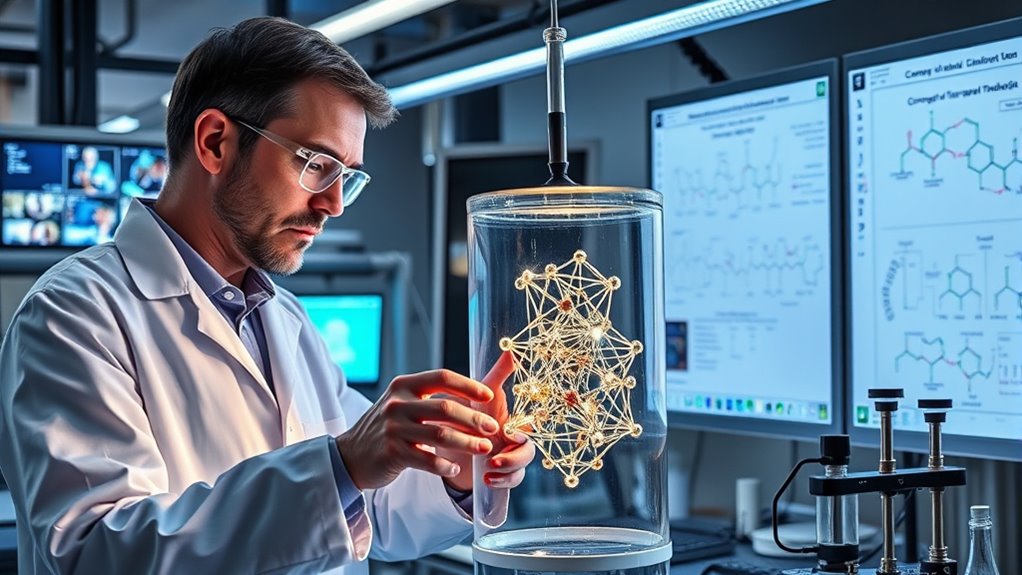
Metal–Organic Frameworks (MOFs) have revolutionized the field of materials science by offering a highly tunable platform for gas storage, separation, and catalysis. Their unique structure, composed of metal ions linked by organic ligands, creates a porous network that can be customized for specific functions. This versatility stems from the variety of synthesis methods available, which allow you to design MOFs with precise pore sizes, surface areas, and chemical properties. Techniques like solvothermal synthesis, where you heat metal salts and organic linkers in a solvent, enable you to produce high-quality MOF crystals suitable for research and practical use. Other methods, such as microwave-assisted synthesis or mechanochemical approaches, can reduce production time and energy consumption, making MOFs more feasible for industrial applications. As you explore these synthesis methods, you’ll notice how the ability to tailor the framework’s structure directly impacts its practical applications. Additionally, understanding the synthesis techniques helps in optimizing MOFs for specific industrial needs and enhances their overall performance.
In real-world settings, MOFs find uses across multiple industries. For example, in gas storage, they serve as efficient tanks for hydrogen or methane, which are critical for clean energy initiatives. When it comes to separation, MOFs excel at filtering out impurities or isolating specific gases from mixtures, such as carbon dioxide from industrial emissions. Their high surface area and customizable pore sizes give you the advantage of selectivity and capacity, making them invaluable in environmental and energy sectors. In catalysis, MOFs act as highly active, recyclable catalysts for chemical reactions, including those involved in pollution control and sustainable fuel production. These practical applications demonstrate how the fundamental understanding of MOF synthesis translates into impactful solutions.
As research progresses, the potential of MOFs continues to expand. The ability to engineer frameworks at the molecular level means you can develop materials specifically tailored for emerging challenges. The journey from concept to practical application involves intricate synthesis techniques, but the payoff is substantial—offering innovative solutions that address global issues like clean energy, pollution, and resource management. The recognition of MOFs with the Nobel Prize underscores their significance, marking a milestone in scientific advancement. So, as you explore into the world of MOFs, you’ll find that their story is one of clever design, practical impact, and transformative potential—an exciting frontier in modern materials science.
Frequently Asked Questions
How Do MOFS Compare to Other Porous Materials in Efficiency?
You’ll find that MOFs excel in efficiency compared to other porous materials because they offer higher adsorption capacity and better selectivity enhancement. Their tunable structures allow you to customize pore sizes and functionalities, making them more effective at capturing specific molecules. This adaptability means MOFs often outperform traditional materials like zeolites or activated carbons, especially in applications like gas storage, separation, and sensing.
What Are the Current Commercial Applications of MOFS?
You’ll find MOFs actively used in catalyst applications and gas storage, showcasing their versatility. They outperform traditional materials by offering higher surface areas and tunable properties, making them ideal for storing hydrogen or capturing CO2. While still emerging, these commercial uses highlight MOFs’ potential to revolutionize industries, from energy to environmental management, as they continue to develop more efficient, cost-effective solutions for real-world challenges.
How Sustainable Are MOF Synthesis Processes?
You’ll find that MOF synthesis processes are becoming increasingly sustainable through green chemistry principles. Researchers are using renewable feedstocks and eco-friendly methods to minimize environmental impact. While some processes still rely on solvents and energy-intensive steps, there’s a clear shift toward greener alternatives, making MOF production more sustainable overall. Continued innovation aims to reduce waste and carbon footprint, aligning MOF manufacturing with global sustainability goals.
What Challenges Remain for Large-Scale MOF Production?
You face several challenges when scaling up MOF production, primarily due to scalability hurdles that complicate maintaining quality and consistency. Additionally, manufacturing costs remain high because of expensive raw materials and complex synthesis processes. Overcoming these obstacles requires developing cost-effective, simpler methods and improving scalability techniques, so you can produce MOFs efficiently and affordably on a large scale, making their widespread application more feasible.
Are There Any Environmental Concerns Related to MOF Use?
You should be aware that Mof use raises environmental impact and toxicity concerns. Some MOFs contain toxic metals or linkers, which could harm ecosystems if not properly managed. Manufacturing and disposal processes might release hazardous substances, so it is crucial to develop greener, safer methods. Staying informed about these issues helps guarantee responsible use, minimizing environmental risks while harnessing MOFs’ benefits.
Conclusion
As you reflect on the journey of metal–organic frameworks, imagine building a house with tiny, perfectly fitting Lego bricks—each designed to liberate new possibilities. Just like that meticulous construction led to a Nobel Prize, your own innovations can transform industries and spark breakthroughs. These frameworks, evolving from simple ideas to groundbreaking solutions, remind you that with patience and precision, even the most complex puzzles can be solved, paving the way for a future shaped by your ingenuity.