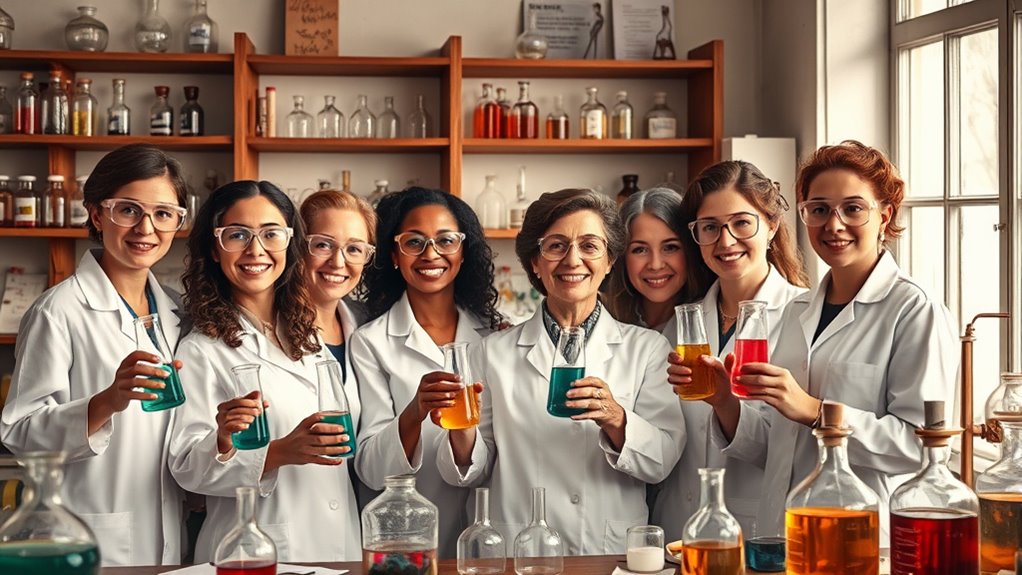

Women in chemistry have broken many barriers and made groundbreaking discoveries despite societal challenges. Marie Curie, the first woman to win a Nobel Prize, advanced our understanding of radioactivity, while Rosalind Franklin’s work was essential to uncovering DNA’s structure. Their perseverance challenged gender norms and inspired future generations. Today, recognition of their achievements promotes gender equality and diversity in science. If you explore further, you’ll discover even more inspiring stories of these pioneering women.
Key Takeaways
- Marie Curie was the first woman Nobel laureate, winning in physics and chemistry for her groundbreaking work on radioactivity.
- Rosalind Franklin’s meticulous research provided critical insights into DNA’s structure, advancing genetics significantly.
- Women in chemistry faced societal barriers but persisted, achieving breakthroughs that challenged gender norms and inspired future generations.
- Recognition of women’s contributions has increased, promoting greater gender equality and diversity in STEM fields.
- Their pioneering efforts continue to inspire societal change, emphasizing that gender should not limit scientific achievement.
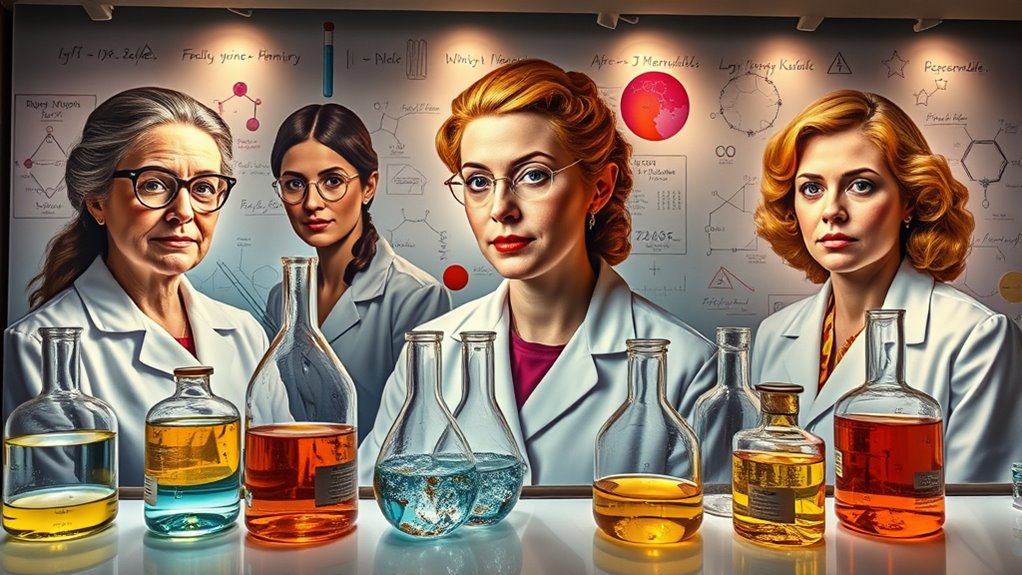
Throughout history, women have made groundbreaking contributions to the field of chemistry, often overcoming significant barriers to do so. Despite facing gender inequality and societal expectations that limited their opportunities, many women pushed forward, driven by curiosity and a desire to advance scientific knowledge. Their perseverance not only led to scientific breakthroughs but also challenged gender norms within the scientific community. When you look at these pioneering women, you see a pattern of resilience and determination that helped reshape the landscape of chemistry. Their work laid the foundation for future generations and proved that gender should never be a barrier to scientific achievement.
You might not always hear about these women in mainstream history, but their impact is undeniable. Marie Curie stands out as a prime example. She broke barriers by becoming the first woman to win a Nobel Prize and remains the only woman to have won Nobel Prizes in two different scientific fields—physics and chemistry. Her pioneering research on radioactivity opened new frontiers in science, leading to medical advancements and deeper understanding of atomic science. Her success challenged the long-standing gender inequality prevalent in scientific circles, encouraging other women to pursue careers in chemistry and physics. Similarly, Rosalind Franklin’s essential contributions to understanding the structure of DNA often went unrecognized during her lifetime, but her meticulous work provided the key insights that propelled genetic research forward. Franklin’s story reminds you that scientific breakthroughs often rely on collaboration and perseverance, regardless of gender.
As you explore the history of women in chemistry, you’ll find that their recognition has gradually increased, though disparities still exist. Their achievements have helped push for greater gender equality in scientific fields, inspiring young women to pursue careers in STEM. Your awareness of these trailblazers highlights how important it is to acknowledge and celebrate diverse contributions to science. Their achievements demonstrate the importance of color accuracy and precision in scientific work, which are crucial for reliable results. Their stories serve as a testament to how breaking down gender barriers can lead to groundbreaking discoveries that benefit society as a whole. Recognizing their work encourages institutions and individuals to foster inclusive environments where everyone has equal opportunities to innovate and succeed.
In essence, these pioneering women didn’t just make scientific breakthroughs—they also challenged the gender inequities that stifled many talented scientists. Their perseverance helped pave the way for a more equitable future in chemistry and beyond. They remind you that progress often requires breaking societal norms and advocating for gender equality, ensuring that future scientists can thrive regardless of gender. Their stories continue to inspire you to support diversity in science, knowing that groundbreaking discoveries can come from anyone with passion, curiosity, and resilience.
Frequently Asked Questions
How Did Societal Norms Impact Women’s Participation in Chemistry Historically?
Societal norms heavily impacted your participation in chemistry through gender stereotypes and educational barriers. These norms often convinced others that women weren’t suited for scientific pursuits, limiting your access to quality education and opportunities. You faced skepticism and discrimination, which discouraged many women from pursuing chemistry careers. Despite these challenges, some women persevered, breaking barriers and paving the way for future generations to participate more equally in the field.
What Challenges Did Pioneering Women Face in Gaining Recognition?
You face an uphill climb, as gender bias and institutional barriers often dimmed your achievements. Societal norms acted like invisible walls, making recognition elusive. Despite groundbreaking work, you struggled to be taken seriously, battling stereotypes that questioned your expertise. These hurdles forced you to prove yourself repeatedly, often without the support you deserved. Yet, your perseverance carved paths for future women, breaking down barriers one discovery at a time.
Are There Any Notable Women Chemists From Non-Western Countries?
You’ll find notable women chemists from Asia and female scientists in Africa making significant contributions. Women chemists from Asia like Tu Youyou, who discovered artemisinin, have gained international recognition. In Africa, female scientists are advancing research in health and environmental sciences, breaking barriers despite challenges. These women inspire future generations by demonstrating that talent and dedication transcend geographic boundaries and cultural limitations.
How Has Women’s Representation in Chemistry Evolved Over Recent Decades?
You might be surprised to learn that women’s representation in chemistry has markedly improved over recent decades. Gender disparities are narrowing thanks to mentorship programs and increased awareness. Yet, progress isn’t uniform everywhere, and challenges remain. As more women step into leadership roles and influence research, the landscape continues to evolve. Your support and advocacy can help accelerate this change, making chemistry more inclusive and inspiring for future generations.
What Current Initiatives Support Women in Chemistry Today?
Today, you can access various initiatives supporting women in chemistry, like mentorship programs that connect you with experienced scientists and funding opportunities that help you pursue research. These programs aim to increase representation, foster professional growth, and address gender disparities. By participating in such initiatives, you gain valuable support, build your network, and advance your career in chemistry. Your involvement can make a meaningful difference in shaping a more inclusive scientific community.
Conclusion
As you reflect on these groundbreaking women, it’s clear their contributions transformed chemistry and paved the way for future generations. Their perseverance and brilliance broke barriers and challenged stereotypes. But isn’t it your responsibility to continue honoring their legacy by supporting diversity and inclusion in science? Recognizing their achievements isn’t just about history; it’s about shaping a more equitable and innovative future. Will you be part of that change, ensuring their stories inspire others to follow in their footsteps?