For students seeking one dependable science reference, I rank Knowledge Encyclopedia Science! 2nd Edition as the best overall pick because it combines broad subject coverage with an approachable visual format. Everything You Need to Ace Science in One Big Fat Notebook is better for middle school beginners who need concepts taught in a course-like sequence, while A Dictionary of Science serves readers who mainly need exact definitions. The central choice is broad explanation versus rapid lookup, with age level, portability, and subject depth shaping the rest of the decision. Atlases and laminated guides can be useful additions, but their narrower scope makes them less suitable as a student’s only science reference. Continue reading for the full breakdown of all 13 options and the buyer each one serves best.
Key Takeaways
- I place Knowledge Encyclopedia Science! 2nd Edition first because it offers the strongest balance of breadth and visual accessibility; the Big Fat Notebook teaches more sequentially, while Oxford’s dictionary is faster for terminology.
- I found the QuickStudy titles most useful as subject-specific revision tools: Physical Science and Earth & Space support middle school courses, while Earth Science and Physics Terminology favor rapid fact retrieval.
- I treat National Geographic Student World Atlas as the premium visual geography choice and Student World Atlas, 9th Edition as the more traditional map reference, but neither replaces a broad science book.
- I rank Everything You Need to Know About Science Homework as the more practical shared desk reference for families, while Teach Yourself Instant Reference Science favors independent lookup over guided study.
- I reserve Science Fundamentals 1 for middle school life science and Microbiology for students needing narrower biological vocabulary; the latter is too specialized for most beginners.
| Knowledge Encyclopedia Science! 2nd Edition |  | Best Overall Visual Encyclopedia | Product type: Science encyclopedia | Edition: Second edition | Subject scope: Multiple science disciplines | VIEW LATEST PRICE | See Our Full Breakdown |
| A Dictionary of Science (Oxford Quick Reference) |  | Best for Scientific Terminology | Product type: Scientific dictionary | Series: Oxford Quick Reference | Subject scope: Terminology across multiple science disciplines | VIEW LATEST PRICE | See Our Full Breakdown |
| Everything You Need to Know About Science Homework: A Desk Reference for Students and Parents |  | Best for Parent-Guided Homework | Product type: Science desk reference | Primary audience: Students and parents | Subject scope: General school science | VIEW LATEST PRICE | See Our Full Breakdown |
| Everything You Need to Ace Science in One Big Fat Notebook: The Complete Middle School Study Guide |  | Best Middle School Study Guide | Product type: All-in-one science study guide | Series: Big Fat Notebook | Grade level: Middle school | VIEW LATEST PRICE | See Our Full Breakdown |
| Science Fundamentals 3 – Physical Science: for Middle School – A QuickStudy Laminated Reference & Study Guide |  | Best Compact Physical Science Reference | Product type: Laminated reference and study guide | Series: QuickStudy Science Fundamentals | Series volume: Science Fundamentals 3 | VIEW LATEST PRICE | See Our Full Breakdown |
| National Geographic Student World Atlas, 6th Edition |  | Best for Geographic Science | Edition: 6th Edition | Reference type: Student world atlas | Primary subject: World geography | VIEW LATEST PRICE | See Our Full Breakdown |
| Earth Science: A QuickStudy Laminated Reference Guide |  | Best Portable Earth Science Guide | Format: Laminated reference guide | Subject: Earth science | Content style: Condensed overview | VIEW LATEST PRICE | See Our Full Breakdown |
| Physics Terminology: QuickStudy Laminated Reference Guide |  | Best for Physics Vocabulary | Format: Laminated reference guide | Subject: Physics | Content focus: Physics terminology and definitions | VIEW LATEST PRICE | See Our Full Breakdown |
| Science Fundamentals 4 – Earth & Space: for Middle School – A QuickStudy Laminated Reference & Study Guide |  | Best for Middle School Earth and Space | Series: Science Fundamentals 4 | Format: Laminated reference and study guide | Subjects: Earth and space science | VIEW LATEST PRICE | See Our Full Breakdown |
| Teach Yourself Instant Reference Science |  | Best Beginner Science Overview | Reference type: General science reference guide | Subject scope: Multiple science disciplines | Content level: Fundamental concepts | VIEW LATEST PRICE | See Our Full Breakdown |
| Science Fundamentals 1 – Life Science – Cells, Plants & Animals: for Middle School – QuickStudy Laminated Reference & Study Guide | 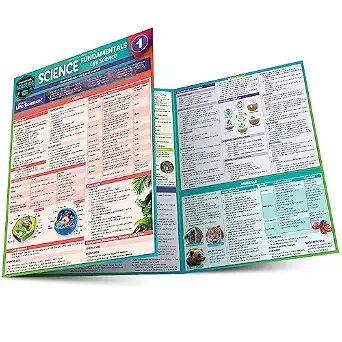 | Best Life Science Cheat Sheet | Reference type: Laminated study guide | Subject: Life science | Core topics: Cells, plants, and animals | VIEW LATEST PRICE | See Our Full Breakdown |
| Student World Atlas, 9th Edition |  | Best Geography Reference | Reference type: Student world atlas | Edition: 9th edition | Primary subject: World geography | VIEW LATEST PRICE | See Our Full Breakdown |
| Microbiology: A Quick Study Laminated Reference Guide |  | Best for Introductory Microbiology Review | Reference type: Quick-study reference guide | Subject: Microbiology | Coverage level: Fundamentals and key concepts | VIEW LATEST PRICE | See Our Full Breakdown |
| science reference books for student | Content style |
|---|---|
| Knowledge Encyclopedia Science | Concept explanations with reference entries |
| A Dictionary of Science | — |
| Everything You Need to Know Ab | Explanations and homework guidance |
| Everything You Need to Ace Sci | Guided explanations and review material |
| Science Fundamentals 3 | Condensed concepts and quick facts |
| National Geographic Student Wo | — |
| Earth Science: A QuickStudy La | Condensed overview |
| Physics Terminology: QuickStud | Concise reference entries |
| Science Fundamentals 4 | — |
| Teach Yourself Instant Referen | — |
| Science Fundamentals 1 | Concise reference material |
| Student World Atlas | — |
| Microbiology: A Quick Study La | Concise overview |
More Details on Our Top Picks
Knowledge Encyclopedia Science! 2nd Edition
I rank Knowledge Encyclopedia Science! 2nd Edition first because its broad subject coverage and colorful illustrations make difficult ideas easier to grasp. Unlike A Dictionary of Science, which is built for fast terminology checks, this encyclopedia gives concepts enough explanation and visual context to support genuine understanding. That makes it a stronger main reference for students moving between biology, chemistry, physics, and other branches of science. The tradeoff is speed: readers seeking one short definition may find the Oxford dictionary more efficient, while students preparing for a specific middle school test may prefer the structured practice in Everything You Need to Ace Science in One Big Fat Notebook. I see this as the best all-purpose choice for visual learners, but its wide scope may provide less depth on any single discipline.
Pros:- Color illustrations help students interpret complex scientific ideas
- Broad coverage supports assignments across several science disciplines
- Explanatory format offers more context than a terminology guide
- Second edition signals revised editorial content
Cons:- Wide coverage can limit the depth devoted to specialized subjects
- Less efficient than a dictionary for quick term lookups
- Does not emphasize practice questions or homework exercises
Best for: Visual learners who want one broad science reference for school assignments and independent reading
Not ideal for: Students who need practice questions, curriculum-based lessons, or rapid dictionary-style definitions
- Product type:Science encyclopedia
- Edition:Second edition
- Subject scope:Multiple science disciplines
- Primary audience:Students and general science readers
- Content style:Concept explanations with reference entries
- Visual content:Color illustrations
- Learning purpose:Concept discovery and assignment research
- Coverage approach:Broad, cross-disciplinary overview
Our verdict“I recommend this as the strongest single-volume choice for students who learn best through explanations paired with visuals.”
A Dictionary of Science (Oxford Quick Reference)
I place A Dictionary of Science high for students who need fast, authoritative definitions across several disciplines. Its alphabetical dictionary structure is more efficient than Knowledge Encyclopedia Science! 2nd Edition when a reader encounters an unfamiliar term during homework or exam revision. The concise entries also suit older students who already understand the surrounding topic and want precise wording without a long detour. That economy is also its main limitation: compared with the encyclopedia’s illustrations or the guided instruction in Everything You Need to Ace Science in One Big Fat Notebook, this book supplies little visual support, practice, or extended context. I would treat it as a dependable companion rather than a stand-alone teaching resource. It earns its role through lookup speed and breadth, not through lesson-based learning.
Pros:- Covers terminology from multiple scientific disciplines
- Concise entries make information quick to retrieve
- Oxford reference positioning supports academic use
- Useful alongside textbooks at several study levels
Cons:- Definitions provide less conceptual context than an encyclopedia
- Lacks the illustrations that many younger students need
- Offers no practice questions or structured study sequence
Best for: Secondary-school and college students who regularly need concise definitions while reading textbooks or completing assignments
Not ideal for: Younger or visual learners who need diagrams, worked examples, and full explanations before terminology makes sense
- Product type:Scientific dictionary
- Series:Oxford Quick Reference
- Subject scope:Terminology across multiple science disciplines
- Primary audience:Students, educators, and professionals
- Entry style:Clear, concise definitions
- Organization:Dictionary-style term lookup
- Visual content:Text-led rather than illustration-led
- Learning purpose:Quick terminology reference
Our verdict“I recommend this as a companion reference for students who value precise terminology more than illustrations or guided lessons.”
Everything You Need to Know About Science Homework: A Desk Reference for Students and Parents
I chose Everything You Need to Know About Science Homework for households where a student and parent need a shared desk reference. Its focus on explanations and homework guidance gives families a clearer starting point than A Dictionary of Science, whose brief definitions assume the reader can supply much of the context. It also differs from Everything You Need to Ace Science in One Big Fat Notebook: the latter is a more structured middle school study guide with practice questions, while this pick is framed around resolving homework confusion at home. That makes it flexible for nightly support, but less compelling for independent exam preparation or disciplined skill building. The stated content depth is unclear, so advanced students may outgrow it. I rank it for collaborative learning, especially when an adult wants language that helps explain a topic without becoming the science teacher.
Pros:- Designed for both students and parents
- Connects science explanations directly to homework needs
- Supports discussion when a student is stuck on a concept
- More instructional context than a dictionary entry
Cons:- Content depth is not clearly defined
- Less structured for exam review than a dedicated study guide
- May not challenge students working beyond general school science
Best for: Families with school-age students who want an approachable reference for working through science homework together
Not ideal for: Advanced students or independent test-prep learners who need deeper coverage and a large bank of practice questions
- Product type:Science desk reference
- Primary audience:Students and parents
- Subject scope:General school science
- Content style:Explanations and homework guidance
- Learning setting:At-home study support
- Intended use:Homework help and concept clarification
- Study approach:Parent-supported reference learning
- Coverage format:Multi-topic desk resource
Our verdict“I recommend this for families seeking practical homework support rather than a formal course or advanced reference.”
Everything You Need to Ace Science in One Big Fat Notebook: The Complete Middle School Study Guide
I give Everything You Need to Ace Science in One Big Fat Notebook the study-guide role because it combines middle school topic coverage with clear instruction and practice questions. That structure makes it more useful for planned review than Everything You Need to Know About Science Homework, which is better suited to parent-assisted problem solving as questions arise. It also teaches more actively than Science Fundamentals 3 – Physical Science: the laminated guide favors condensed facts, while this book gives students room to learn and check their understanding. The compromise is portability and lookup speed; a broad all-in-one notebook is less convenient for a rapid formula check, and students studying only physical science may encounter more material than they need. I rank it as the strongest option for self-directed middle school revision, though it is less suitable outside that grade range.
Pros:- Targets the middle school science curriculum
- Pairs explanations with practice questions
- Supports both self-study and revision
- Covers multiple core science topics in one resource
Cons:- Grade-specific approach has limited value for advanced study
- Broader and less portable than a laminated reference guide
- Not as fast as a dictionary or chart for isolated fact checks
Best for: Middle school students who want one guided resource for learning, reviewing, and practicing core science topics independently
Not ideal for: College students, subject specialists, or learners who only need a slim quick-reference sheet
- Product type:All-in-one science study guide
- Series:Big Fat Notebook
- Grade level:Middle school
- Subject scope:Core middle school science topics
- Content style:Guided explanations and review material
- Practice content:Practice questions included
- Study mode:Self-study and test review
- Coverage approach:Single-volume multi-topic guide
Our verdict“I recommend this for middle schoolers who need guided learning and practice rather than a reference they merely scan.”
Science Fundamentals 3 – Physical Science: for Middle School – A QuickStudy Laminated Reference & Study Guide
I selected Science Fundamentals 3 – Physical Science as the quick-reference pick for middle school students who need core facts close at hand. Its laminated format is better suited to repeated desk, binder, or backpack use than Everything You Need to Ace Science in One Big Fat Notebook, and its narrow physical science focus reduces the time spent searching through unrelated biology or Earth science material. The cost of that convenience is teaching depth: condensed facts cannot replace the notebook’s explanations and practice questions when a concept is new. It is also less versatile than Knowledge Encyclopedia Science! 2nd Edition, which spans many disciplines and uses richer visual context. I would choose this guide as a supplement for last-minute review and routine lookup, not as a student’s only science resource or for courses centered on life, Earth, or space science.
Pros:- Laminated construction supports frequent handling
- Focused scope makes physical science facts faster to find
- Compact reference style works well for short review sessions
- Content is aimed specifically at middle school learners
Cons:- Condensed format leaves little room for detailed explanations
- Physical science focus excludes other major school science areas
- Cannot replace a full study guide with practice questions
Best for: Middle school physical science students who want a durable, condensed guide for frequent fact checks and pre-test review
Not ideal for: Students learning physical science from scratch or anyone needing coverage of biology, Earth science, or space science
- Product type:Laminated reference and study guide
- Series:QuickStudy Science Fundamentals
- Series volume:Science Fundamentals 3
- Grade level:Middle school
- Subject:Physical science
- Format:Laminated quick-reference guide
- Content style:Condensed concepts and quick facts
- Intended use:Study support and rapid review
Our verdict“I recommend this as a durable physical science supplement for middle schoolers who already have a textbook or fuller study guide.”
National Geographic Student World Atlas, 6th Edition
I give the National Geographic Student World Atlas, 6th Edition a specialist place because it connects science study with countries, cities, landforms, and physical geography. Its detailed maps can help students place climate, ecosystems, geology, and human activity in a spatial setting. Compared with Earth Science: A QuickStudy Laminated Reference Guide, this atlas offers broader geographic context but less direct explanation of scientific processes. The Student World Atlas, 9th Edition may appeal more to buyers seeking a later edition, while this sixth edition remains a focused classroom reference. The main tradeoff is scope: it supports geographic literacy very well, yet it cannot replace a general science guide or subject textbook. I rank it for students whose assignments regularly involve maps and locations.
Pros:- Detailed world maps support location-based assignments
- Coverage of countries, cities, and physical features builds geographic literacy
- Useful companion for Earth science, climate, and environmental topics
- Sixth-edition content reflects updated geographic data
Cons:- Narrower scientific scope than a general reference book
- A ninth edition is available elsewhere in the lineup
- Supplementary learning materials are not specified
Best for: Upper-elementary through high-school students who need maps to support geography, Earth science, climate, or environmental studies
Not ideal for: Students seeking explanations of experiments, formulas, biology, chemistry, or physics rather than geographic context
- Edition:6th Edition
- Reference type:Student world atlas
- Primary subject:World geography
- Map coverage:Countries and cities
- Physical geography coverage:Physical features
- Intended audience:Students and learners
- Educational purpose:Geographic literacy
Our verdict“Choose this atlas when maps and geographic context matter more than explanations of scientific principles.”
Earth Science: A QuickStudy Laminated Reference Guide
I rank Earth Science: A QuickStudy Laminated Reference Guide as the portable choice for students who need fast topic review between lessons or before a quiz. The laminated format is more resistant to routine backpack wear than a standard paper reference, and its condensed layout makes facts easy to locate. Compared with Science Fundamentals 4 – Earth & Space, this guide is less explicitly tied to middle-school study and may suit a wider mix of learners. That flexibility comes with a cost: brief coverage cannot explain complex processes with textbook-level depth, and advanced students may find gaps. It also stays within Earth science, unlike Teach Yourself Instant Reference Science, which crosses several scientific fields. I would choose this as a durable supplement, not as the main source for learning unfamiliar material.
Pros:- Compact format fits easily in a school bag
- Lamination protects the guide during frequent handling
- Condensed coverage supports rapid fact checking
- Focused subject matter reduces search time
Cons:- Brief explanations offer limited help with difficult processes
- Advanced Earth science topics may be absent
- Too narrow to serve as an all-subject science reference
Best for: Students who already receive Earth science instruction and want a durable, portable sheet for quick review
Not ideal for: Advanced learners or independent students who need worked examples and detailed explanations of unfamiliar Earth science concepts
- Format:Laminated reference guide
- Subject:Earth science
- Content style:Condensed overview
- Primary use:Quick reference and study review
- Portability:Compact and portable
- Protective finish:Laminated
- Intended audience:Students and science enthusiasts
Our verdict“This is the strongest pick for students who want durable Earth science reminders within easy reach.”
Physics Terminology: QuickStudy Laminated Reference Guide
Physics Terminology: QuickStudy Laminated Reference Guide earns its position by solving a specific problem: helping students decode physics vocabulary quickly. Clear access to definitions can make lectures, homework prompts, and textbook passages less confusing, while lamination suits repeated desk or backpack use. Unlike Teach Yourself Instant Reference Science, this guide concentrates on terminology rather than introducing principles across several subjects. It is also narrower than Science Fundamentals 3 – Physical Science, which is framed as a middle-school study guide rather than a vocabulary aid. That specialization is both its advantage and its limit. Definitions cannot show how to apply formulas, build conceptual reasoning, or solve numerical problems, and advanced language may be missing. I place it highest for students who need a physics glossary at hand, not a substitute for instruction.
Pros:- Focused definitions make physics language easier to check
- Laminated construction supports frequent handling
- Portable format works well beside a textbook
- Condensed organization favors quick retrieval
Cons:- Definitions do not teach problem-solving methods
- Coverage is limited to physics terminology
- Advanced terms and detailed explanations may be missing
Best for: Introductory physics students who frequently encounter unfamiliar terms in lessons, homework, or textbook reading
Not ideal for: Students who need formula derivations, worked calculations, experiments, or detailed conceptual teaching
- Format:Laminated reference guide
- Subject:Physics
- Content focus:Physics terminology and definitions
- Content style:Concise reference entries
- Primary use:Vocabulary lookup
- Portability:Compact and portable
- Protective finish:Laminated
Our verdict“Buy this as a durable physics glossary, but pair it with a teaching resource for concepts and calculations.”
Science Fundamentals 4 – Earth & Space: for Middle School – A QuickStudy Laminated Reference & Study Guide
I place Science Fundamentals 4 – Earth & Space above broader quick-reference sheets for students who need middle-school-level focus. Its coverage joins Earth and space concepts in one laminated guide, making it useful for classroom review when a course moves between terrestrial systems and astronomy. Compared with Earth Science: A QuickStudy Laminated Reference Guide, this pick has a clearer grade-level audience and adds an explicit space-science component. Compared with Teach Yourself Instant Reference Science, it gives up subject breadth for a tighter match with one portion of a middle-school curriculum. The compact presentation is helpful for recall, but short explanations may leave independent learners without enough context, examples, or step-by-step teaching. I recommend it as a unit-review companion for students who already have lessons or a textbook providing the deeper instruction.
Pros:- Content is aimed directly at middle-school learners
- Combines Earth and space science in one focused guide
- Laminated format withstands regular school use
- Condensed presentation supports quiz and test review
Cons:- Explanations are too brief for stand-alone instruction
- Subject coverage excludes life science, chemistry, and most physics
- Advanced Earth and space topics receive limited treatment
Best for: Middle-school students reviewing an Earth and space science unit alongside classroom instruction or a textbook
Not ideal for: Older students and independent learners who need advanced astronomy, detailed geology, or extended explanations
- Series:Science Fundamentals 4
- Format:Laminated reference and study guide
- Subjects:Earth and space science
- Grade level:Middle school
- Content level:Fundamental concepts
- Primary use:Learning support and review
- Protective finish:Laminated
Our verdict“This guide makes the most sense as a durable review sheet for a middle-school Earth and space science course.”
Teach Yourself Instant Reference Science
I select Teach Yourself Instant Reference Science for beginners who want one approachable starting point rather than separate guides for every discipline. Its concise explanations cover fundamental scientific ideas, which can help students check basic concepts without working through a full textbook chapter. Compared with Physics Terminology: QuickStudy Laminated Reference Guide, it offers wider subject coverage and more emphasis on principles than definitions alone. It is also broader than Science Fundamentals 4 – Earth & Space, though less closely matched to a particular grade or unit. Breadth creates the central compromise: individual topics receive limited depth, advanced learners may outgrow the material quickly, and the stated lack of illustrations or diagrams weakens support for visual concepts. I rank it as a general-purpose primer for quick clarification, not a detailed academic reference.
Pros:- Broad science scope reduces the need for several basic guides
- Accessible explanations suit readers new to scientific concepts
- Quick-reference structure supports homework checks
- Principle-focused coverage goes beyond vocabulary alone
Cons:- Basic treatment may be insufficient for advanced coursework
- Lack of illustrations or diagrams limits visual learning
- Broad coverage leaves less room for subject-specific detail
Best for: Beginning students who want concise explanations across several science subjects in a single reference
Not ideal for: Visual learners and advanced students who need diagrams, detailed theory, or deep coverage of individual disciplines
- Reference type:General science reference guide
- Subject scope:Multiple science disciplines
- Content level:Fundamental concepts
- Explanation style:Concise and accessible
- Primary use:Quick concept lookup
- Intended audience:Students, beginners, and science enthusiasts
- Illustrations and diagrams:Not included
Our verdict“Choose this for an accessible multi-subject science primer, especially when breadth matters more than depth or visual instruction.”
Science Fundamentals 1 – Life Science – Cells, Plants & Animals: for Middle School – QuickStudy Laminated Reference & Study Guide
I rank Science Fundamentals 1 as the best life science cheat sheet because it keeps cells, plants, and animals within easy reach during middle-school homework or test review. Unlike Everything You Need to Ace Science in One Big Fat Notebook, it compresses the subject into a reference-first format instead of teaching through extended lessons and worked examples. It is also broader and more age-appropriate than Microbiology: A Quick Study Laminated Reference Guide, which narrows its attention to microscopic life. The laminated construction suits backpacks, shared classrooms, and repeated handling. That convenience comes at the cost of depth: students who do not already understand a topic may find too little explanation. I place it below full study books for independent learning, but above them for fast middle-school review.
Pros:- Condenses cells, plants, and animals into a quick-reference format
- Laminated surface withstands frequent classroom and backpack use
- Content scope matches core middle-school life science topics
- Faster to scan than a full-length study book
Cons:- Limited depth makes it weak as a stand-alone teaching resource
- Brief entries do not explain difficult processes step by step
- Narrower subject range than a general middle-school science guide
Best for: Middle-school students who already receive classroom instruction and want a durable life science refresher for homework and tests
Not ideal for: Advanced students or independent learners who need detailed explanations, examples, and extended coverage
- Reference type:Laminated study guide
- Subject:Life science
- Core topics:Cells, plants, and animals
- Student level:Middle school
- Primary use:Quick review and homework reference
- Surface:Laminated
- Content style:Concise reference material
Our verdict“I recommend this guide as a durable review companion for middle-school life science, not as a replacement for a textbook or lesson-based study guide.”
Student World Atlas, 9th Edition
I give the Student World Atlas, 9th Edition the role of best geography reference because it adds spatial context that most science study guides cannot provide. Its world maps help students connect climate, ecosystems, resources, and current affairs with actual locations. Compared with Earth Science: A QuickStudy Laminated Reference Guide, this atlas offers broader global coverage and more map-based detail, though it is less efficient for memorizing scientific definitions. The National Geographic Student World Atlas, 6th Edition is its closest rival in this lineup; choosing between them will depend on map design and edition-specific content that the supplied data does not describe. This pick also occupies more study space than a laminated sheet and does not teach scientific processes. I rank it highly for visual geographic context, but not for general science revision.
Pros:- Detailed world maps support location-based learning
- Links geography with environmental science and world affairs
- Global scope makes it useful across several school subjects
- Ninth-edition positioning provides updated geographic information
Cons:- Less useful for learning scientific processes or terminology
- Not as quick to scan as a single-topic laminated guide
- Supplied data lacks dimensions and specific edition changes
Best for: Students studying geography, environmental science, climate, ecosystems, or world affairs who need map-based context
Not ideal for: Students seeking a compact guide to scientific definitions, formulas, experiments, or step-by-step concepts
- Reference type:Student world atlas
- Edition:9th edition
- Primary subject:World geography
- Coverage:Global
- Content:World maps and geographic information
- Intended audience:Students
- Related study areas:Geography and current world affairs
- Information status:Updated geographic information
Our verdict“I recommend this atlas for students who need geographic context across science and social studies, while subject-focused learners should choose a dedicated study guide.”
Microbiology: A Quick Study Laminated Reference Guide
I assign Microbiology: A Quick Study Laminated Reference Guide the role of best introductory microbiology review because it isolates key concepts that receive limited space in broader science books. Compared with Science Fundamentals 1 – Life Science – Cells, Plants & Animals, this guide is more specialized and can serve older students or professionals who need rapid recall. A Dictionary of Science offers wider terminology coverage, but finding and connecting microbiology concepts there may take longer. The laminated reference format works well beside class notes or in a lab-study setting because it tolerates frequent handling and supports quick scanning. Its narrow scope is also its main weakness: advanced mechanisms, extended explanations, and some microbiology subfields may be absent. I rank it as a supplementary aid rather than a primary text, especially for students encountering the subject without instructor support.
Pros:- Focused coverage makes microbiology concepts quick to locate
- Laminated construction supports frequent desk or lab-side handling
- Concise layout suits review before classes, quizzes, or exams
- More specialized than general science dictionaries and guides
Cons:- Insufficient depth for advanced microbiology courses
- Brief coverage cannot replace a textbook or structured lessons
- May omit specialized microbiology subfields
Best for: High-school, college-entry, or professional learners who need a durable refresher on basic microbiology concepts
Not ideal for: Advanced microbiology students or self-directed beginners who need full explanations, laboratory methods, and broad subfield coverage
- Reference type:Quick-study reference guide
- Subject:Microbiology
- Coverage level:Fundamentals and key concepts
- Intended users:Students and professionals
- Primary use:Study aid and quick reference
- Surface:Laminated
- Content style:Concise overview
Our verdict“I recommend this guide for rapid microbiology recall, provided the buyer already has a textbook, course, or instructor supplying deeper explanations.”

How We Picked
I ranked these books by how well they answer the everyday needs behind the search for science reference books for students. My main criteria were subject coverage, clarity at the intended grade level, and speed of finding useful information. I also weighed whether each title explains relationships between ideas or merely supplies facts and definitions. Format mattered because a large illustrated encyclopedia, a course-style study guide, and a laminated sheet support different study habits. I gave added credit to books that can remain useful across multiple assignments rather than serving a single chapter or unit.
The order reflects both capability and limitations. Broad, student-friendly resources rank highest because they can serve as a primary reference, while dictionaries and subject sheets earn stronger marks for targeted lookup than for teaching unfamiliar material. I placed the atlases below the broad science books because geography is only one part of a student’s science workload. Highly focused guides rank according to age fit, information density, and whether their narrow coverage fills a clear gap. Price alone did not determine value; I favored usefulness per school year over the lowest initial cost.
Factors to Consider When Choosing Science Reference Books For Students
I would begin by identifying the job the book must perform rather than choosing the title with the most pages. A student learning a topic from scratch needs a different structure from one checking a formula or definition during homework. Age fit, subject breadth, and lookup speed usually matter more than decorative extras. The strongest purchase is the resource that matches the student’s recurring study pattern and leaves the fewest knowledge gaps.
Match the Scope to the Student’s Workload
I separate broad references from single-subject aids before comparing price or appearance. A student taking general science usually benefits from coverage across biology, chemistry, physics, and Earth science, even if each topic receives less detail. A subject guide makes more sense when the course stays within one discipline or when a recurring weak area needs extra support. Buying several narrow sheets too early can cost more than one broad book while leaving connections between subjects unexplained. On the other hand, a large encyclopedia may slow down a student who only needs formulas, definitions, or labeled diagrams. I would match the scope to the next year of coursework as well as the current assignment.
Decide Between Teaching and Lookup
Some reference books teach through explanations and examples, while others function as organized fact banks. I favor a teaching-oriented guide for beginners because it supplies context, sequence, and links between ideas. Dictionaries and laminated references are quicker when the student already understands the topic but cannot recall a term or relationship. A common mistake is expecting a definition-only resource to repair a conceptual gap. Another is buying a heavily guided study book for a reader who only wants fast confirmation during homework. I would ask whether the student usually says “I do not understand this” or “I cannot remember this,” since those problems call for different formats.
Check Reading Level and Information Density
A book can cover the right material and still fail if its language or page design overwhelms the reader. I look for short explanation blocks, clear headings, labeled visuals, and enough white space for the intended age group. Younger students often benefit from visual hierarchy and plain-language definitions, while older students may prefer denser entries that reduce page turning. Oversimplified text can become frustrating once assignments demand scientific precision. Dense terminology can also turn a reference into something the student avoids opening. I would choose a book the student can use independently, not one that always requires an adult to translate it.
Choose a Format That Fits the Study Setting
Physical format affects how often a reference gets used. A large illustrated book works well at a homework desk, but it is less convenient in a crowded backpack or small locker. Laminated sheets offer quick access, resist spills, and take up little space, though their compressed layout limits explanation. Paperback study guides balance portability and depth but may wear faster under daily school use. Atlases need enough page area for readable labels, so smaller dimensions can reduce their practical value. I would pay for durability and readable page size when several students will share the book or it will be used across multiple school years.
Check Edition Age and Curriculum Alignment
Core scientific principles remain stable, but terminology, classifications, maps, statistics, and examples can change. I would check the publication date most carefully for atlases, Earth science resources, and life science references. An older book may still explain gravity or cell structure well, yet its geographic boundaries or taxonomic language may not match current coursework. Edition numbers alone do not prove that every section has been revised, so the table of contents and sample pages are useful checks. A book built around another country’s curriculum may also organize topics in an unfamiliar order. I favor clear topic alignment with the student’s syllabus over a book that merely claims broad coverage.
Know When Paying More Makes Sense
I would spend more on a book that will act as the student’s main reference for several years. Better visual organization, stronger binding, and wider coverage can justify a higher price when the resource supports many subjects and assignments. Premium presentation offers less value when the need is only one exam or one short course. In that case, a concise study guide or borrowed library copy may be enough. Families with multiple students can gain more from durable, age-spanning references than from grade-specific workbooks that are quickly outgrown. I judge value by frequency and length of use, not page count or cover price alone.
Frequently Asked Questions
Should I Buy a Science Encyclopedia or a Science Dictionary?
I would choose an encyclopedia for learning concepts and a dictionary for checking terminology. Encyclopedias usually provide diagrams, examples, and links between related ideas, making them better for projects and unfamiliar topics. Dictionaries reach an exact definition faster but rarely supply enough explanation to teach a full lesson. If the student can own only one book, I favor the encyclopedia unless vocabulary lookup is the main recurring need.
Can a Laminated QuickStudy Guide Replace a Full Science Book?
I would not use a laminated guide as the only resource for a beginner. Its strength is rapid revision, especially when a student needs formulas, vocabulary, classifications, or diagrams on one compact sheet. The same compression leaves little room for worked examples, misconceptions, or step-by-step explanations. A QuickStudy guide works best as a companion to a textbook or broader reference, not as a replacement for either.
Is a World Atlas Useful Enough to Count as a Science Reference?
I count an atlas as a specialized Earth and geography reference, not a complete science resource. It can support lessons on climate, ecosystems, geology, population, and spatial relationships that ordinary study guides may handle briefly. Its value rises for students completing map-based projects or studying environmental science. For general science homework, I would pair an atlas with a broader explanatory book rather than buying it alone.
Is One Broad Reference Better Than Several Subject Guides?
I favor one broad reference first for general science students because it reduces gaps and shows how disciplines connect. Separate guides become worthwhile when a student reaches a harder course, develops a specific weak area, or needs a portable revision aid. Buying every subject guide at once can create overlap and clutter without improving understanding. I would add targeted references only when a repeated need appears.
How Much Does the Publication Edition Matter for a Student Science Book?
I place the most weight on edition age when a book contains maps, classifications, current examples, or scientific statistics. Older editions can remain useful for stable principles such as basic mechanics, matter, or cell structure. The risk is that vocabulary and supporting examples may differ from the student’s current course materials. I would compare the contents with the syllabus and pay more for a newer edition when current data or terminology affects assignments.
Conclusion
For most students, I recommend Knowledge Encyclopedia Science! 2nd Edition as the best overall choice because it balances broad coverage with visual accessibility. My best-value pick is Everything You Need to Know About Science Homework for families wanting a shared desk reference that supports both students and parents. Beginners are better served by Everything You Need to Ace Science in One Big Fat Notebook, whose course-like organization is easier to follow than a dictionary or condensed sheet. I would choose National Geographic Student World Atlas as the premium geography option, while Oxford’s A Dictionary of Science is the stronger terminology reference. For specific needs, the Science Fundamentals guides suit middle school subject review, Physics Terminology supports formula and vocabulary checks, and Microbiology fits a narrower biology focus. The right choice depends on whether the student needs explanation, lookup speed, portability, or depth in one subject, but I would start broad and add specialist references only when coursework calls for them.