TL;DR

Prime made for students and young adults
- Fast, free delivery for dorm and study essentials
- Prime Video and Amazon Music included
- Member-only deals
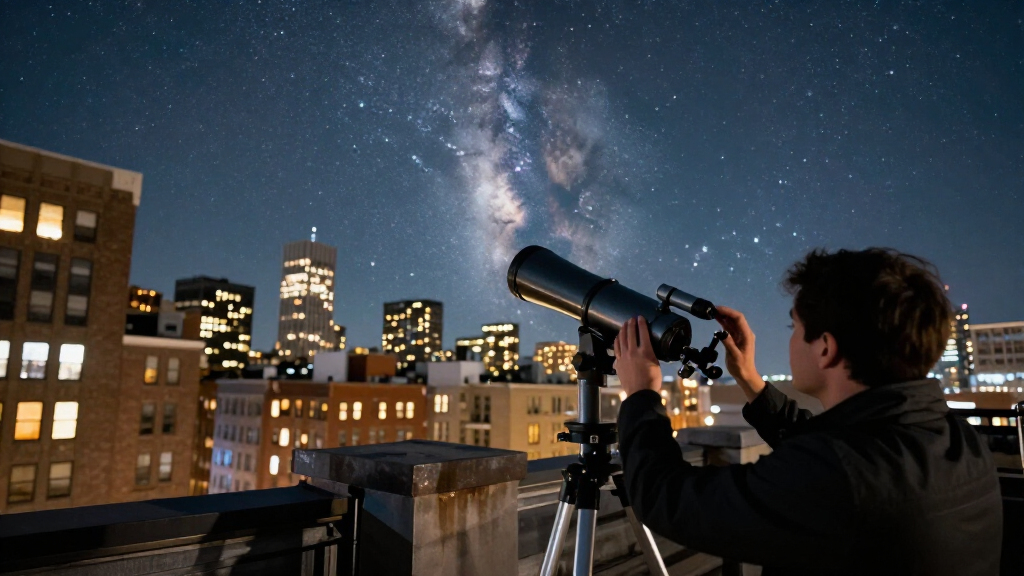
NASA’s Astronomy Picture of the Day for October 15, 2026, features the Milky Way above Manhattan in an image credited to Jason Kurth and Ty Buckley. NASA says the photograph uses a filter that blocks most visible light and captures near-infrared light, reducing the effect of some city lighting.
NASA’s Astronomy Picture of the Day for October 15, 2026, features the Milky Way above Manhattan, an urban-sky image captured with a filter that blocks most visible light and records near-infrared light. The agency’s explanation says the technique reduces light from some common city lamps, allowing stars that are also bright in near-infrared to appear in the photograph.
The image is credited to Jason Kurth and Ty Buckley. NASA’s APOD page describes the photograph as showing the Milky Way in a sky where city lights would ordinarily outshine many stars. The agency says the image was made using a filter that blocks most visible wavelengths and captures light in the near-infrared region, which has lower energy than visible light.
NASA’s explanation distinguishes between different kinds of artificial lighting. It says incandescent bulbs and some neon lights remain bright in near-infrared, while fluorescent and LED bulbs do not. Stars also emit near-infrared light, the page says, enabling the photographer’s setup to reduce much of the city’s visible-light pollution while retaining a view of the Milky Way.
The page presents the image as a reminder that people share the same sky and that astronomy can help explain humanity’s place in the cosmos. APOD is a daily NASA feature pairing an image or photograph with an explanation written by a professional astronomer. The October 15 entry lists Cecilia Chirenti, Robert Nemiroff, Jerry Bonnell and Keighley Rockcliffe as authors and editors.
How Near-Infrared Reveals City Stars
The photograph illustrates how the wavelength being recorded can affect what an urban sky image shows. Manhattan’s artificial lighting overwhelms many stars in ordinary visible-light views, but the filter described by NASA blocks most visible light and captures a different part of the spectrum. Because some city lamps produce less near-infrared light than visible light, the resulting image can show stars against a less dominant background of city illumination.
This is an explanation of a photographic technique, not evidence that the city’s light pollution has gone away or that the Milky Way is easily visible to the unaided eye from Manhattan. The image instead points to how specialized imaging can reveal astronomical features that are difficult to see under bright urban skies. For readers, it offers a concrete example of how astronomers and astrophotographers adapt observations to conditions on the ground.
near-infrared camera filter for astrophotography
As an affiliate, we earn on qualifying purchases.
As an affiliate, we earn on qualifying purchases.
NASA’s Daily Astronomy Feature
Astronomy Picture of the Day publishes a different image or photograph each day alongside a short explanation. NASA describes the feature as an introduction to the cosmos, with the explanation written by a professional astronomer. The October 15 post is an image feature rather than a report of a new discovery, telescope mission or change in Manhattan’s lighting.
The entry’s central point is the use of near-infrared rather than ordinary visible-light photography. NASA notes that the filter blocks most visible light, while the photographer’s setup takes advantage of differences in how artificial light sources appear in near-infrared. The source does not provide technical camera settings, exposure details or a precise account of where in Manhattan the photograph was taken.
The APOD page also lists its service contributors as NASA’s Astrophysics Science Division at Goddard Space Flight Center, NASA Science Activation and Michigan Technological University. Its next listed image is titled “Chasing the ISS.”
urban light pollution reduction filter
As an affiliate, we earn on qualifying purchases.
As an affiliate, we earn on qualifying purchases.
Image Details Not Provided by NASA
NASA’s post does not specify the photograph’s exact location, date or exposure settings. It also does not identify the particular filter model or quantify how much artificial light the setup blocked. The page’s explanation describes broad differences among lamp types; it does not claim that all city light is removed or that every source of illumination behaves identically.
The entry does not state that the Milky Way would appear this clearly to someone looking up without imaging equipment. The confirmed information is that the credited photograph was made with a near-infrared filter and that NASA selected it for the October 15 APOD. Further claims about the photographer’s precise process or the visibility of the band to the naked eye would require information not included in the source.
As an affiliate, we earn on qualifying purchases.
The Next APOD Is an ISS Image
NASA’s APOD page lists “Chasing the ISS” as the picture for the following day. The service is designed to feature a new image or photograph each day, but the October 15 post does not provide further details about the next entry beyond its title.
For the Manhattan photograph, no additional release, follow-up measurement or observing event is announced. Readers seeking more technical specifics would need information from the photographers or a fuller account of the image’s capture conditions; those details are not included in NASA’s APOD explanation.
As an affiliate, we earn on qualifying purchases.
Key Questions
What did NASA feature on October 15, 2026?
NASA’s Astronomy Picture of the Day featured a photograph of the Milky Way over Manhattan, credited to Jason Kurth and Ty Buckley.
How was the Milky Way captured above the city?
NASA says the image used a filter that blocks most visible light and captures near-infrared light. The explanation says stars are bright in near-infrared, while fluorescent and LED lights are not.
Does the photograph mean the Milky Way is plainly visible from Manhattan?
Not necessarily. NASA describes a photograph made with a specialized filter; it does not say the Milky Way is easily visible to the naked eye from Manhattan.
Which city lights can still appear in near-infrared?
NASA’s explanation says incandescent bulbs and some neon lights remain bright in near-infrared. It says fluorescent and LED bulbs do not.
What is NASA’s next listed Astronomy Picture of the Day?
The October 15 entry lists the following day’s picture as “Chasing the ISS.”
Source: primary
Halloween Picks
halloween
As an affiliate, we earn on qualifying purchases.