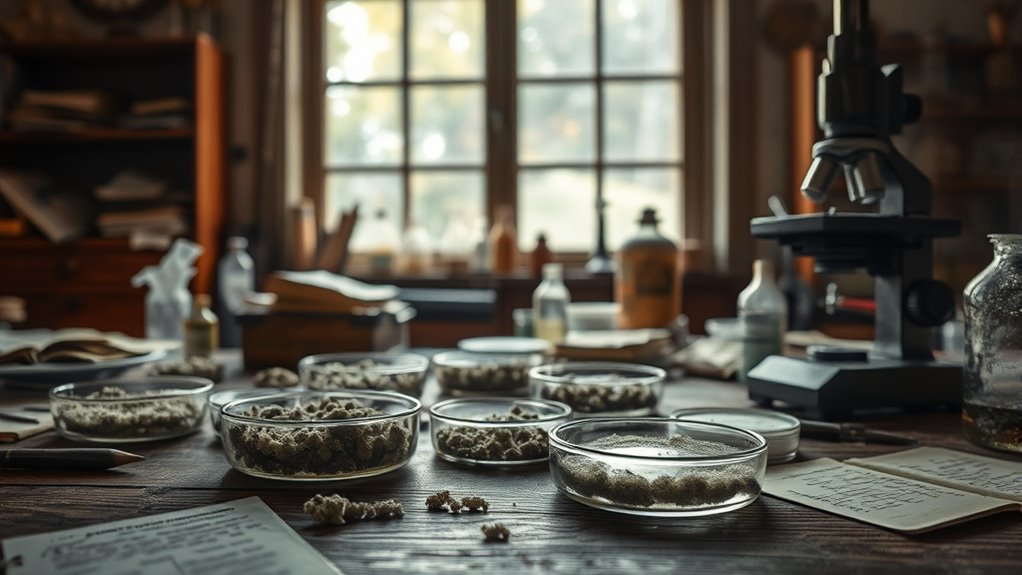
In 1928, Alexander Fleming accidentally discovered penicillin when mold grew on his petri dish and killed nearby bacteria. This unexpected event sparked the first true antibiotic, changing medicine forever. It allowed doctors to treat bacterial infections effectively, saving countless lives during wartime and peacetime. Over time, the production process improved, but resistance issues emerged. If you continue exploring, you’ll uncover how this simple accident led to a medical revolution and ongoing challenges.
Key Takeaways
- Alexander Fleming discovered penicillin accidentally in 1928 when mold killed bacteria on a petri dish.
- This accidental discovery marked the first effective antibiotic, transforming infectious disease treatment.
- Penicillin’s development enabled the shift from symptom management to bacterial eradication.
- Its widespread use led to microbial resistance, highlighting the need for responsible antibiotic stewardship.
- Penicillin’s discovery inspired ongoing research into natural microbial sources for new medicines.

Have you ever wondered how a simple mold changed medicine forever? The discovery of penicillin was a groundbreaking moment that transformed healthcare and saved countless lives. It all started with Alexander Fleming’s accidental observation in 1928, when he noticed a mold growing on a petri dish that had killed the bacteria around it. This seemingly small event led to the development of the first true antibiotic, revolutionizing the way we fight infectious diseases. Before penicillin, infections like pneumonia, syphilis, and strep throat often resulted in death or severe disability. The ability to target bacteria directly marked a new era in antibiotic development, changing medicine from a mostly palliative practice to one capable of curing bacterial illnesses.
A mold’s accidental discovery in 1928 revolutionized medicine with the first antibiotic, saving countless lives from bacterial infections.
As scientists began to understand how penicillin worked, they faced the challenge of producing it in large quantities to meet the growing demand. This was no small feat, as early efforts involved cultivating the mold and extracting tiny amounts of the antibiotic. Despite these hurdles, penicillin proved highly effective against many bacterial infections, drastically reducing mortality rates. Its success prompted a surge of interest in discovering other antibiotics, fueling a wave of scientific innovation aimed at combating bacterial pathogens. The impact was immediate and profound, especially during World War II, when penicillin saved countless wounded soldiers from deadly infections.
However, the widespread use of penicillin also led to unforeseen problems, such as microbial resistance. Bacteria are incredibly adaptable; over time, they evolved mechanisms to survive even in the presence of antibiotics. This microbial resistance threatened to undermine the very foundation of antibiotic development, making infections harder to treat. It became clear that while antibiotics like penicillin revolutionized medicine, their continued effectiveness depended on responsible use and ongoing research. Today, antibiotic resistance remains a significant concern, emphasizing the need for new drugs and strategies to stay ahead of evolving bacteria. Vetted – Grobal World
You might not realize it, but the discovery of penicillin set the stage for modern medicine’s battle against infectious disease. It demonstrated how a natural substance could be harnessed to develop life-saving drugs, inspiring generations of scientists to explore microbial sources for new medicines. Yet, it also showed us the importance of stewardship—using antibiotics wisely to prevent resistance from spiraling out of control. The story of penicillin is a reminder that even the simplest discoveries can have profound and lasting impacts, shaping the future of healthcare. In the ongoing fight against microbial resistance, the lessons learned from penicillin remain more relevant than ever.
antibiotic medication storage box
As an affiliate, we earn on qualifying purchases.
As an affiliate, we earn on qualifying purchases.
Frequently Asked Questions
Who Was Alexander Fleming’s Main Inspiration for His Research?
You should know that Alexander Fleming’s main inspiration for his research came from his interest in bacteria and infectious diseases, influenced by historical influences like earlier discoveries in microbiology. His scientific mentorship by prominent scientists also played a pivotal role, guiding his curiosity and methods. These factors combined to motivate him to explore antimicrobial agents, ultimately leading to the groundbreaking discovery of penicillin, which transformed medicine forever.
How Quickly Did Penicillin Become Available for Medical Use?
You might be surprised to learn that penicillin was available for medical use within just about a decade after Fleming’s discovery. Despite distribution challenges, manufacturing breakthroughs, like mass production techniques, enabled widespread availability by the early 1940s. These advancements dramatically shortened the time from discovery to medical application, saving countless lives and transforming medicine forever. Your understanding of these rapid developments highlights how innovation can overcome logistical hurdles quickly.
Were There Any Early Challenges in Penicillin Production?
Yes, early penicillin production faced significant challenges. You’d encounter contamination issues that hindered the purity and safety of the antibiotic. Scaling difficulties also arose, making it hard to produce enough penicillin for widespread medical use. Researchers struggled to develop reliable methods for large-scale fermentation, delaying availability. Overcoming these obstacles required innovative techniques, ultimately enabling mass production and transforming medicine forever.
Did Fleming Anticipate Penicillin’s Future Impact on Medicine?
Fleming didn’t fully anticipate penicillin’s future impact on medicine, especially in combating antibiotic resistance and enabling medical breakthroughs. He recognized its potential but couldn’t foresee how it would revolutionize infection treatment or the challenges it might face, like resistance development. You can appreciate how his discovery paved the way for advancements, yet the full implications, including ongoing struggles with resistance, became clear only later through continued research and medical progress.
How Did Penicillin Influence Antibiotic Development Afterward?
You see, after penicillin’s discovery, antibiotic development skyrocketed—by 1945, 10 new antibiotics entered the market, transforming medicine. It sparked a wave of medical breakthroughs, but also led to challenges like antibiotic resistance. This development set the stage for ongoing research, emphasizing the need for new drugs to combat resistant bacteria, ensuring you understand how critical antibiotics are in saving lives and the importance of responsible use.
antibiotic resistance testing kit
As an affiliate, we earn on qualifying purchases.
As an affiliate, we earn on qualifying purchases.
Conclusion
So, you see, the accidental discovery of penicillin changed everything in medicine. It’s a perfect example of how sometimes, luck strikes when you least expect it, turning the tide against deadly infections. This breakthrough paved the way for antibiotics, saving millions of lives. Remember, in science, as in life, sometimes you’ve got to seize the moment—because fortune favors the bold. Penicillin’s story proves that big changes often come from a happy accident.
microbial culture laboratory kit
As an affiliate, we earn on qualifying purchases.
As an affiliate, we earn on qualifying purchases.
antibiotic stewardship guidebook
As an affiliate, we earn on qualifying purchases.
As an affiliate, we earn on qualifying purchases.

![The early History of the Singular Value Decomposition (1993) [pdf]](https://varietychem.com/wp-content/uploads/2026/07/the-early-history-of-the-singular-value-decomposition-1993-pdf-featured-560x300.jpg)