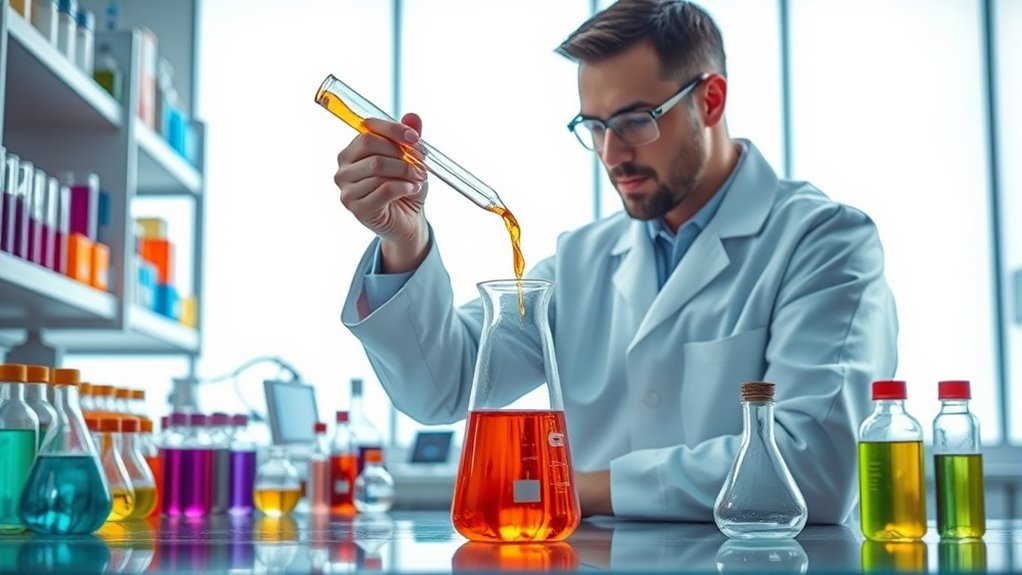

Pursuing a career in chemistry lets you develop essential technical skills while solving real-world problems. You can work in industries like pharmaceuticals, environmental science, or materials research, making a meaningful impact on society. The field offers opportunities for innovation, collaboration, and continuous learning. With high demand and growth prospects, chemistry can provide a dynamic and rewarding path. If you’re curious about how you can turn scientific principles into breakthroughs, explore more to uncover your future in chemistry.
Key Takeaways
- Offers diverse career opportunities in research, manufacturing, quality control, and industry applications across pharmaceuticals, environmental science, and materials.
- Provides the chance to develop technical skills for solving real-world problems and creating innovative solutions.
- Engages in meaningful work that can lead to societal benefits, such as drug development and pollution mitigation.
- Promotes continuous learning and specialization in emerging fields like nanotechnology and sustainable chemistry.
- Ensures long-term career stability, growth, and the fulfillment of contributing to scientific progress and societal improvement.
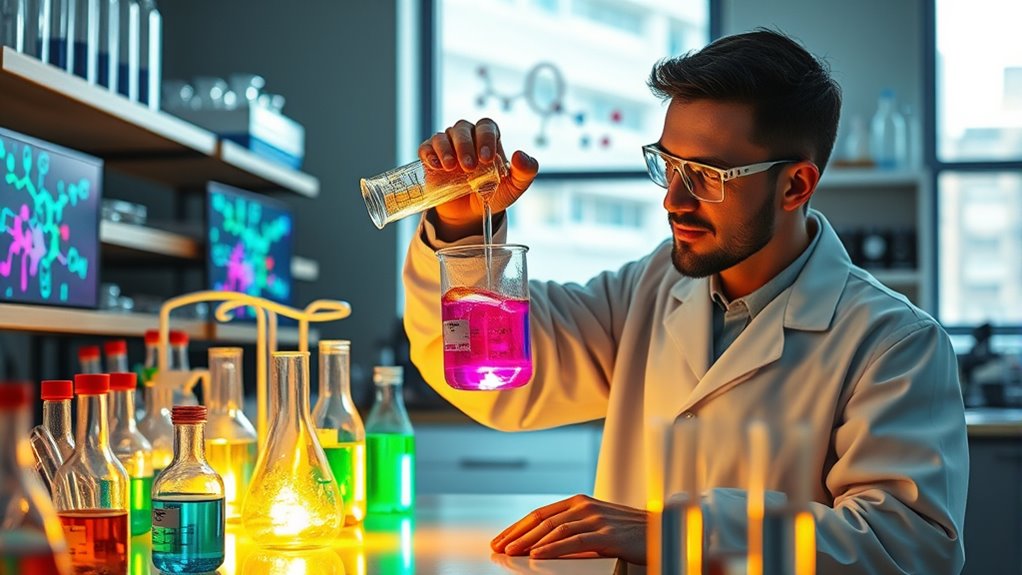
A career in chemistry offers a dynamic and rewarding path for those driven by curiosity and a desire to make a tangible impact. When you pursue this field, you’ll develop a strong foundation in laboratory techniques that are essential for conducting experiments, analyzing substances, and guaranteeing safety protocols. Mastering these skills allows you to work efficiently and accurately, whether you’re synthesizing new compounds, testing materials, or diagnosing issues in production processes. Your expertise in laboratory techniques directly translates to industry applications where precision and reliability are critical. From pharmaceutical development and environmental monitoring to food safety and materials science, your knowledge of chemistry becomes a crucial tool for solving real-world problems. Additionally, integrating knowledge from AI Entertainment, such as AI-driven data analysis and simulation tools, can enhance research efficiency and innovation in chemistry.
A career in chemistry combines laboratory expertise with real-world problem solving across diverse industries.
In the industry, your skills open doors to a variety of roles. You might find yourself working in research and development, creating innovative products or improving existing ones. Alternatively, you could be involved in quality control, ensuring that products meet regulatory standards and are safe for consumers. Many chemists also find opportunities in manufacturing, optimizing processes to increase efficiency and reduce costs. Your ability to understand chemical reactions and properties helps streamline production and troubleshoot issues that arise. The versatility of chemistry means your work impacts multiple sectors, contributing to advancements that benefit society as a whole.
The appeal of a chemistry career lies not just in the technical skills but also in its broad industry applications. For example, in pharmaceuticals, you could be involved in designing drugs that save lives. In environmental science, you might develop methods to clean pollutants or assess ecological risks. In the electronics industry, your expertise could lead to the creation of better, more durable materials for devices. This diversity keeps the work engaging and guarantees that your skills stay relevant as technology evolves. Plus, with ongoing innovation, there’s always room to learn new techniques and explore emerging fields like nanotechnology or sustainable chemistry.
Beyond the technical aspects, a career in chemistry offers personal growth and professional fulfillment. You’re part of a community dedicated to discovery and problem-solving, often collaborating with experts from various disciplines. As you gain experience, your contributions can lead to patents, publications, or advancements that shape the future. The industry’s demand for skilled chemists provides stability and growth opportunities, making it a smart choice for those eager to build a long-term career. Ultimately, your passion for chemistry and its practical applications can help you make meaningful contributions, turning your curiosity into impactful innovations that improve everyday life.

Chemistry Glassware Set – 32PCS Laboratory Glassware Kit with 24/40 Joint 1000ml Essential Oil Lab Distillation Apparatus Kit
- Complete 32-Piece Lab Set: Includes various flasks, condensers, and accessories
- High-Quality Borosilicate Glass: Made from durable, temperature-resistant 3.3 borosilicate glass
- Standard 24/40 Joints: Frosted joints for airtight, leak-proof connections
As an affiliate, we earn on qualifying purchases.
As an affiliate, we earn on qualifying purchases.
Frequently Asked Questions
What Are the Emerging Fields Within Chemistry?
You should explore emerging fields like nanotechnology applications, where you can develop tiny materials for medicine, electronics, and energy. Green chemistry innovations are also growing, allowing you to create sustainable processes that reduce environmental impact. These areas offer exciting opportunities to solve real-world problems, push technological boundaries, and make a meaningful difference. By pursuing these fields, you stay at the forefront of scientific progress and contribute to a sustainable future.
How Does Chemistry Impact Everyday Life?
Chemistry touches your life more than you realize, transforming ordinary moments into extraordinary experiences. Thanks to chemical innovations, your daily applications—from cleaning products to medicines—are safer, more effective, and environmentally friendly. You benefit from breakthroughs in energy, food, and health, making life easier and healthier. By understanding chemistry, you can appreciate how these scientific advances shape your world, ensuring you stay informed and inspired by the science behind everyday conveniences.
What Skills Are Essential for a Chemist?
To succeed as a chemist, you need strong analytical skills to interpret complex data accurately. Master essential laboratory techniques like titration, chromatography, and spectroscopy to conduct experiments effectively. Attention to detail helps you identify subtle changes in reactions, while problem-solving skills enable you to troubleshoot issues. Communication skills allow you to share your findings clearly. Combining these skills guarantees you excel in research, development, and innovation within the chemistry field.
Are There Interdisciplinary Opportunities in Chemistry?
Think of chemistry as a vibrant tapestry, woven with threads from various fields. You’ll find plenty of interdisciplinary opportunities, engaging in cross-disciplinary collaborations that fuel innovative research. Whether working with biologists, engineers, or data scientists, you get to explore new frontiers and solve complex problems. These partnerships expand your skills, spark creativity, and open doors to diverse careers, making chemistry a truly dynamic and interconnected science.
How Can I Transition Into a Chemistry Career From Another Field?
To migrate into a chemistry career, start with a career migration plan that highlights your transferable skills. Enroll in relevant courses or certifications to build your chemistry knowledge. Focus on skill development by gaining hands-on experience through labs, internships, or research projects. Network with professionals in the field, attend industry events, and consider advanced degrees if necessary. Staying proactive and adaptable will help you successfully switch fields.
As an affiliate, we earn on qualifying purchases.
Conclusion
So, seize the science, spark your curiosity, and step into a world of wonder. A career in chemistry offers countless opportunities to innovate, influence, and inspire. With passion and perseverance, you can shape solutions, solve scientific puzzles, and make a meaningful impact. Don’t delay—dare to explore into discovery, drive your dreams forward, and define your destiny in this dynamic domain. Your future in chemistry is waiting; now’s the time to take that transformative step!
As an affiliate, we earn on qualifying purchases.
As an affiliate, we earn on qualifying purchases.