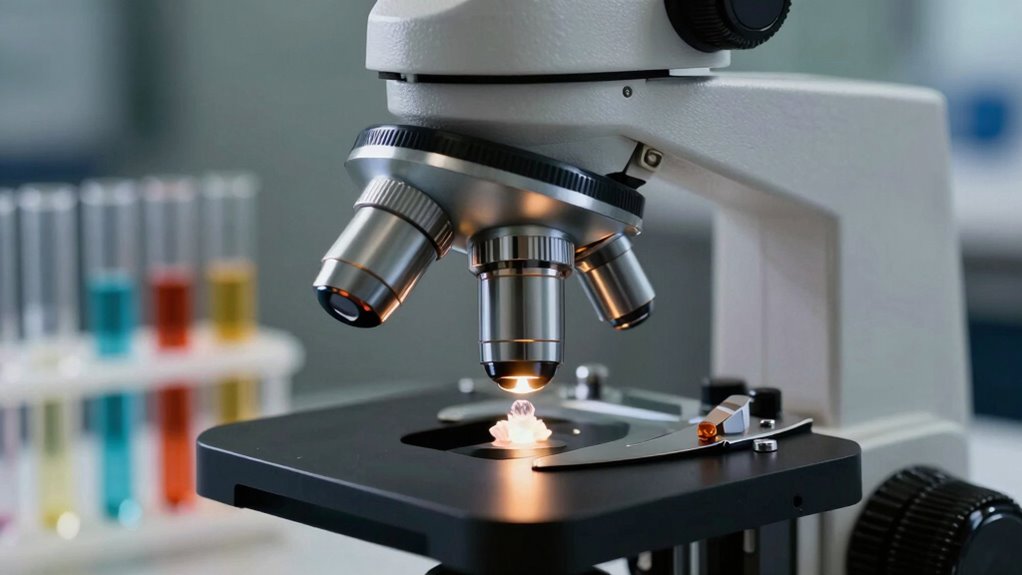

Microscopes support your work in chemistry and materials by revealing structures at micro- and nanoscales, allowing you to see how materials are arranged, shaped, and how they change under different conditions. They help analyze surface features, chemical compositions, and defects that affect performance. Combining multiple techniques, microscopes enable you to explore dynamic processes and develop advanced materials with precision. Keep exploring to discover how these tools uncover deeper insights into material behavior and innovations.
Key Takeaways
- Enable visualization of nanostructures, defects, and morphological features crucial for understanding material properties.
- Provide high-resolution surface imaging to analyze texture, roughness, and coatings impacting performance.
- Allow real-time, atomic-scale observation of structural changes under environmental conditions.
- Facilitate elemental and chemical analysis to link composition with material behavior.
- Support multimodal techniques for comprehensive, integrated insights into material structure and function.

Microscopes play a crucial role in advancing research in chemistry and materials science by allowing scientists to observe structures at the microscopic and nanoscopic levels. When you use high-powered microscopes, you gain insights into the fundamental building blocks that make up materials and chemical compounds. This level of detail is essential for nanostructure analysis, where understanding the arrangement, size, and shape of nanometer-scale features can reveal how materials behave and interact. By examining these tiny structures, you can identify defects, porosity, or unique morphological features that influence properties like strength, conductivity, or reactivity.
Microscopes reveal nanoscale structures that determine material properties and behaviors.
Surface characterization is another key aspect supported by microscopes. When you analyze surfaces at the micro- and nanoscale, you uncover details about surface roughness, texture, and coatings that directly impact material performance. For example, in developing new catalysts or protective coatings, understanding surface features helps optimize their effectiveness and durability. Electron microscopes, such as SEM (scanning electron microscopes), are especially valuable for this purpose, providing clear images that reveal surface topography and composition at high resolution. This detailed surface information enables you to tailor materials for specific applications, ensuring they meet desired criteria.
Advanced microscopy techniques also facilitate the study of how materials respond to environmental changes. You can observe how nanostructures evolve when exposed to heat, chemicals, or mechanical stress. This dynamic insight supports the development of more resilient materials and smarter chemical processes. Furthermore, microscopes allow you to perform elemental analysis through techniques like EDS (energy-dispersive X-ray spectroscopy), giving you a deeper understanding of the chemical composition at particular sites. This capability is crucial for correlating structural features with chemical makeup, thereby driving innovations in material design. Additionally, microscopy advancements continue to expand possibilities in observing dynamic processes at the nanoscale, providing real-time insights that were previously unattainable. These advancements also enable you to better understand atomic-scale phenomena, opening new avenues for scientific discovery. Moreover, the integration of multimodal microscopy techniques allows for a more comprehensive analysis by combining different imaging and analytical methods to obtain a complete picture of material properties.
In addition, the ability to visualize and analyze nanostructures enables you to innovate in fields such as nanotechnology, biomaterials, and electronics. For instance, you might investigate nanowires, quantum dots, or layered materials, all of which require precise imaging at the atomic scale. By combining surface characterization and nanostructure analysis, microscopes empower you to manipulate and engineer materials at an unprecedented level of precision. This synergy accelerates research, allowing you to develop new materials, improve existing ones, and deepen your understanding of complex chemical phenomena. The integration of multiple microscopy techniques further enhances your capacity to comprehensively analyze material properties at different scales. Overall, microscopes serve as indispensable tools that underpin the ongoing progress in chemistry and materials science by transforming microscopic observations into tangible scientific advancements. An understanding of microscopic structures is essential for pushing the boundaries of material innovation and application.

Scanning Electron Microscopy and X-Ray Microanalysis: Third Edition
As an affiliate, we earn on qualifying purchases.
As an affiliate, we earn on qualifying purchases.
Frequently Asked Questions
How Do Microscopes Enhance Chemical Reaction Observations?
You use microscopes to enhance chemical reaction observations by providing optical clarity and high magnification. These tools allow you to see reactions at a cellular or molecular level, revealing details invisible to the naked eye. With advanced magnification techniques, you can observe changes in reaction rates, formation of new compounds, or interactions of molecules in real-time. This detailed view helps you better understand complex chemical processes and improve experimental accuracy.
What Are the Limitations of Microscopes in Materials Analysis?
Microscopes can be as limited as a tiny fish in an ocean of details. You might struggle with sample preparation, which affects your results, and optical resolution, which confines how much detail you can see. These constraints mean you might miss critical features or misinterpret structures. Despite their power, microscopes can’t always reveal the full complexity of materials, so you often need complementary techniques for complete analysis.
Can Microscopes Identify Chemical Compositions Directly?
No, microscopes alone can’t directly identify chemical compositions. Instead, you use spectroscopic techniques integrated with microscopy, like Raman or FTIR spectroscopy, to analyze chemical makeup. Chemical imaging combines these methods, allowing you to visualize chemical distributions across samples at high resolution. This approach helps you link microscopic structures to their chemical properties, providing an all-encompassing understanding essential for advanced materials research and chemistry applications.
How Do Microscopes Contribute to Nanotechnology Development?
Microscopes are like treasure maps guiding you through nanoworlds. They enable precise nano fabrication by allowing you to manipulate materials at atomic scales. With advanced surface imaging, you can explore surface structures with incredible detail, essential for developing new materials. This helps you push boundaries in nanotechnology, creating innovations in electronics, medicine, and materials science—unlocking tiny worlds with big potential.
What Safety Precautions Are Necessary When Using Microscopes?
When using microscopes, you need to prioritize safety by practicing proper sample preparation to prevent contamination and guarantee clear results. Always handle specimens carefully and use gloves if necessary. Maintain ergonomic safety by adjusting the microscope height and your posture to avoid strain. Keep the workspace clean and free of clutter, and never force the lenses or stage. Regularly check equipment for damage to ensure safe operation.

Digital Microscope for Skin Analysis, 1000X 1080P HD Wireless USB Skin Camera with Stand, Portable Scalp & Hair Follicle Magnifier, Personal Beauty Tool Compatible with Phone/PC for Home & Salon
- Professional Skin & Scalp Analysis: Includes stand and calibration ruler for detailed examination
- 1000X HD Zoom with Adjustable LED: High-definition clarity with 50X to 1000X zoom and adjustable lighting
- Wireless and Wired Connectivity: Connect via WiFi for cordless use or USB for stable connection
As an affiliate, we earn on qualifying purchases.
As an affiliate, we earn on qualifying purchases.
Conclusion
Microscopes truly revolutionize your work in chemistry and materials science, helping you uncover details invisible to the naked eye. Did you know that electron microscopes can resolve structures as small as 0.2 nanometers? This incredible precision allows you to analyze materials at an atomic level, leading to breakthroughs in innovation. With these powerful tools, you can push the boundaries of discovery and develop new materials that shape the future.

SVBONY SV189 Microscope Camera, Digital Attachment Lens, 1.3 Million Pixel
- High-Resolution Imaging: 1.3 million pixels for detailed images
- Time-Saving Observation: Capture specimens directly without eye strain
- Wide System Compatibility: Compatible with MAC OS10.5+ and Windows Vista/7/8/10
As an affiliate, we earn on qualifying purchases.
As an affiliate, we earn on qualifying purchases.

SURFACE TOPOGRAPHY OF ETCHED ICE CRYSTALS OBSERVED BY A SCANNING ELECTRON MICROSCOPE
As an affiliate, we earn on qualifying purchases.
As an affiliate, we earn on qualifying purchases.