

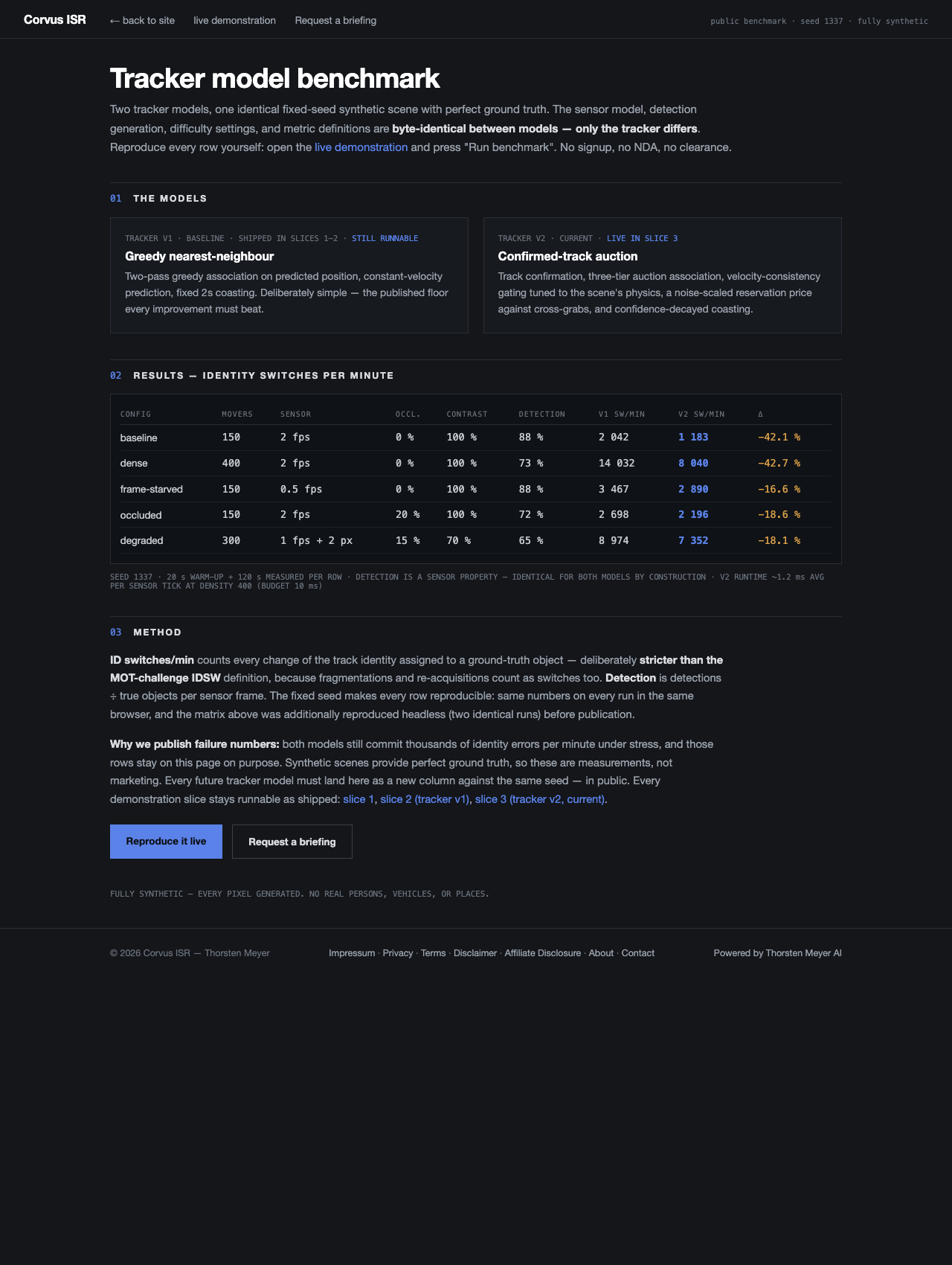
Corvus ISR, known for its wide-area motion imagery (WAMI) exploitation solutions, has released a public tracker benchmark that rigorously compares two different tracking models on a synthetic scene with perfect ground truth. This approach ensures a high level of control and precision, allowing for detailed analysis of each model’s performance without the ambiguities found in real-world data. Synthetic scenes provide an ideal environment for benchmarking, fully eliminating noise and unpredictability inherent in real data, and instead focusing purely on algorithmic effectiveness.

Prime made for students and young adults
- Fast, free delivery for dorm and study essentials
- Prime Video and Amazon Music included
- Member-only deals
The benchmark pits an older, baseline model—v1, known as “greedy nearest-neighbour”—against the newer, more sophisticated v2, called “confirmed-track auction”. The v1 model employs a straightforward, two-pass greedy association with constant-velocity prediction and fixed 2-second coasting, serving as a solid published baseline. In contrast, v2 uses advanced techniques like three-tier auction association, velocity-consistency gating, and noise-scaled reservation pricing, representing the state-of-the-art in tracker development. The comparison was performed on identical fixed seed data, ensuring that the only difference was the tracking algorithm itself.
Results reveal that v2 significantly outperforms v1 in terms of ID switches per minute. For example, in a scenario with 150 movers running at 2fps, v1 logged 2,042 switches, while v2 reduced this to 1,183—a decrease of 42.1%. Similar improvements are seen with higher densities, with 400 movers dropping from 14,032 to 8,040 switches, a 42.7% reduction. The benchmark also tested under resource-constrained conditions, such as frame-starved (0.5fps) and occluded (20%) scenarios, where v2 maintained fewer identity errors, demonstrating robustness across various stress tests.
One critical aspect of this methodology is its strict metric honesty. The ID switch count includes every change of identity assigned to a ground-truth object—more rigorous than typical MOT-challenge definitions, as re-acquisitions and fragmentation are counted too. By publishing these failure numbers, Corvus ISR emphasizes transparency; every future tracker must produce comparable results against the same seed, fostering a culture of measurement over marketing hype. This approach underscores the importance of honest benchmarking in advancing the field and setting clear expectations for real-world performance.
From an engineering perspective, v2 demonstrates impressive efficiency, averaging approximately 1.2 milliseconds per sensor tick at the highest density of 400 objects, with a worst-case around 5 milliseconds—well within a 10-millisecond real-time processing budget. This performance is verified in the live demo where anyone can reproduce the benchmark by simply clicking the “Run benchmark” button—no signup or NDA required.
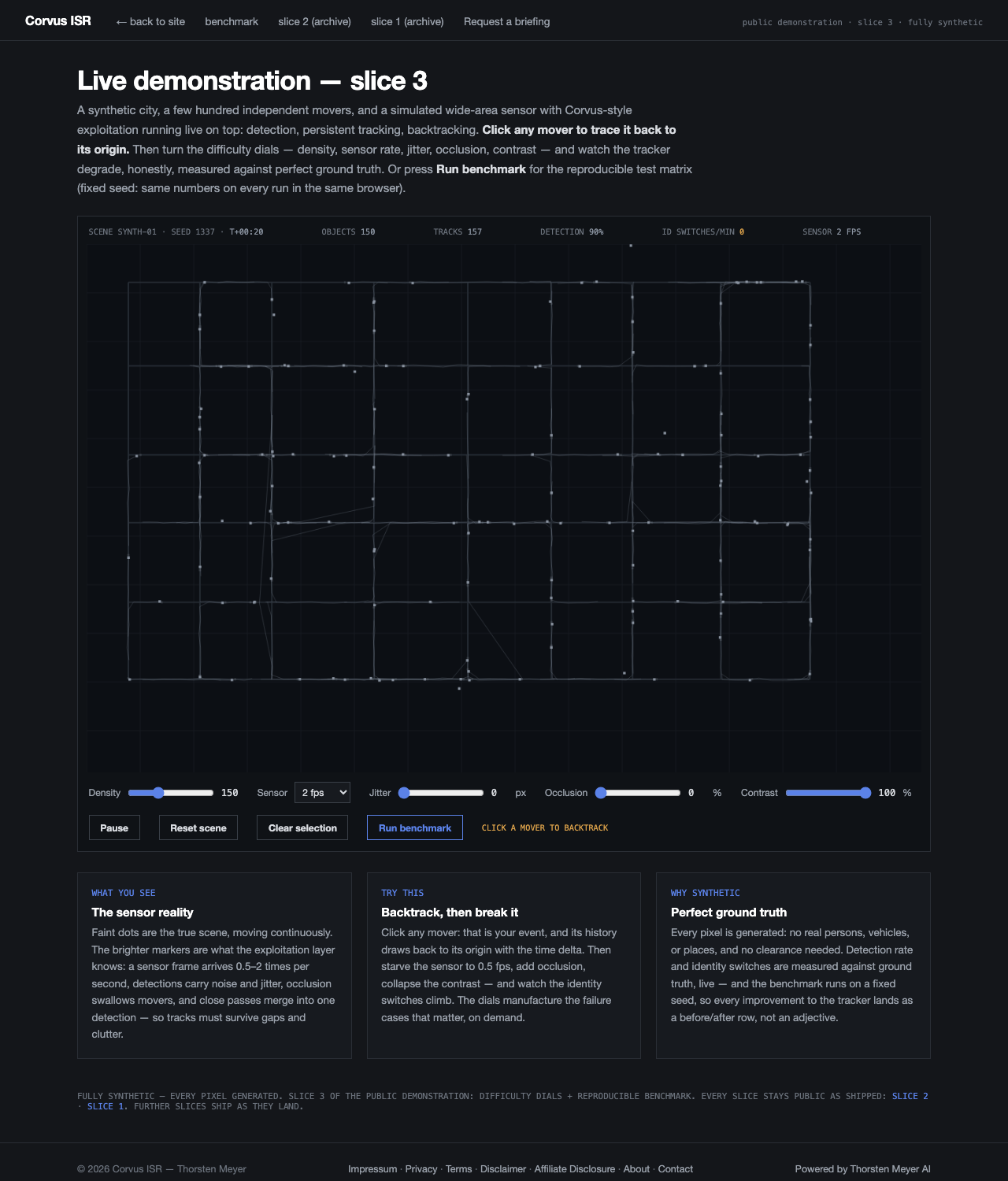
All of the benchmarks are conducted within a fully synthetic environment, where every pixel is generated, and no real persons, vehicles, or locations are involved. This synthetic approach enables an exact measurement of algorithmic performance, free from the confounding variables present in real-world data. Publishing failure metrics alongside success stories promotes transparency and accountability—key factors in progressing tracker technology. As synthetic scenes provide perfect ground truth, they serve as an invaluable tool for developers aiming to improve their algorithms systematically.
For science-minded readers, understanding the methodology behind these benchmarks reveals why synthetic, fixed-seed environments are critical for objective evaluation. They allow researchers to isolate the tracker’s capabilities, measure its weaknesses precisely, and compare improvements across versions. This transparent, data-driven approach exemplifies best practices in AI and computer vision evaluation, encouraging the community to adopt similar standards. Anyone interested can explore the public benchmark and reproduce it live—and run the benchmark themselves to see how their algorithms perform under controlled conditions.
As an affiliate, we earn on qualifying purchases.
synthetic scene benchmarking tools
As an affiliate, we earn on qualifying purchases.
As an affiliate, we earn on qualifying purchases.
As an affiliate, we earn on qualifying purchases.
As an affiliate, we earn on qualifying purchases.
Halloween Picks
halloween
As an affiliate, we earn on qualifying purchases.