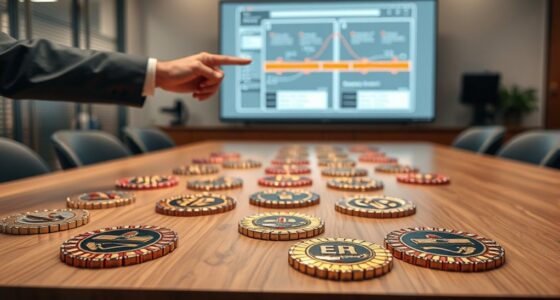
To choose the right balance, first consider what weights you’ll typically measure. Opt for a readability that matches your needs—0.1g for small samples, for example—while guaranteeing the capacity can handle the heaviest weights you expect. Aim for a balance that offers enough precision without sacrificing the ability to weigh larger items. Matching capacity and readability to your specific tasks ensures accurate results and efficiency. Keep exploring for more tips on selecting the best balance for you.
Key Takeaways
- Match the balance’s readability (e.g., 0.1g) to the smallest weights you need to measure accurately.
- Select a capacity that exceeds your maximum expected sample weight with margin for flexibility.
- Prioritize readability for precise measurements over higher capacity if small weight differences are critical.
- Balance capacity should be sufficient for your heaviest samples while maintaining measurement precision.
- Consider your typical sample sizes and measurement requirements to find an optimal balance between readability and capacity.
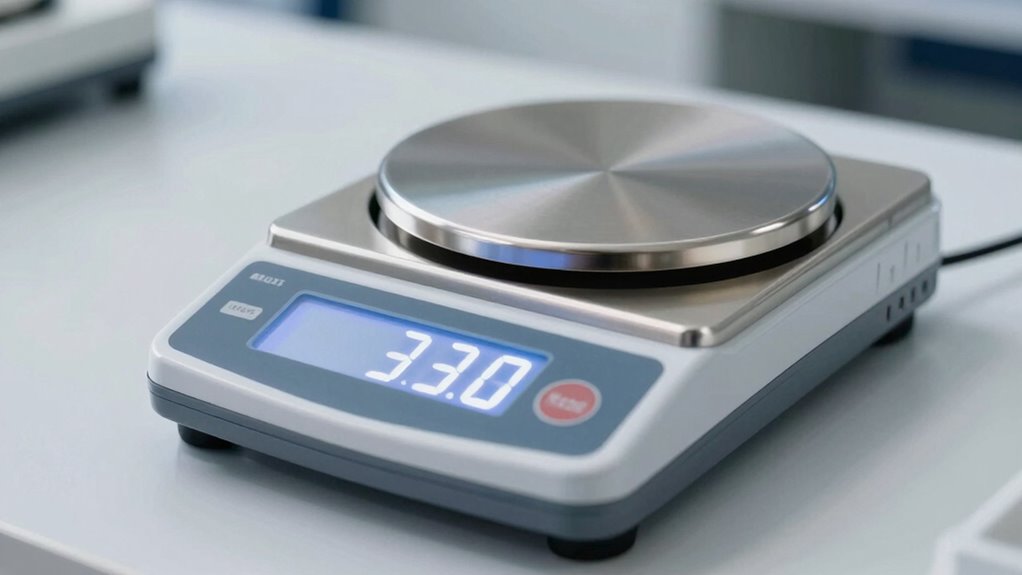
When selecting a precision balance, how do you determine the right balance between readability and capacity? It’s a crucial decision because choosing a balance with too high capacity might mean sacrificing the fine detail you need for precise measurements, while prioritizing readability could limit the maximum weight you can measure. To find this balance, start by evaluating the typical weights you’ll be measuring. If most of your samples are under 200 grams, then a balance with a readability of 0.1 grams and a capacity of 300 grams might suffice. But if you regularly work with larger samples, consider a higher capacity that still offers acceptable readability. Keep in mind that the capacity should comfortably encompass your heaviest expected load, with some margin for flexibility. Measurement range is an important factor to consider when balancing capacity and readability, especially since it directly impacts your ability to measure a variety of weights accurately. Additionally, considering the precision requirements of your work can help tailor your choice to ensure accurate results.
Next, consider how calibration procedures influence your choice. Regular calibration ensures your balance provides accurate measurements, especially when measuring at the lower range where readability is critical. A balance with clear, consistent calibration procedures will help you maintain accuracy over time. Look for models that are easy to calibrate and that come with straightforward calibration instructions. Additionally, a balance’s maintenance schedule is essential to keep it functioning reliably. If maintenance is simple and scheduled regularly, you can be more confident that your measurements will stay precise and consistent. Proper calibration and maintenance are fundamental for ensuring measurement accuracy and reliability over the lifespan of your balance. Incorporating environmental protections can further safeguard measurement accuracy in challenging conditions.
Another key factor is how often you need to use the balance. If you use it frequently, opting for a device with durable components and a robust design can reduce downtime and maintenance costs. For less frequent use, a more delicate, high-precision balance might be suitable, but ensure it’s still easy to maintain and calibrate when needed. Equally important is considering the environment in which you’ll operate the balance. Dust, vibrations, and temperature fluctuations can all affect measurement accuracy. Choose a balance with appropriate environmental protections or features designed to mitigate these factors.
Ultimately, selecting a balance that balances readability and capacity depends on understanding your specific measurement needs and maintaining it properly. Regular calibration procedures and a well-planned maintenance schedule are crucial to preserving accuracy and extending the lifespan of your equipment. By carefully evaluating these factors, you can guarantee your precision balance provides accurate, reliable results without sacrificing the capability to handle the weights you need to measure.

Bonvoisin Digital Scale 0.1 Gram Accuracy Precision Lab Scale 6000g Scientific Digital Balance for Laboratory, Jewelry Weighing
Parameter – Capacity: 6000g; readability: 0.1g; minimum weighing: 1g; tolerance: ±0.3g.
As an affiliate, we earn on qualifying purchases.
As an affiliate, we earn on qualifying purchases.
Frequently Asked Questions
How Does Environmental Temperature Affect Precision Balance Readings?
Environmental temperature affects your precision balance readings by causing fluctuations that can lead to inaccuracies. You should focus on maintaining temperature stability around the balance to guarantee consistent results. Rapid temperature changes may require more frequent calibration, so keep an eye on calibration frequency to maintain accuracy. By controlling temperature and regularly calibrating, you can minimize errors caused by environmental factors, ensuring reliable and precise measurements every time.
Can I Calibrate My Balance Myself or Need Professional Service?
You can attempt DIY calibration if your balance’s manual provides clear instructions, but think of it like tuning a musical instrument—you might hit the right note, or you might need a professional to perfect it. While small adjustments are manageable on your own, professional servicing guarantees the balance stays precise over time. Trust experts when accuracy is critical, as they bring the skill and tools to keep your balance singing in tune.
What Maintenance Is Required to Ensure Long-Term Accuracy?
To guarantee your precision balance stays accurate long-term, regularly perform calibration procedures and keep it dust protected. Calibration should be done according to the manufacturer’s instructions, ideally using certified weights. Regularly clean the balance with a soft, dry cloth to prevent dust buildup, which can affect readings. Store it in a clean, stable environment, and avoid sudden temperature changes to maintain consistent accuracy.
How Do I Handle Samples That Are Too Large or Heavy?
When handling samples that are too large or heavy, always check your balance’s weight limit to avoid damage. If your sample exceeds the capacity, divide it into smaller portions that fit within the balance’s maximum sample size. Use a container or weighing paper to hold the sample securely. This guarantees accurate readings and protects your device from overload, maintaining precision and longevity.
Are There Specific Features to Look for in a Laboratory Balance?
Think of a laboratory balance as a trusted navigator on your scientific voyage. Look for features like easy-to-read displays to guarantee clarity, and straightforward calibration procedures to keep accuracy in check. A balance with a high readability display helps you see measurements clearly, while simple calibration ensures reliable results. Also, consider durability and overload protection to safeguard your investment, making your experiments precise and hassle-free.

FOUR E'S SCIENTIFIC Lab Scale 300g x 0.001g Accuracy – High Precision Laboratory Analytical Balance with Windshield Digital Scientific Scale Jewelry/Kitchen Scale
0.001 g High Precision: This lab scale is equip with high precision strain gauge sensor to strengthen the…
As an affiliate, we earn on qualifying purchases.
As an affiliate, we earn on qualifying purchases.
Conclusion
Ultimately, selecting the right readability and capacity guarantees your balance meets your needs accurately and efficiently. Are you prepared to invest in a tool that guarantees precision and reliability for your work? By understanding your weighing requirements and future needs, you’ll make smarter choices, avoiding frustration and errors. Remember, the right balance isn’t just about numbers—it’s about empowering your work with confidence. So, why settle for less when precision is within your grasp?

RUISHAN Lab Scale 5000gx0.01g High Precision Scientific Electronic Digital Laboratory Lab Weight Analytical Balance Scale .01g Accuracy Jewelry Pharmacy Chemistry Industria Calibrated Gram Scale
✔FAST ACCURATE RESPONSE SAVES YOU TIME AND MONEY: To ensure to get the results quickly and accurately. The…
As an affiliate, we earn on qualifying purchases.
As an affiliate, we earn on qualifying purchases.

Eosphorus Science Digital Lab Scale Analytical Balance for Laboratory 0.01g Accuracy Electronic Scientific Weighing Device for Education Chemistry and Jewelry – Carats, Ounces and Grams (Blue)
High Precision – Our Ounce, Carat, and Gram Scale 0.01g Accuracy, Laboratory Scale Digital Balance is equipped with…
As an affiliate, we earn on qualifying purchases.
As an affiliate, we earn on qualifying purchases.