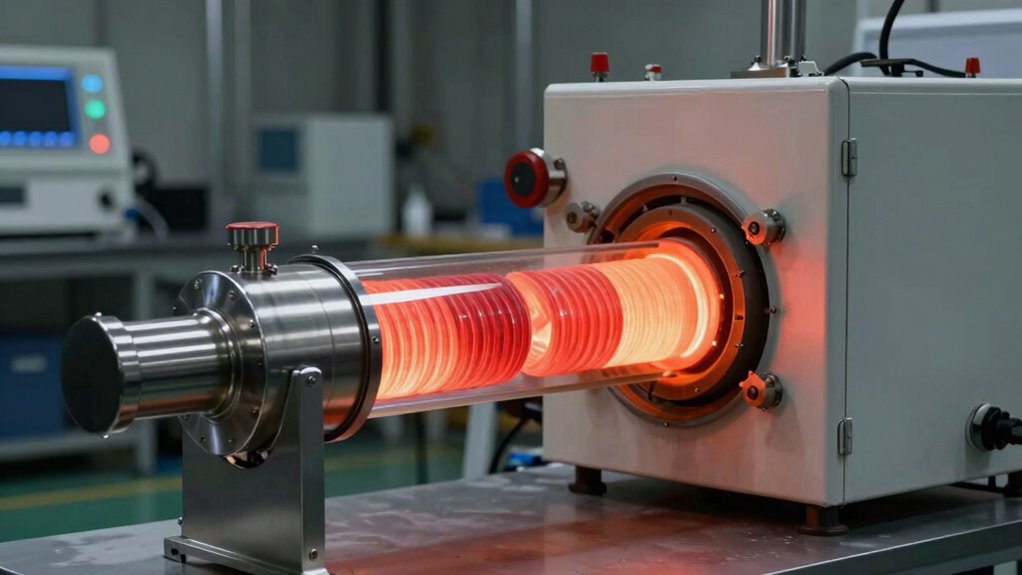

A tube furnace makes more sense than a box furnace when you need precise temperature control, uniform heating, and compatibility with reactive or sensitive materials. It’s ideal for applications requiring controlled atmospheres, such as inert gases or vacuum environments, reducing contamination risk. The energy-efficient design heats samples quickly and evenly, which is perfect for small or delicate samples. To discover more about when to choose a tube furnace over a box furnace, keep exploring.

Prime made for students and young adults
- Fast, free delivery for dorm and study essentials
- Prime Video and Amazon Music included
- Member-only deals
Key Takeaways
- When precise temperature control and uniform heating are critical for sensitive or reactive samples.
- For applications requiring controlled atmospheres, inert gases, or vacuum environments.
- When processing small, delicate, or specialized materials needing targeted and efficient heating.
- To reduce energy consumption and operational costs in high-temperature or continuous processes.
- For tasks where contamination prevention and material compatibility with aggressive atmospheres are essential.

When choosing a furnace for your laboratory or industrial processes, understanding the differences between a tube furnace and a box furnace is vital. You need to contemplate how each design handles material compatibility and energy efficiency to guarantee you select the right equipment for your specific needs. Tube furnaces are often preferred when precise control over process conditions and material compatibility are priorities. They feature a narrow, cylindrical chamber that allows you to insert materials directly into a heated tube, making it ideal for applications requiring uniform heating along a specific length. This design minimizes thermal gradients, guaranteeing your materials experience consistent temperatures, which is essential when working with sensitive or reactive substances. Because of their construction, tube furnaces are typically more compatible with a range of materials, especially when you need to heat samples in inert atmospheres or controlled environments. The tube design makes it easier to introduce gases or vacuum systems, expanding material compatibility options without risking contamination or unwanted reactions. Additionally, their chemical resistance ensures they can withstand aggressive atmospheres, making them suitable for specialized processes. Moreover, the ability to maintain a controlled atmosphere further enhances their application versatility. Advanced temperature control systems also improve the precision of process parameters, adding to their efficiency and reliability. Energy efficiency is another key factor where tube furnaces often outperform box furnaces. Their design concentrates heat within a narrow space, reducing heat loss and allowing you to reach the desired temperature faster. This targeted heating means you consume less energy overall, making tube furnaces a more cost-effective choice in the long run, especially for high-temperature or continuous processes. Plus, their ability to be precisely controlled with modern temperature controllers means you can optimize energy use, avoiding unnecessary heat loss. Incorporating temperature uniformity is also easier with tube furnaces, ensuring consistent results across samples. On the other hand, box furnaces, with their larger, more spacious chambers, tend to have higher heat capacities and may take longer to reach temperature. They are better suited for processing bulk materials or items that require uniform heating across a larger area, but this comes at the expense of higher energy consumption.
If your work involves small, delicate samples or requires specific atmospheres, a tube furnace provides better material compatibility and energy efficiency. It offers precise control, faster heating times, and lower operational costs. Conversely, if your applications involve larger quantities of materials or bulk processing, a box furnace might be more suitable, despite its higher energy demands. Ultimately, your choice hinges on understanding these differences: tube furnaces excel in precision, material compatibility, and energy efficiency, making them the smarter option for specialized, high-precision tasks.
tube furnace with precise temperature control
As an affiliate, we earn on qualifying purchases.
As an affiliate, we earn on qualifying purchases.
Frequently Asked Questions
What Industries Most Benefit From Tube Furnace Applications?
You’ll find industries like electronics, aerospace, and ceramics benefit most from tube furnace applications. They handle material compatibility well, as they’re designed for precise, high-temperature processes. Plus, safety considerations are easier to manage because you can contain reactions within the tube, reducing risks. These furnaces offer uniform heating and control, making them ideal for delicate materials and complex processes, ensuring quality and safety throughout production.
How Does Cost Compare Between Tube and Box Furnaces?
Think of cost comparison as a balancing act—you’ll find tube furnaces often have higher installation costs upfront due to their specialized design, but they can be more energy-efficient over time. This efficiency can reduce operational expenses, making them a smarter investment in the long run. Box furnaces tend to be cheaper initially, but higher energy consumption might offset those savings. So, consider both installation costs and energy efficiency when choosing.
Are Tube Furnaces Suitable for High-Volume Production?
Yes, tube furnaces are suitable for high-volume production because they offer consistent temperature control and rapid heating, boosting efficiency. Their design allows you to process materials with specific compatibility needs, ensuring minimal contamination and precise results. Plus, tube furnaces tend to be more energy-efficient due to targeted heating zones, making them a practical choice when scaling up operations. This combination of material compatibility and energy efficiency makes them ideal for continuous, high-volume tasks.
What Are the Maintenance Requirements for Tube Furnaces?
You need to regularly inspect and clean your tube furnace to maintain ideal performance. Focus on temperature control systems to guarantee accurate heating and avoid overheating. Follow safety protocols by checking for any damaged wiring or insulation, and replace worn parts promptly. Keep the interior free of debris, and calibrate temperature settings periodically. Proper maintenance extends your furnace’s lifespan, ensures safety, and keeps it operating efficiently for high-quality results.
Can Tube Furnaces Operate at Ultra-High Temperatures?
You bet a tube furnace can operate at ultra-high temperatures, but you need to pay close attention to temperature regulation and material compatibility. These furnaces are designed for precise control, making them ideal for high-temperature applications. Just keep in mind that not all materials withstand those extreme heat levels, so double-check the specifications. With proper maintenance and careful selection, your tube furnace can handle those scorching temps safely and efficiently.
high temperature tube furnace for reactive materials
As an affiliate, we earn on qualifying purchases.
As an affiliate, we earn on qualifying purchases.
Conclusion
So, when precision and high temperatures matter, a tube furnace often outperforms a box furnace. Imagine your lab reaching temperatures over 1,500°C with consistent results—almost like having a miniature sun in your workspace. If you need uniform heating and better control for your experiments, switching to a tube furnace isn’t just smart; it’s essential. Trust me, that small investment can make your research more accurate, efficient, and even inspire breakthroughs you never thought possible.
laboratory tube furnace for controlled atmospheres
As an affiliate, we earn on qualifying purchases.
As an affiliate, we earn on qualifying purchases.
energy-efficient tube furnace for small samples
As an affiliate, we earn on qualifying purchases.
As an affiliate, we earn on qualifying purchases.
Fall Picks
fall essentials
As an affiliate, we earn on qualifying purchases.