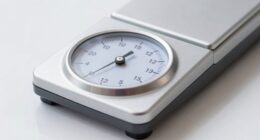
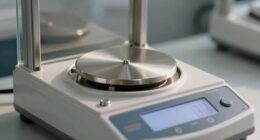
A semi-micro balance lets you measure tiny samples with high precision, down to micrograms, making it ideal for detailed analysis. In contrast, a standard lab balance handles larger, routine measurements with good accuracy but less sensitivity. You’ll need to calibrate and maintain the semi-micro balance more carefully due to environmental sensitivity. If you want to understand these differences in detail and find out which balance fits your needs, keep going.
Key Takeaways
- Semi-micro balances measure very small quantities with high precision, suitable for microgram-level accuracy, unlike standard balances for larger measurements.
- Calibration is more frequent and critical for semi-micro balances due to their sensitivity to environmental factors.
- Semi-micro balances require meticulous maintenance and controlled environments to ensure measurement accuracy.
- Standard balances are more robust, easier to maintain, and suitable for routine measurements with less sensitivity.
- Choice depends on measurement precision needs, calibration requirements, and operational environment.

When choosing a balance for your laboratory, understanding the differences between a semi-micro balance and a standard lab balance is essential. These two types of balances serve different purposes, and selecting the right one depends on your specific measurement needs. A semi-micro balance is designed to measure very small quantities with high precision, often down to the microgram level. In contrast, a standard lab balance is suited for larger measurements, typically ranging from grams to kilograms, and provides a good balance between accuracy and ease of use. Calibration procedures are crucial for ensuring the accuracy of both balances. Semi-micro balances usually require more frequent calibration due to their sensitivity to environmental factors like temperature fluctuations, drafts, or vibrations. You’ll need to follow detailed calibration procedures, often involving certified weights, to maintain precise measurements. Regular calibration not only guarantees accuracy but also extends the lifespan of your balance. Proper calibration procedures for these balances are straightforward, often requiring less frequent adjustments, but neglecting them can lead to measurement errors that compromise your results. Maintenance requirements differ between the two. Semi-micro balances demand meticulous upkeep because even minor dirt or residue can affect their delicate sensors. You should clean the weighing pan regularly, avoid exposing the balance to air currents, and store it in a controlled environment to prevent damage. The balance’s internal components may need periodic servicing to ensure consistent performance. On the other hand, standard lab balances are more robust and typically require less frequent maintenance. Regular cleaning and ensuring the device is level are usually sufficient. However, neglecting maintenance can cause inaccuracies or mechanical failures, so a routine checkup schedule is still essential. Additionally, environmental factors such as air currents and vibrations can significantly impact the accuracy of sensitive balances, making proper setup vital. Ensuring proper environmental controls can help mitigate these effects and improve measurement reliability. Proper setup and environmental controls are crucial for accuracy, especially when working with highly sensitive instruments. Selecting the appropriate balance also involves understanding the measurement environment, including factors like temperature stability and air flow, to optimize performance. Being aware of instrument sensitivity helps in choosing the right balance for your specific needs. Choosing between a semi-micro and a standard lab balance involves considering your measurement precision, calibration needs, and maintenance capacity. If your work involves precise measurements at the microgram level, investing in a semi-micro balance is worthwhile, but be prepared for stricter calibration procedures and diligent maintenance. Conversely, if your measurements are less sensitive and more routine, a standard lab balance provides a practical, cost-effective solution with simpler calibration and maintenance routines. Ultimately, understanding these differences allows you to select a balance that meets your accuracy requirements while fitting your operational capabilities.
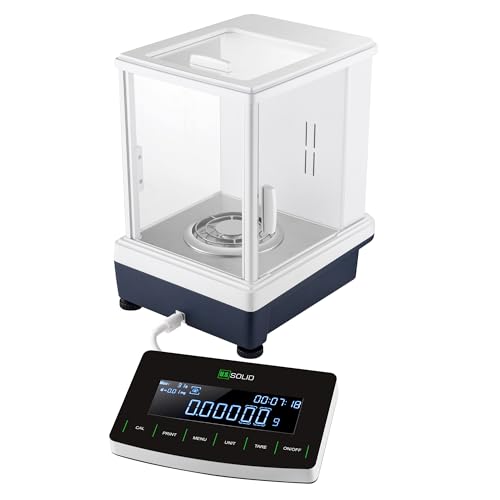
U.S. Solid Semi-Micro Analytical Balance, 31g x 0.01mg / 120g x 0.1mg, 0.00001g Readability, RS232 & USB, g/mg/oz/ct/lb/gn/ozt/DWT, Aluminum Alloy Body, Removable VA Touchable LCD Display
Stability: The use of full aluminum alloy material ensures a stable structure, providing a reliable base for accurate…
As an affiliate, we earn on qualifying purchases.
As an affiliate, we earn on qualifying purchases.
Frequently Asked Questions
What Maintenance Is Required for Semi Micro Balances?
You need to regularly perform calibration procedures to guarantee your semi micro balance stays accurate. Follow the manufacturer’s guidelines for calibration, often involving standard weights. Additionally, stick to cleaning protocols by gently wiping the balance with a soft, lint-free cloth and avoiding liquids that could damage sensitive components. Regular maintenance helps maintain precision, prolongs the balance’s lifespan, and ensures reliable measurements for your experiments.
How Do Environmental Factors Affect Balance Accuracy?
Environmental factors can drastically impact your balance’s accuracy, sometimes more than you’d expect—like a tiny breeze causing chaos. Humidity interference can lead to fluctuating readings, and temperature instability can make sensitive balances drift off calibration. To guarantee precise measurements, keep your balance in a controlled environment, away from drafts, direct sunlight, and moisture. Stable conditions help your balance perform reliably, giving you the confidence that your results are spot-on.
Are Semi Micro Balances Suitable for Field Use?
Semi micro balances aren’t ideal for field use because they lack portable accuracy and field durability. These balances are designed for controlled lab environments where precision is essential, but they’re typically fragile and sensitive to environmental factors like dust and vibrations. For field applications, you need a more rugged, portable balance that maintains accuracy despite outdoor conditions, ensuring reliable measurements wherever you go.
What Are the Cost Differences Between the Two Balances?
The semi micro balance generally costs more than a standard lab balance, with a price comparison showing a significant difference due to its higher precision features. When considering affordability, you should weigh the needs of your work against the budget, as semi micro balances are more expensive but offer greater accuracy. If high precision isn’t essential, a standard balance might be a more economical choice.
How Long Is the Typical Calibration Period?
Imagine you’re stuck in a 90s sci-fi flick—time to recalibrate! Typically, the calibration period for balances depends on their usage, but most labs recommend every few days or weekly. Semi micro balances, due to their precision, demand more frequent calibration to meet accuracy standards, especially in high-precision work. Regular calibration ensures your measurements stay reliable, preventing costly errors and maintaining consistency in your results.

Lab Scale 5000g x 0.01g, High Precision Digital Analytical Balance, 0.01g Accuracy Electronic Scale with Backlit LCD, for Laboratory, Kitchen, Jewelry, Scientific Research
Exceptional 0.01g Precision & Professional Calibration: This lab-grade digital scale offers a high capacity of 5000g with a…
As an affiliate, we earn on qualifying purchases.
As an affiliate, we earn on qualifying purchases.
Conclusion
Choosing between a semi-micro balance and a standard lab balance depends on your specific needs. While a semi-micro balance offers higher precision, some might worry about its complexity or cost. But think of it this way: investing in the right balance guarantees more accurate results, saving you time and effort in the long run. Don’t settle for less—your experiments deserve the best tools to succeed.

RUISHAN Lab Scale 5000gx0.01g High Precision Scientific Electronic Digital Laboratory Lab Weight Analytical Balance Scale .01g Accuracy Jewelry Pharmacy Chemistry Industria Calibrated Gram Scale
✔FAST ACCURATE RESPONSE SAVES YOU TIME AND MONEY: To ensure to get the results quickly and accurately. The…
As an affiliate, we earn on qualifying purchases.
As an affiliate, we earn on qualifying purchases.

AWS Gemini-20 Milligram Scale 20g x 0.001g–Digital Jewelry/Lab Scale for Powder, Gold, Gems – Includes Calibration Weights, Tweezers & Tray–Tare, Cal, 6 Units (Gemini – 20 – Silver)
WEIGHING ON-THE-GO: This scale is a MULTIFUNCTIONAL WEIGHING TOOL that can fit in your pocket; Weigh just about…
As an affiliate, we earn on qualifying purchases.
As an affiliate, we earn on qualifying purchases.