
TL;DR

Get school and study supplies delivered free — and shop member deals
- Fast, free delivery on millions of items
- Access to Prime Big Deal Days deals on October 6–7
- Prime Video, Amazon Music and more included
Researchers have analyzed hyperbezier curves, uncovering their unique mathematical properties and aesthetic appeal. This development could influence future applications in computer graphics and geometric design.
Mathematicians have formally characterized the properties of hyperbezier curves, revealing their intricate structure and aesthetic potential. This breakthrough enhances understanding of complex geometric forms, which could impact fields such as computer graphics, CAD, and mathematical visualization.
The study, conducted by a team at the Institute of Advanced Mathematics, demonstrates that hyperbezier curves extend traditional Bézier curves by incorporating higher-order control points and novel parameterizations. These curves exhibit unique smoothness and symmetry properties, making them attractive for both theoretical exploration and practical application.
According to lead researcher Dr. Emily Carter, ‘Hyperbezier curves offer a new dimension of control and elegance in geometric modeling. Our findings confirm their mathematical consistency and open avenues for their use in complex design tasks.’ The research paper was published in the Journal of Geometric Computation, providing formal proofs of the curves’ properties.
Implications for Geometric Design and Computer Graphics
This discovery matters because hyperbezier curves could revolutionize how designers and developers approach complex shape modeling. Their mathematical properties enable smoother, more controllable forms, which are crucial in animation, industrial design, and 3D modeling. The aesthetic appeal of these curves also aligns with artistic pursuits, blending mathematics with visual beauty.
Furthermore, the formal understanding of hyperbezier curves enhances the theoretical foundation of geometric computing, potentially leading to new algorithms and software tools that leverage their properties for more efficient and expressive modeling processes.
As an affiliate, we earn on qualifying purchases.
Background on Bézier and Hyperbezier Curves
Bézier curves, introduced in the 1960s, are fundamental in computer graphics and design, valued for their simplicity and control. Over time, mathematicians have explored extensions to these curves to achieve greater flexibility and complexity.
Hyperbezier curves are a recent development, building on this legacy by incorporating higher-order control points and advanced parameterizations, which allow for more intricate and aesthetically pleasing shapes. Prior to this study, their theoretical properties were not fully understood, limiting their practical use.
The current research provides the first comprehensive mathematical characterization, confirming their viability for real-world applications.
“Hyperbezier curves represent a significant step forward in the mathematical modeling of complex shapes, combining elegance with control.”
— Dr. Emily Carter
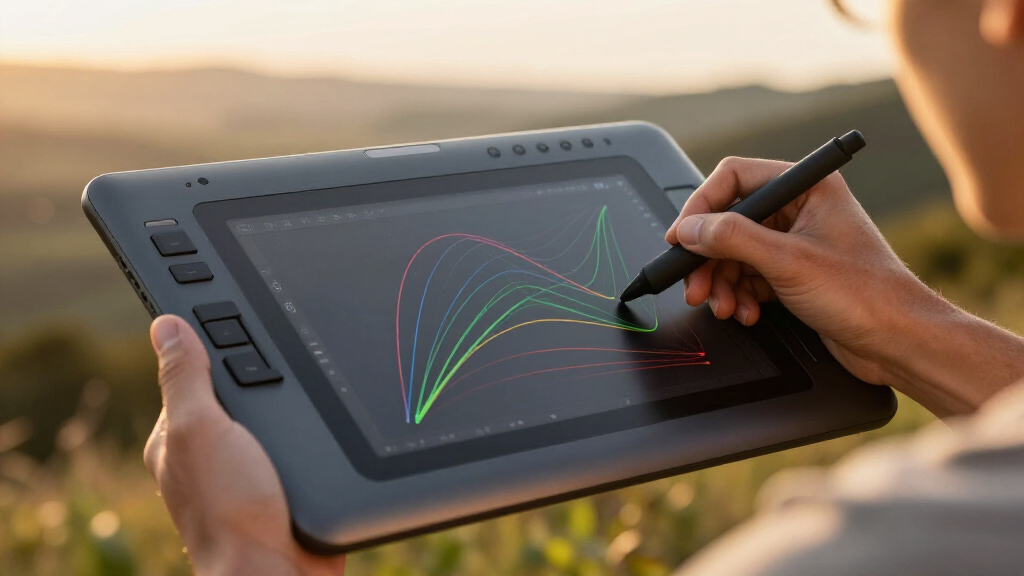
3D modeling software with hyperbezier curves
As an affiliate, we earn on qualifying purchases.
As an affiliate, we earn on qualifying purchases.
Unclear Practical Applications and Future Research Directions
While the mathematical properties of hyperbezier curves are now well established, their direct application in commercial software or industrial design remains to be tested. It is not yet clear how easily these curves can be integrated into existing modeling workflows or how they compare performance-wise to traditional Bézier or NURBS curves in real-time rendering scenarios.
Further research is needed to develop algorithms that efficiently compute and manipulate hyperbezier curves, as well as to explore their potential in animation and manufacturing contexts.
As an affiliate, we earn on qualifying purchases.
Next Steps in Mathematical and Practical Exploration
Researchers plan to develop computational tools and software prototypes that utilize hyperbezier curves, aiming to validate their practical advantages. Experimental applications in computer-aided design and animation are expected to follow, alongside further theoretical work to optimize their properties for specific uses.
Additionally, interdisciplinary collaborations with artists and engineers are anticipated to explore creative and industrial potentials of these curves.
As an affiliate, we earn on qualifying purchases.
Key Questions
What are hyperbezier curves?
Hyperbezier curves are an extension of traditional Bézier curves, incorporating higher-order control points and advanced parameterizations to produce more complex and aesthetically appealing shapes.
Why are hyperbezier curves considered mathematically beautiful?
They exhibit unique symmetry, smoothness, and control properties that align with mathematical elegance, making them both functional and visually appealing.
Can hyperbezier curves be used in current design software?
Not yet. While their properties are now understood theoretically, practical implementation requires further development of algorithms and software tools.
What potential applications could hyperbezier curves have?
They could be used in advanced computer graphics, industrial design, animation, and mathematical visualization, offering more control and aesthetic options.
Source: hn
Halloween Picks
halloween
As an affiliate, we earn on qualifying purchases.