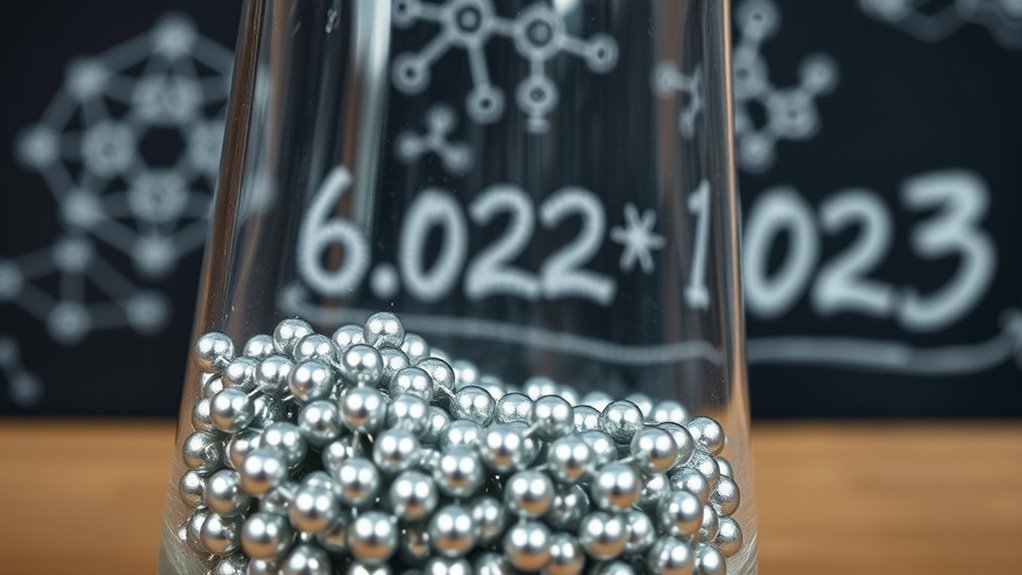

Avogadro’s number is a fundamental constant that tells you how many particles—like atoms or molecules—are in one mole of a substance, approximately 6.022 x 10²³. It helps you connect the tiny world of particles to measurable quantities like mass. This makes chemical calculations easier and more precise. Understanding why it’s important can enhance your grasp of chemistry and its practical applications, so continue exploring to learn more.
Key Takeaways
- Avogadro’s Number (6.022 x 10²³) indicates the particles in one mole of a substance.
- It links microscopic particles to macroscopic measurements in chemistry.
- Essential for converting mass to the number of atoms or molecules in calculations.
- Facilitates accurate chemical reactions and material design in labs and industry.
- Provides a standardized constant crucial for scientific precision and understanding.

Have you ever wondered how scientists measure such tiny particles as atoms and molecules? It’s a fascinating challenge because these particles are incredibly small, far beyond the reach of everyday measurement tools. To understand and work with these particles, scientists need a way to relate large quantities of atoms or molecules to something more manageable. That’s where Avogadro’s number comes into play. It provides a bridge for understanding the molecular scale, allowing us to connect the microscopic world to the macroscopic world we experience daily. Essentially, Avogadro’s number tells us how many individual particles are contained in one mole of a substance, which simplifies chemical calculations considerably.
When you perform chemical calculations, knowing the number of particles involved is vital. For example, if you want to determine how much of a substance you need to react with another, you need to connect the mass of the substance to the number of molecules or atoms involved. Without Avogadro’s number, this process would be much more complicated, as you’d have to count or estimate unimaginably tiny particles directly—something impossible in practice. Instead, you can work with moles, a convenient unit that relates mass to particles through the number 6.022 x 10²³. This number is so large that it’s almost unfathomable, yet it provides a practical way to handle atomic and molecular calculations.
Imagine you’re working in a lab, trying to determine the exact amount of a chemical needed for a reaction. You measure a certain mass of the substance, then use molar mass and Avogadro’s number to find out how many molecules or atoms that mass contains. This process hinges on the molecular scale: understanding that each molecule is incredibly tiny, but when multiplied by Avogadro’s number, the total count becomes manageable and meaningful. It’s like translating the microscopic universe into a language you can work with, so chemical reactions can be predicted and controlled accurately. Additionally, the concept of moles simplifies the process of relating mass to particle count, making complex calculations more accessible.
Without Avogadro’s number, chemists would struggle to connect the dots between the microscopic world of particles and the quantities we handle in the lab. It’s the cornerstone that makes chemical calculations precise and consistent, enabling everything from designing new materials to understanding biological processes. In essence, it’s the fundamental constant that simplifies the complex, ensuring you can work confidently with the tiny particles that make up everything around you.
Frequently Asked Questions
How Was Avogadro’s Number Originally Determined?
You might find that Avogadro’s number was originally determined through historical methods involving experimental measurements. Scientists in the early 20th century used techniques like X-ray crystallography and molar volume comparisons to estimate the number of particles in a mole. These methods allowed them to connect macroscopic measurements with atomic-scale details, ultimately leading to the precise value we use today.
Can Avogadro’s Number Change Over Time?
Avogadro’s number is like a fixed star in the sky, constant and unchanging. While it represents a precise measurement, there’s always a bit of variability because measurement techniques improve over time. However, due to its definition based on fundamental constants, it remains effectively constant. So, although measurement precision may evolve, the actual value of Avogadro’s number stays stable, ensuring consistency in scientific calculations.
How Does Avogadro’s Number Relate to Molar Mass?
You use Avogadro’s number in molar mass calculation to relate the mass of a substance to the number of particles it contains. When particle counting, it helps you convert between grams and individual atoms or molecules. This constant guarantees accurate measurements, allowing you to determine how much of a substance corresponds to a specific number of particles, making it essential for precise chemical analysis and reactions.
Why Is Avogadro’s Number Important in Chemical Reactions?
You’re really on the ball when you understand why Avogadro’s number is essential in chemical reactions. It helps you with molecular counting, ensuring you know how many particles are involved. This makes reaction stoichiometry accurate, so you can predict product yields precisely. Without it, chemistry would be a shot in the dark. It’s the key to translating microscopic events into measurable, real-world results—truly the backbone of chemistry calculations.
Is Avogadro’s Number the Same Across All Scientific Disciplines?
Yes, Avogadro’s number is the same across all scientific disciplines, ensuring unit consistency in measurements and calculations. You’ll find it essential in chemistry, physics, and even biology, where interdisciplinary applications depend on this constant. Its universal value allows scientists to accurately compare quantities, convert between units, and maintain consistency, making it a fundamental cornerstone that bridges diverse fields and supports clear, precise scientific communication.
Conclusion
Remember, a picture is worth a thousand words, and in science, Avogadro’s number helps you see the big picture. It connects the tiny world of atoms to the tangible amounts you measure in labs. Without it, understanding molecules and reactions would be nearly impossible. So, keep this number in mind—it’s the key to revealing the universe’s smallest secrets. As they say, knowledge is power, and Avogadro’s number gives you just that in the domain of chemistry.