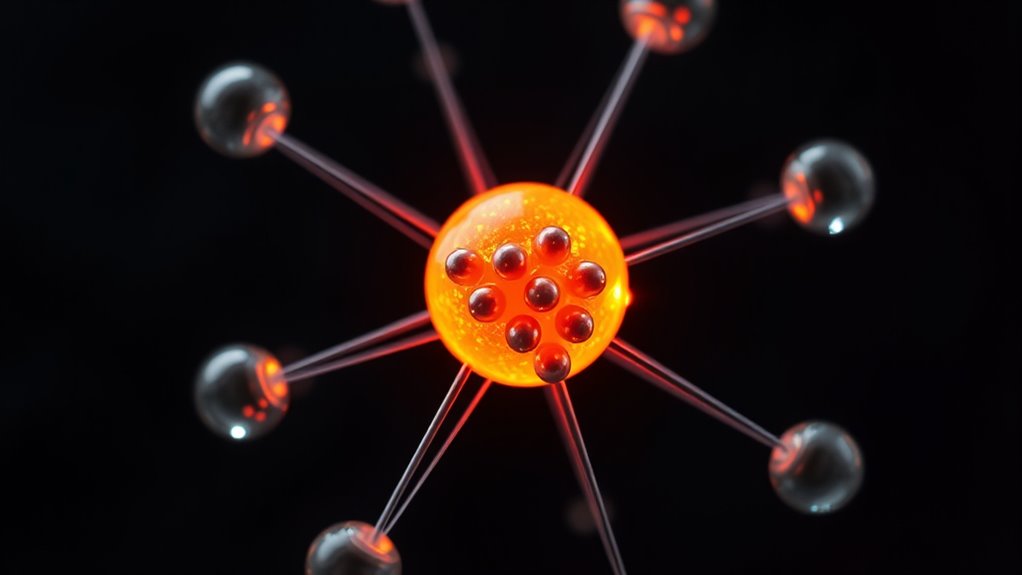

Atoms are made up of protons, neutrons, and electrons. Protons, which have a positive charge, and neutrons, which are neutral, reside in the nucleus at the center of the atom. Electrons, carrying a negative charge, move around the nucleus in regions called orbitals. The number of protons determines the element, while neutrons and electrons influence stability and chemical behavior. If you keep exploring, you’ll discover how these particles shape everything around you.
Key Takeaways
- Atoms are made up of protons, neutrons, and electrons, which determine their structure and properties.
- Protons carry a positive charge and define the element’s identity.
- Neutrons are neutral particles that help stabilize the nucleus.
- Electrons are negatively charged particles that orbit the nucleus in probabilistic regions called orbitals.
- The arrangement of electrons influences the atom’s chemical behavior and bonding capabilities.
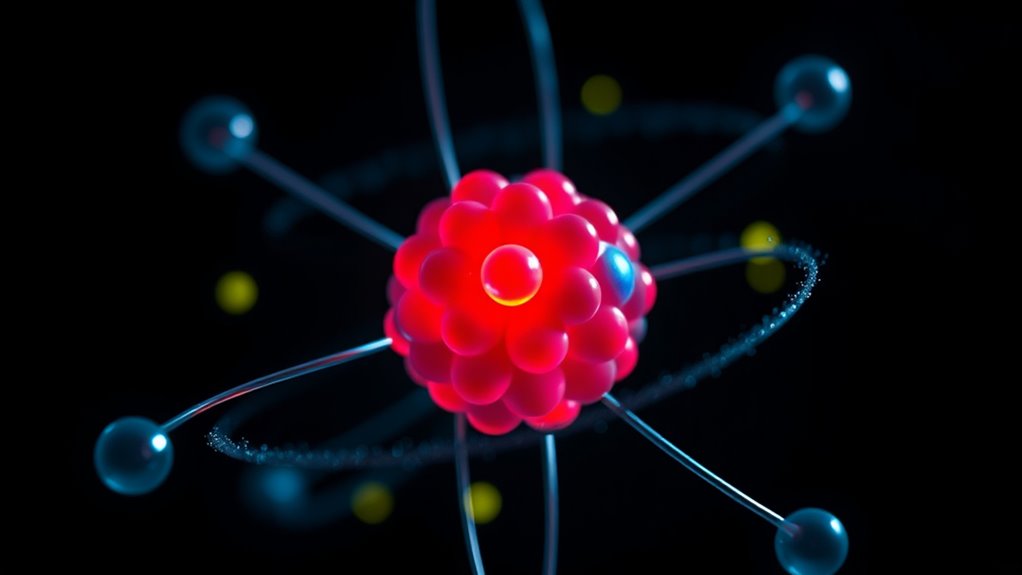
Have you ever wondered what makes up the matter around you? At the microscopic level, everything is built from tiny particles called atoms. Each atom is composed of even smaller particles: protons, neutrons, and electrons. These particles come together in specific ways to form the matter you see and touch every day. Understanding their arrangement helps you grasp the fundamentals of chemistry and physics.
Atoms are the tiny particles that make up all matter around us.
The nucleus, at the center of an atom, contains protons and neutrons. Protons carry a positive electric charge, while neutrons are neutral, meaning they have no charge. The number of protons determines the element’s identity—carbon, oxygen, or gold, for example. Neutrons add stability to the nucleus, preventing protons from repelling each other due to their positive charges. The balance between protons and neutrons influences the atom’s isotopes but doesn’t change the element itself.
Electrons, on the other hand, are tiny particles with a negative charge. They move rapidly around the nucleus in regions called atomic orbitals. These orbitals are not fixed paths like planets orbiting a star but rather regions of probability where an electron is likely to be found. Think of them as a kind of electron cloud—a fuzzy, dynamic region where electrons are constantly moving. This electron cloud isn’t a solid object but a visual representation of where electrons tend to spend most of their time.
Atomic orbitals come in different shapes and sizes, such as spherical s-orbitals or dumbbell-shaped p-orbitals. Each orbital can hold a certain number of electrons, and their arrangement determines the atom’s chemical properties. The way electrons fill these orbitals follows specific rules, like the Pauli exclusion principle and Hund’s rule, which explain why elements behave the way they do in reactions. When atoms form bonds, electrons in their outermost orbitals interact, leading to the formation of molecules.
In essence, your understanding of atomic structure hinges on how these particles are arranged. The electron cloud and atomic orbitals define where electrons are likely to be, influencing how atoms connect and interact. Meanwhile, protons and neutrons in the nucleus give the atom its identity and stability. The concept of atomic stability is crucial to understanding why atoms behave the way they do. Together, these components form the building blocks of everything around you. This tiny, complex world operates constantly and invisibly, shaping the physical universe, and it all starts with these fundamental particles and their arrangements.
Frequently Asked Questions
How Do Isotopes Affect Atomic Properties?
You’ll notice that isotopes affect atomic properties because their different isotope masses influence the atom’s overall mass and how it behaves physically. Heavier isotopes can alter nuclear stability, making some more prone to decay. These changes can impact chemical reactions, physical properties like density, and stability of the nucleus. So, understanding isotopes helps you predict variations in atomic behavior and stability across different forms of the same element.
What Is the Role of Electrons in Chemical Bonding?
Think of electrons as the connectors in a game of social bonding—they facilitate electron transfer and covalent bonding. When atoms share electrons, they form strong connections, much like best friends sharing secrets. Your role in understanding this is to see how electrons create stability and link atoms together. Without electrons, atoms couldn’t bond, just as friends can’t connect without sharing experiences. This sharing leads to the formation of molecules and compounds essential for life.
How Do Subatomic Particles Influence Atomic Stability?
Subatomic particles influence atomic stability through the electron cloud and nuclear force. The electrons in the cloud balance the positive charge of protons, preventing the atom from collapsing, while the nuclear force between protons and neutrons holds the nucleus together. You can think of the electron cloud as providing stability by managing electrical attraction and repulsion, and the nuclear force as ensuring the nucleus remains intact under nuclear interactions.
Can Atoms Have More Than a Full Outer Electron Shell?
Atoms generally don’t have more than a full outer electron shell because they’re most stable when their outer shell is complete. Regarding electron configuration, once the outer shell reaches its maximum capacity, adding more electrons isn’t typical unless the atom bonds with others. This full outer shell ensures outer shell stability, preventing the atom from reacting further. So, atoms tend to maintain a full outer shell for maximum stability.
How Do Atomic Structures Vary in Different Elements?
Think of atoms like unique houses with different layouts. You’re aware that each element’s atomic number determines its proton count, which influences its electron configuration. These configurations vary, giving each element a distinctive structure—like a fingerprint. For example, hydrogen has one electron, while carbon has six. So, the atomic structure varies based on atomic number, shaping how elements behave and interact in the universe.
Conclusion
Understanding atomic structure helps you grasp how elements behave and interact. For instance, imagine a scientist manipulating protons in a lab to create a new isotope, demonstrating how tiny changes can alter an atom’s properties. By mastering concepts like protons, neutrons, and electrons, you gain insight into everything from chemical reactions to nuclear energy. This knowledge empowers you to explore advanced topics and innovate in fields like medicine, energy, and materials science.