
Water distillation still matters in modern labs because it provides reliably pure water essential for accurate experiments. You can trust it to remove ions, microbes, and organic contaminants, ensuring consistent results. Its long-standing principles make it a cost-effective, low-maintenance choice that fits various applications. Plus, its simplicity and proven effectiveness support high-quality research. Keep exploring to find out more about why this age-old method remains a cornerstone in scientific labs today.

Prime made for students and young adults
- Fast, free delivery for dorm and study essentials
- Prime Video and Amazon Music included
- Member-only deals
Key Takeaways
- Distillation provides a proven method for producing highly pure water essential for sensitive experiments.
- It offers cost-effective, scalable solutions with low maintenance compared to alternative purification methods.
- Traditional techniques ensure consistency and reliability, crucial for maintaining experimental integrity.
- Its simplicity and robustness make it suitable for diverse laboratory applications and regulatory compliance.
- The historical foundation of distillation guarantees ongoing effectiveness and troubleshooting advantages in modern labs.
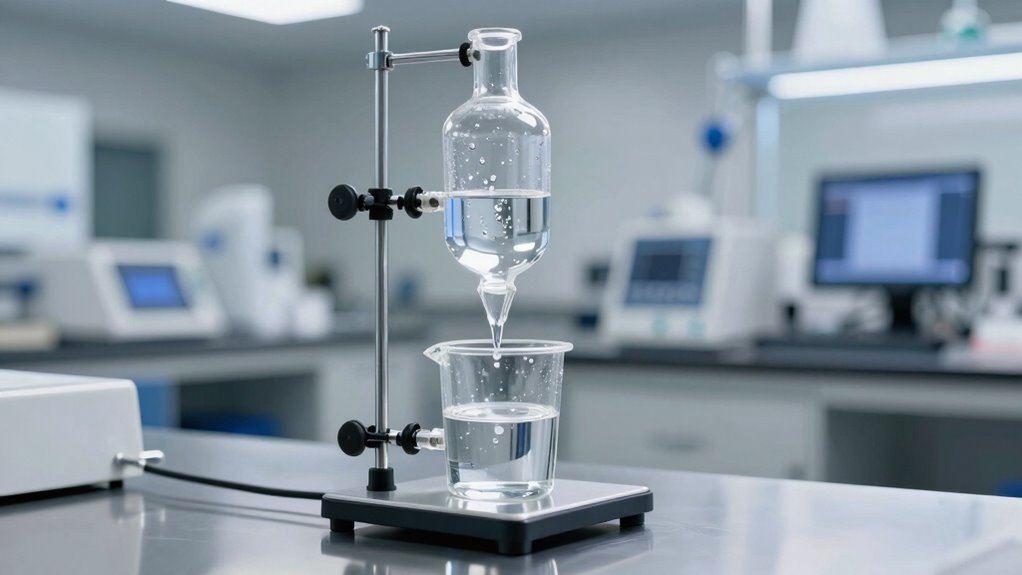
Water distillation plays an essential role in modern laboratories, guaranteeing the purity and quality of water used in experiments and analysis. Despite advances in technology, the fundamental principles of distillation remain rooted in historical techniques that have been refined over centuries. These traditional methods laid the groundwork for the highly efficient systems you see today. While today’s distillation units are more automated and precise, they still rely on core concepts developed long ago. This historical continuity underscores the importance of understanding traditional techniques, which contribute to the reliability and consistency of water purification processes in modern labs. Additionally, maintaining knowledge of fundamental techniques helps ensure the ongoing effectiveness and safety of laboratory practices. Understanding these foundational methods also aids in troubleshooting and optimizing current distillation systems, ensuring they operate at peak performance. Cost efficiency is another key reason why water distillation continues to be relevant. While alternative purification methods, like reverse osmosis or deionization, can be cost-effective for certain applications, distillation still offers a straightforward, scalable solution for laboratories that require high purity at a reasonable expense. In fact, the initial investment in a good distillation apparatus can be offset over time by its durability and low maintenance needs. Since distilled water minimizes the risk of contamination and impurities that could interfere with sensitive experiments, it reduces waste and the need for repeat tests, saving you money in the long run. Furthermore, water distillation is highly adaptable, making it suitable for a wide range of laboratory settings. Whether you’re conducting chemical syntheses, preparing biological samples, or running analytical procedures, distilled water provides a consistent baseline that guarantees accuracy. This consistency is essential, especially when your experiments demand exacting standards. You can trust that the distilled water you use is free from ions, microbes, and organic contaminants, which could otherwise compromise your results. The simplicity of the distillation process also means fewer variables and less chance of error, which is critical for maintaining experimental integrity. Despite the availability of newer technologies, water distillation remains a reliable choice because it’s easy to implement and maintain. Its proven effectiveness, combined with cost efficiency, makes it a staple in many laboratories. By understanding the roots of distillation through historical techniques, you appreciate its robustness and continued relevance. It is also important to recognize the regulatory standards that govern laboratory water quality to ensure compliance and safety. When your work depends on the highest quality water, distillation provides a straightforward, dependable solution that integrates well with the rigorous demands of modern scientific research. Fundamentally, the enduring significance of water distillation is rooted in its simplicity, proven performance, and cost-effective nature—traits that keep it indispensable in contemporary laboratory environments.
water distillation apparatus for lab
As an affiliate, we earn on qualifying purchases.
As an affiliate, we earn on qualifying purchases.
Frequently Asked Questions
How Energy-Efficient Are Modern Water Distillation Systems?
Modern water distillation systems are quite energy-efficient, thanks to advanced designs that reduce energy consumption while maintaining high system efficiency. You’ll find that newer models use less power, often incorporating features like improved insulation and energy recovery systems. These innovations help you save on operating costs and decrease environmental impact, making modern distillation equipment a smart choice for labs aiming for sustainable and cost-effective water purification processes.
Can Distillation Remove All Types of Contaminants?
Distillation effectively removes many contaminant types, including bacteria, salts, and organic compounds. However, it has purification limitations with certain volatile chemicals and dissolved gases that can vaporize alongside water, potentially passing through the system. You should know that while distillation is powerful, it might not eliminate all contaminants completely, especially those with similar boiling points, so combining it with other purification methods can guarantee higher purity levels.
What Are the Maintenance Requirements for Distillation Units?
You should follow regular maintenance schedules to keep your distillation units running smoothly. This includes cleaning components like the condenser and boiling chamber to prevent buildup. Equipment calibration is vital to guarantee accurate purity levels. Check seals and replace worn parts periodically. Proper maintenance extends the lifespan of your unit, maintains efficiency, and assures the quality of distilled water. Staying proactive with these steps helps avoid costly repairs and downtime.
How Does Distillation Compare to Reverse Osmosis?
You’ll find that distillation and reverse osmosis both produce pure water, but they do so differently. Distillation heats water to remove contaminants, including salts and microbes, making it highly effective for contaminant removal. Reverse osmosis pushes water through a membrane to filter out impurities. While both methods achieve purity, distillation is better for removing volatile substances, whereas reverse osmosis is faster and uses less energy for most common contaminants.
Are There Environmentally Friendly Distillation Options?
You might think all distillation methods are energy-intensive, but eco-friendly alternatives exist. Solar-powered distillation uses renewable energy, reducing environmental impact. Some systems incorporate sustainable practices by recycling heat or using energy-efficient components. These innovations make distillation more environmentally friendly, helping labs lower their carbon footprint. Embracing these sustainable practices guarantees you can purify water effectively while supporting eco-conscious initiatives.
laboratory distilled water still
As an affiliate, we earn on qualifying purchases.
As an affiliate, we earn on qualifying purchases.
Conclusion
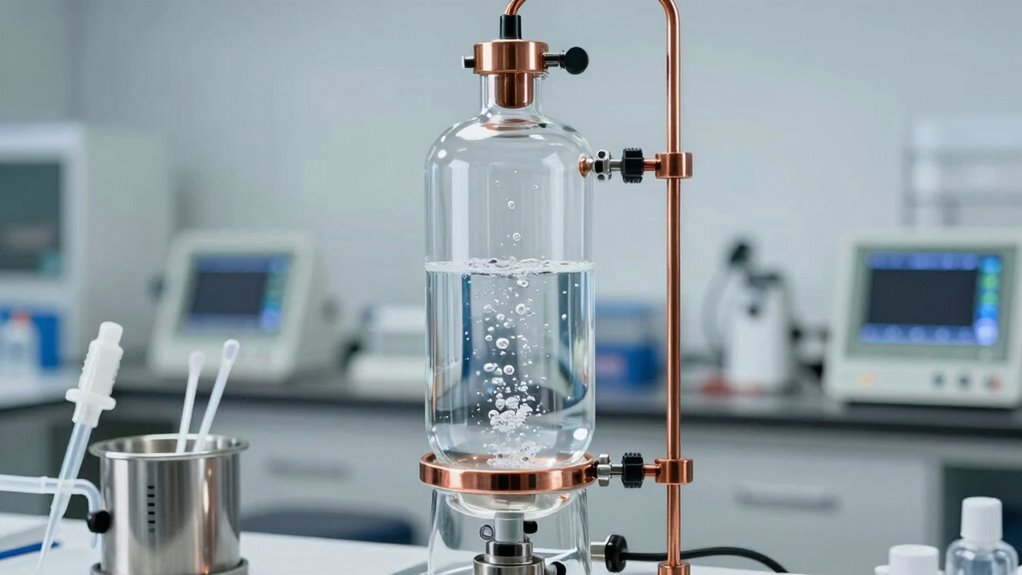
As you peer into your lab’s distillation setup, imagine the clear, shimmering water rising from boiling to condensation—pure, untouched by contaminants. This timeless process creates a pristine stream, essential for your experiments. In a world of complex technology, water distillation remains a simple, reliable beacon of purity. It’s not just about the water—it’s about ensuring every drop supports your quest for precision and discovery, keeping your scientific journey crystal clear and unwavering.
benchtop water distillation unit
As an affiliate, we earn on qualifying purchases.
As an affiliate, we earn on qualifying purchases.
scientific water purification distiller
As an affiliate, we earn on qualifying purchases.
As an affiliate, we earn on qualifying purchases.
Fall Picks
fall essentials
As an affiliate, we earn on qualifying purchases.