
Using ball mills allows you to grind materials to very fine particles, which is vital for enhancing reactivity and improving overall product quality. Fine particles increase surface area, making processes more efficient and reducing energy consumption. They also help guarantee consistent flow and easier downstream handling. Proper control of particle size distribution is key to achieving ideal performance and uniform results. Keep exploring to understand how fine particle size can boost your grinding effectiveness even further.
Key Takeaways
- Ball mills efficiently produce fine particles essential for high-quality material properties and performance.
- Smaller particles increase surface area, enhancing reactivity and interaction with grinding media.
- Achieving fine particle sizes reduces energy consumption and improves grinding efficiency.
- Fine particles enable higher throughput and consistent flow in processing and downstream operations.
- Controlling particle size distribution ensures product uniformity and optimizes grinding process outcomes.
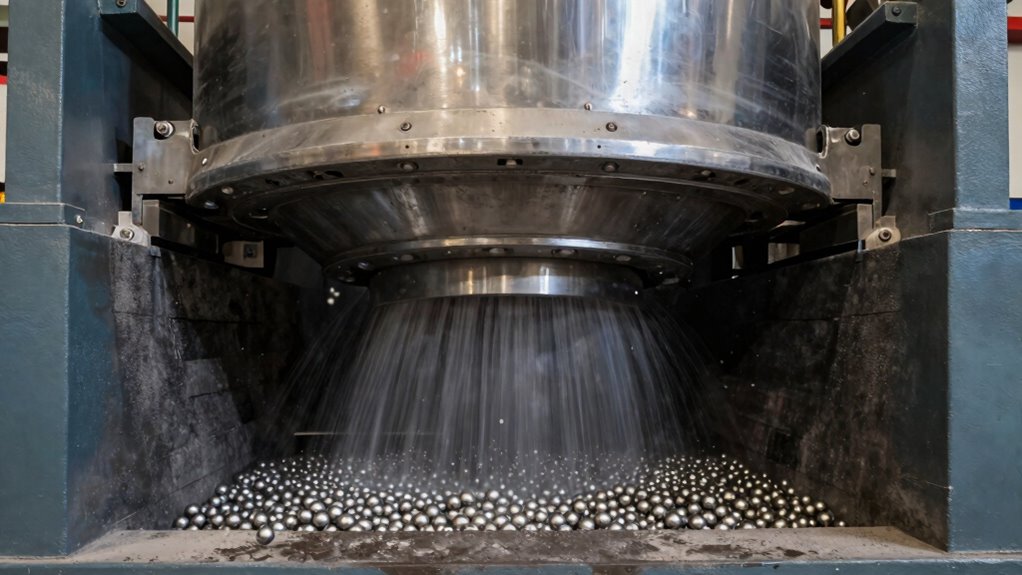
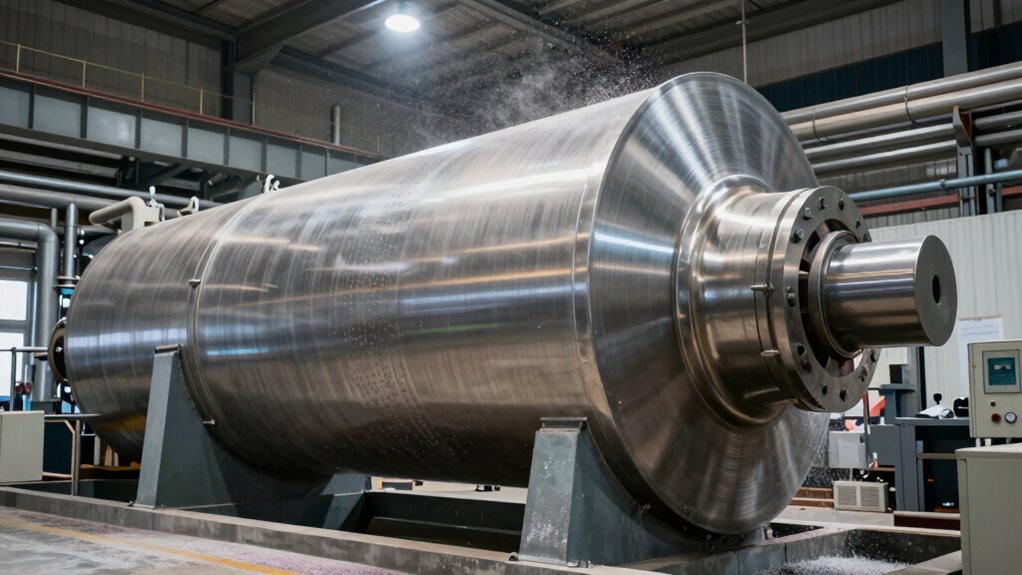
Understanding the importance of fine particle size is vital when it comes to grinding materials, and ball mills are some of the most effective tools for achieving it. When you’re aiming for high-quality final products, the size of the particles you produce plays a pivotal role. Fine particles often translate to better reactivity, improved material properties, and enhanced performance in various applications. But to reach that level of fineness, you need to optimize your grinding process, and that’s where ball mills excel. They are designed to grind materials down to very small sizes efficiently, making them indispensable in many industries.
Fine particle size is crucial for better reactivity, properties, and performance—ball mills efficiently achieve this in various industries.
One of the key factors that determine the success of using a ball mill is grinding efficiency. You want to maximize how effectively the mill reduces particle size with minimal energy consumption. When the particles are fine, your grinding efficiency improves because the increased surface area allows for better interaction with grinding media and the mill’s grinding environment. This means you don’t have to run the mill as long or as hard to achieve your desired particle size, saving you time and energy. Efficient grinding also reduces wear and tear on your equipment, prolonging its lifespan and lowering maintenance costs. Essentially, fine particle sizes are not just about product quality—they also make your entire process more economical. Optimizing grinding parameters can significantly enhance this efficiency and overall performance.
Material throughput is another critical aspect influenced by particle size. When you’re working with a ball mill, producing a finer product often means you can process larger quantities of material within a given time frame. Fine particles tend to flow more smoothly through the grinding chamber, reducing blockages and leading to consistent throughput. This consistency ensures that your production line remains steady, avoiding bottlenecks that could slow down your operations. Additionally, finer particles are easier to handle downstream, whether you’re packaging, transporting, or further processing your material. Achieving the right particle size distribution is vital for maintaining uniformity in your final product, which further enhances overall efficiency. Proper control of particle size distribution can also improve the reactivity of materials, making your process more effective and energy-efficient. The key to successful grinding lies in controlling these parameters to meet your specific production goals. Moreover, understanding the material properties can help tailor the grinding process for optimal results.

Ball Mill 2KG Laboratory Grinding Machine, White and Gray, Speed Control System, Electric Powered Industrial Equipment with Steel Ball Bearings
- Capacity: 2KG grinding capacity
- Speed Control: Adjustable speed regulation
- Construction: Durable white and gray housing
As an affiliate, we earn on qualifying purchases.
As an affiliate, we earn on qualifying purchases.
Frequently Asked Questions
How Do Ball Mills Compare to Other Grinding Methods?
You find that ball mills are often more energy-efficient than traditional grinding methods, especially for fine particle sizes. They effectively reduce material to very small particles with less environmental impact due to lower energy consumption. Compared to methods like hammer mills or jet mills, ball mills offer a gentler, more consistent grind, making them ideal for applications requiring precise, fine particle sizes while minimizing environmental footprint.
What Materials Are Best Suited for Ball Milling?
A wise man once said, “Know your tools.” For ball milling, you’re best suited to materials with moderate to low hardness, as overly hard substances can damage equipment and reduce milling efficiency. Soft metals, ceramics, and polymers work well because they break down efficiently into fine particles. By choosing materials suited to your equipment’s capacity and hardness, you guarantee effective milling and sustain peak efficiency.
How Does Particle Size Affect Product Quality?
Smaller particle sizes improve product quality by enhancing particle uniformity and increasing surface area, which boosts reactivity and consistency. When you achieve finer particles, you get more uniform blends, better reaction rates, and improved product performance. Reduced particle size also minimizes size variation, ensuring each batch meets quality standards more reliably. Overall, controlling particle size directly influences the effectiveness, safety, and quality of your final product.
What Maintenance Is Required for Ball Mills?
A stitch in time saves nine, and regular maintenance keeps your ball mill running smoothly. You need to follow lubrication schedules diligently to prevent parts from seizing or wearing prematurely. Wear monitoring is essential—check for unusual vibrations or noises that could indicate issues. Regular inspections of bearings, gears, and liners help prevent costly repairs, ensuring your mill operates efficiently and prolongs its lifespan.
Can Ball Mills Be Scaled for Large Industrial Use?
Yes, you can scale ball mills for large industrial applications, but you face scaling challenges like maintaining uniform grinding and ensuring mechanical stability. Larger mills require stronger materials, advanced control systems, and efficient cooling to handle increased load and heat. Proper design and engineering help optimize performance, making them suitable for extensive industrial use where high throughput and fine particle size are essential.

1.1LB 304 Stainless Steel Balls for Laboratory Ball Mill, 1.5-16mm Grinding Beads, Rolling Media for Material Processing and Sample Preparation (13.5mm(48pieces))
- Material: Premium 304 stainless steel
- Corrosion Resistance: Excellent corrosion resistance
- Durability: High wear resistance
As an affiliate, we earn on qualifying purchases.
As an affiliate, we earn on qualifying purchases.
Conclusion
By now, you see how ball mills play a vital role in achieving fine particle sizes, which directly impacts product quality and efficiency. Imagine reducing particles to a whisper-thin 10 microns—roughly the width of a human hair split into 100 pieces. That’s the power of precision grinding. With such tiny particles, you can enable better reactions, stronger materials, and improved processes. Fine particle size isn’t just a goal—it’s the secret to accessing superior results in your work.
Ball Mill 2KG Laboratory Grinding Machine, White and Gray, Speed Control System, Electric Powered Industrial Equipment with Steel Ball Bearings
- Capacity: 2KG grinding capacity
- Speed Control: Adjustable speed regulation
- Construction: Durable white and gray housing
As an affiliate, we earn on qualifying purchases.
As an affiliate, we earn on qualifying purchases.

TECHTONGDA Planetary Ball Mill Machine, Fine Powder Grinding Machine, Horizontal Pulverizer Ball Milling Equipment for Lab Material Grinding, 4 x 1000ml Stainless Steel Jars, 110V
- High-Speed Grinding: Rapid processing with large capacity
- Precise Grinding Modes: Dry and wet grinding at micron/nanometer levels
- Reverse Operation: Prevents sample agglomeration
As an affiliate, we earn on qualifying purchases.
As an affiliate, we earn on qualifying purchases.