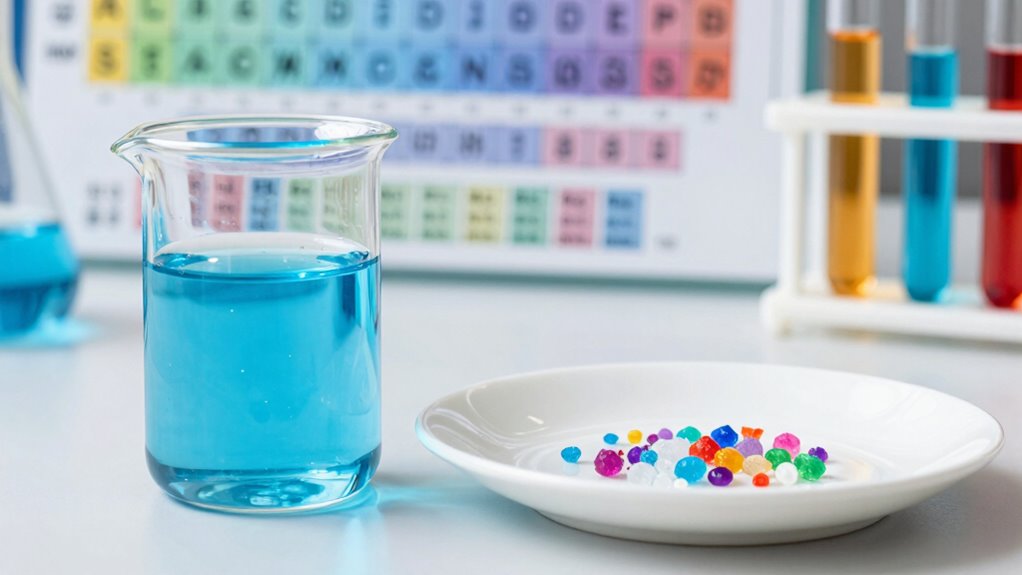

To understand solubility rules faster, focus on recognizing key patterns, like salts with Na, K, or NH4+ being typically soluble and those with silver, lead, or mercury often insoluble. Use visual aids or mnemonics to connect ions with their solubility behavior. Understanding how water interacts with ions and noting hydration energies helps solidify concepts quickly. Keep practicing these patterns, and you’ll discover more insights as you explore further.
Prime for Young Adults — start your free trial
Fast free delivery, streaming and member deals for eligible 18–24 year olds.
As an affiliate, we earn on qualifying purchases.
Key Takeaways
- Focus on common soluble ions like Na+, K+, and NH4+ to quickly identify soluble compounds.
- Memorize key insoluble pairs such as Ag+, Pb2+, and Hg2+ with specific anions.
- Recognize patterns and use visual aids or mnemonics to reinforce solubility rules.
- Understand water’s polarity and ionic interactions to grasp why certain compounds dissolve or precipitate.
- Practice drawing solubility and precipitation reactions to develop intuitive pattern recognition.
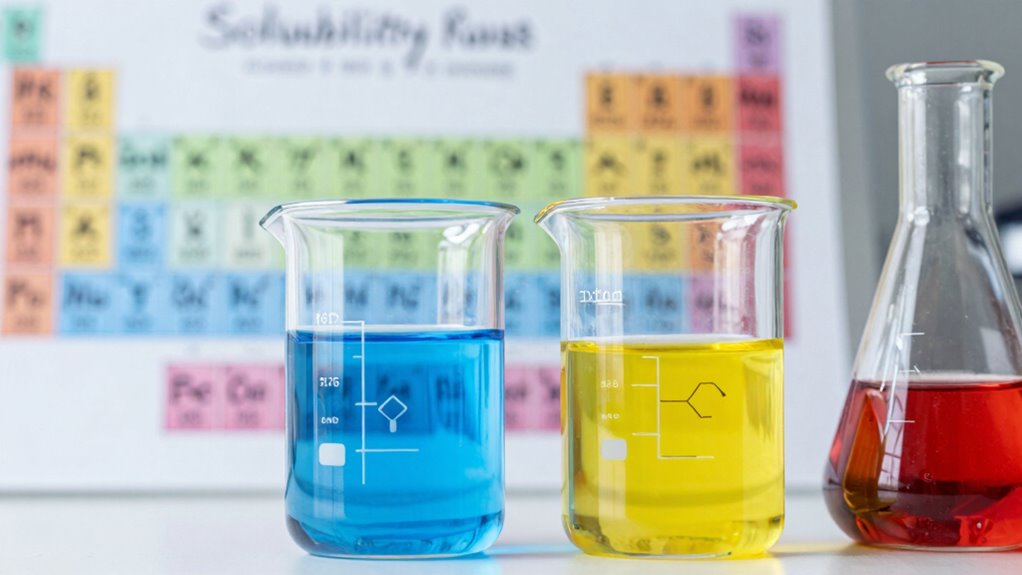
Have you ever wondered why some substances dissolve in water while others don’t? The answer often comes down to the nature of the compounds involved. When you’re trying to grasp solubility rules, it helps to understand that an ionic compound’s ability to dissolve depends on the balance between its ionic bonds and the interactions with water molecules. Water, being a polar solvent, can separate the ions in an ionic compound if the attraction between water molecules and the ions outweighs the ionic bonds holding the compound together. This process explains why some salts readily dissolve, while others remain solid. Recognizing patterns in these behaviors is key to mastering solubility rules. For example, compounds containing sodium, potassium, or ammonium ions tend to be soluble, whereas many containing silver, lead, or mercury are often insoluble.
To accelerate your understanding, focus on how solubility rules relate to precipitation reactions. When two solutions are mixed, insoluble compounds form and settle out as a precipitate. These insoluble compounds are typically ionic compounds that do not meet the solubility guidelines. By understanding the basic criteria for solubility, you can quickly predict whether a reaction will produce a precipitate. Think of it as a puzzle: if the ions in the solution combine to form an ionic compound that’s listed as insoluble, you can anticipate a precipitation reaction. This pattern recognition simplifies the process, saving you from memorizing every individual rule. Instead, you grasp the logic behind why certain ionic compounds are insoluble, which makes recalling the rules more intuitive. Additionally, understanding the contrast in solubility between different compounds helps clarify why some dissolve and others do not. Recognizing these ionic interactions is also crucial for a comprehensive understanding of solubility. Furthermore, a deeper understanding of hydration energy can shed light on the factors influencing solubility, helping you see why some compounds dissolve more readily than others.
Additionally, understanding the role of water polarity in dissolving ionic compounds aids in visualizing how water interacts with various ions and influences solubility behavior. Gaining insight into the structure of water molecules can deepen your grasp of why water is such an effective solvent for ionic compounds. Another way to speed up your comprehension is to use mnemonic devices and visual aids. For instance, associating “Ag” with insolubility because silver compounds often precipitate helps reinforce this concept. Drawing out ion exchange reactions and identifying which ions form insoluble compounds allows your brain to see the connections more clearly. The more you practice these visualizations, the faster you’ll recognize the insoluble combinations during actual problems.
Ultimately, understanding solubility rules becomes easier when you see the bigger picture—how ionic bonds break apart in water and how certain ions tend to form precipitates. Focus on the patterns, use visual tools, and relate the rules to real reactions like precipitation. With consistent practice, you’ll find yourself anticipating solubility outcomes more quickly, making your grasp of chemistry much more instinctive.
As an affiliate, we earn on qualifying purchases.
Frequently Asked Questions
Do Solubility Rules Change With Temperature?
Solubility rules do change with temperature due to temperature dependence affecting solubility variations. As temperature increases, some substances become more soluble, while others may become less soluble. This variation occurs because temperature influences the energy of particles, altering how they dissolve. So, when studying solubility rules, keep in mind that temperature can impact whether a compound is soluble or not, making it essential to take into account temperature dependence in your calculations.
Are There Exceptions to the General Solubility Rules?
Think of solubility rules like a trusty map—generally reliable, but with some exceptions. Yes, there are solubility exceptions, often due to rule limitations like specific ion interactions or temperature effects. For instance, lead or silver salts sometimes defy typical solubility expectations. Recognizing these exceptions helps you avoid assumptions, making your understanding of solubility more accurate and all-encompassing, much like knowing when a map’s directions might need adjusting for the terrain.
How Do Solubility Rules Apply to Complex Ions?
You should recognize that solubility rules help predict how complex ions behave in solution. Complex ion interactions influence solubility equilibria by either stabilizing or destabilizing ions, affecting their dissolution. When studying solubility, consider how ligands coordinate with metal ions, which can increase solubility even if the simple salts are insoluble. Understanding these interactions allows you to better predict whether a complex ion will dissolve or precipitate in solution.
Can Solubility Rules Predict All Precipitates?
Did you know that solubility rules predict precipitates with about 85% accuracy? While they’re helpful for quick pre-lab predictions, they have limitations. Precipitate prediction isn’t foolproof because some compounds defy rules due to complex interactions or unusual conditions. So, relying solely on solubility rules can lead to inaccuracies. Always consider experimental data and other factors for thorough results, especially with complex or borderline cases.
How Reliable Are Solubility Rules for Real-World Applications?
Solubility rules are fairly reliable for real-world applications, but you should consider solubility variations due to temperature, pH, and ionic strength. These factors can affect the accuracy of predictions. Keep in mind application limitations; sometimes, rules oversimplify complex systems. Use them as a helpful guide, but always verify with experimental data when precision is critical, especially in industrial or environmental contexts.
As an affiliate, we earn on qualifying purchases.
Conclusion
Mastering solubility rules isn’t just about memorization—it’s about recognizing the patterns that connect them all. As you get more comfortable, you’ll start to see the clues hidden within each rule, revealing faster understanding. But the real breakthrough happens when you realize there’s always more beneath the surface, waiting to be uncovered. Keep exploring, stay curious, and soon, the puzzle of solubility will become clearer than you ever imagined—yet, some secrets remain just out of reach, urging you forward.
visual aids for chemistry solubility
As an affiliate, we earn on qualifying purchases.
As an affiliate, we earn on qualifying purchases.
As an affiliate, we earn on qualifying purchases.
NFL season / tailgating Picks
team gear
As an affiliate, we earn on qualifying purchases.