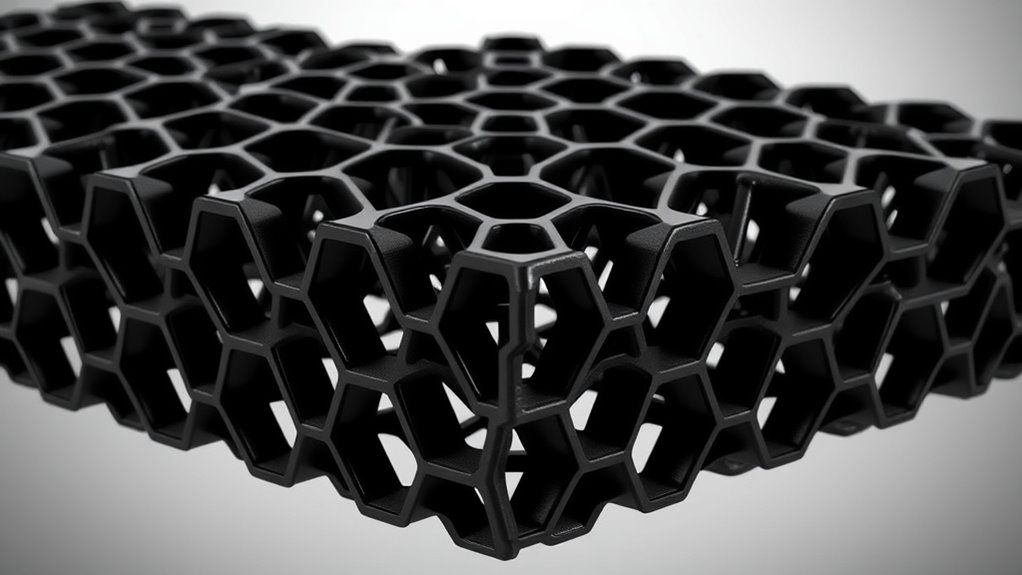

3D-printed metamaterials with Kagome tube structures are highly effective at blocking vibrations and controlling sound waves. You can tailor these internal geometries through advanced topology optimization, creating lightweight designs that absorb or reflect specific frequencies. Using 3D printing, you can realize complex lattice architectures that traditional manufacturing can’t produce. If you want to learn how these innovative structures can improve noise control and vibration management, there’s more to uncover below.
Key Takeaways
- Kagome tube structures leverage lattice geometries to dissipate and reflect vibrational energy effectively.
- Topology optimization designs internal architectures for targeted vibration blocking and noise reduction.
- 3D printing enables precise fabrication of complex Kagome lattice metamaterials with tailored acoustic properties.
- These metamaterials act as frequency-specific sound filters, enhancing vibration control in various environments.
- Integrating Kagome tubes in 3D-printed designs improves structural damping and vibration mitigation strategies.

Have you ever wondered how engineers are creating materials with properties that don’t exist in nature? 3D-printed metamaterials are revolutionizing this field by allowing designers to craft structures with unique mechanical, acoustic, and electromagnetic features. One exciting development involves using topology optimization to design complex internal architectures that enhance specific functionalities, such as acoustic filtering. This process enables you to strategically remove material from a design space, resulting in lightweight yet highly effective structures that can manipulate sound waves in innovative ways.
Imagine creating a material that can block vibrations or dampen noise with high precision. By applying topology optimization, you can identify the most suitable distribution of material within a given volume, leading to intricate internal geometries that traditional manufacturing can’t produce. These geometries often resemble lattice-like structures, which are ideal for acoustic filtering — selectively allowing certain sound frequencies to pass while blocking others. This capability is especially valuable in environments where noise control is critical, such as in aerospace, automotive, or architectural applications.
Topology optimization creates intricate lattice-like structures ideal for selective acoustic filtering.
One particularly promising design involves Kagome tubes, a type of lattice structure characterized by a repeating pattern of interconnected triangles. When 3D-printed, Kagome tubes can be integrated into metamaterials to serve as highly effective vibration blockers. Their unique geometry allows for the dissipation and reflection of vibrational energy, preventing it from propagating through a structure. You can think of them as acoustic shields that target specific frequencies, ensuring a quieter, more controlled environment.
The beauty of using 3D printing in this context is that it lets you realize these complex, optimized geometries with high precision. Traditional manufacturing methods often can’t produce such intricate internal structures, but additive manufacturing makes it possible. By combining topology optimization with 3D printing, you can tailor metamaterials to meet precise acoustic filtering needs, whether it’s muffling machinery noise or enhancing soundproofing in buildings.
In essence, this approach empowers you to design materials that do more than just serve as passive components. They actively control vibrations and sound waves, making environments safer, quieter, and more comfortable. As research advances, expect to see more applications where these refined, 3D-printed metamaterials transform how we manage acoustics in everyday life.
3D printed Kagome lattice metamaterials
As an affiliate, we earn on qualifying purchases.
As an affiliate, we earn on qualifying purchases.
Frequently Asked Questions
How Durable Are 3d-Printed Kagome Tube Metamaterials?
Your 3d-printed Kagome tube metamaterials are quite durable, thanks to their material longevity and manufacturing resilience. You can rely on them for long-term use, as they withstand vibrations and mechanical stress effectively. The choice of high-quality materials and precise printing techniques enhances their durability. While they’re resilient, avoid exposing them to extreme conditions that could compromise their structural integrity over time.
Can These Metamaterials Be Customized for Specific Vibration Frequencies?
Yes, you can customize these metamaterials for specific vibration frequencies through frequency tuning and material adaptability. By adjusting the geometry or material composition of the kagome tubes, you can target precise vibration ranges. This flexibility allows you to optimize their performance for your unique application, ensuring effective vibration blocking. So, with the right design tweaks, you can tailor these metamaterials to meet your specific frequency needs.
What Is the Cost Difference Compared to Traditional Vibration Damping Methods?
You’ll find that 3D-printed metamaterials can be more cost-efficient than traditional vibration damping methods, often reducing manufacturing expenses by up to 30%. This is because their customizable design allows for precise targeting of specific vibration frequencies, which cuts down on material waste and labor costs. While initial setup might be higher, the long-term savings and enhanced performance make them a smarter investment for vibration control.
Are There Environmental Concerns With the Materials Used in 3D Printing?
You should consider the environmental impact of 3D printing materials, as some plastics and resins can be harmful if not properly managed. Recyclability varies with material type; biodegradable options reduce waste, but many materials are not easily recyclable, raising concerns. It is crucial to choose sustainable, eco-friendly materials to minimize environmental effects, and to implement proper disposal or recycling practices to lessen your ecological footprint.
How Scalable Are These Metamaterials for Industrial Applications?
You can scale these metamaterials for industrial use, but manufacturing challenges and scalability limitations exist. Producing complex Kagome tube structures at large volumes requires advanced 3D printing techniques, which can be slow and costly. Additionally, maintaining consistent quality during mass production is tough. Overcoming these hurdles is essential for widespread adoption, but ongoing research aims to improve speed, reduce costs, and address these scalability issues for broader industrial applications.
Vibration Damping, Control, and Design
As an affiliate, we earn on qualifying purchases.
As an affiliate, we earn on qualifying purchases.
Conclusion
Imagine walking through a building made of these 3D-printed kagome tube metamaterials, feeling the vibrations vanish with every step. You might think it’s just science fiction, but these structures actively block unwanted vibrations, protecting you from noise and structural stress. With this technology, you’re not just observing the future—you’re experiencing it. As you move forward, know that these innovative materials could transform how we build safer, quieter spaces, making vibrations a thing of the past.

TroyStudio Enclosed Vocal Booth, Portable Microphone Isolation Shield, Foldable Reflection Filter with Acoustic Foam & Panels, Recording Sound Box Home Studio Equipment for Podcast Music Voice Over
【BASIC INFO】: Internal Dimensions: 8'' (L) x 8'' (W) x 12'' (H), External Dimensions: 12'' (L) x 12''…
As an affiliate, we earn on qualifying purchases.
As an affiliate, we earn on qualifying purchases.
additive manufacturing vibration shields
As an affiliate, we earn on qualifying purchases.
As an affiliate, we earn on qualifying purchases.