Leaf area meters matter in crop research because they help you quickly and accurately measure leaf surface areas, which is vital for understanding plant growth and health. They enable you to track changes over time, detect early stress signs, and evaluate how different conditions affect crop development. By providing reliable data, these tools improve the precision of your research and help optimize crop yields. Keep exploring to discover even more ways leaf area meters boost crop management efforts.
Key Takeaways
- Enable rapid, accurate measurement of leaf surface area for precise crop monitoring.
- Support understanding of how leaf size affects photosynthesis and crop yield.
- Enhance research efficiency through automated data collection and standardized protocols.
- Improve data reliability, comparability, and insights into plant growth and stress responses.
- Aid in optimizing management practices to boost crop health, productivity, and sustainability.
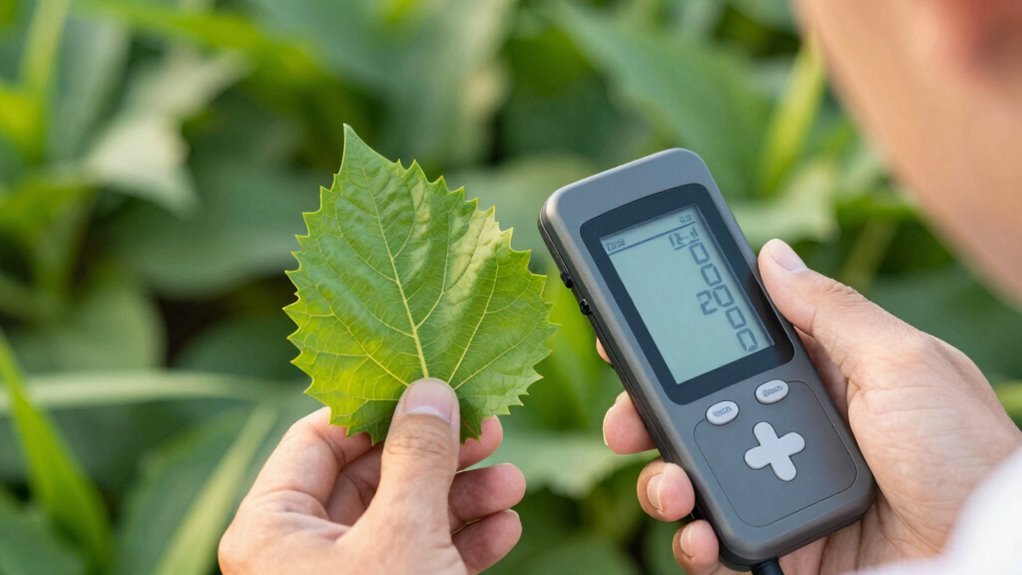
Leaf area meters have become essential tools in crop research, enabling researchers to quickly and accurately measure the surface area of leaves. This capability is critical because leaf size directly influences plant growth monitoring and overall crop health. When you use a leaf area meter, you gain precise data that helps you understand how different factors—such as nutrients, water, and environmental conditions—affect plant development. By tracking leaf surface area over time, you can identify growth patterns, detect stress early, and make informed decisions to maximize crop yields. This real-time monitoring makes your research more efficient and reliable, ensuring you don’t miss important changes in plant growth.
Leaf area meters enable quick, precise measurement of leaf surface area to enhance crop growth monitoring and overall plant health.
Moreover, leaf area measurement is indispensable for evaluating photosynthesis, the process by which plants convert light into energy. Larger, healthier leaves typically mean higher photosynthesis rates, leading to increased biomass and better crop productivity. With a leaf area meter, you can quantify leaf surface area accurately, providing essential data to evaluate how well crops are performing under different conditions. This measurement helps you understand the relationship between leaf size and photosynthetic efficiency, enabling you to select or engineer crop varieties that maximize energy capture. As a result, you can develop strategies to enhance photosynthesis, such as adjusting planting densities or applying growth stimulants, ultimately boosting crop performance.
In addition, leaf area meters streamline the process of collecting data for plant growth monitoring. Instead of relying on manual estimations, which can be inconsistent and time-consuming, you get fast, objective measurements that improve the precision of your research. This efficiency allows you to conduct larger-scale studies or frequent sampling, giving a more detailed picture of crop development. Accurate leaf area data also supports modeling efforts to predict yields and assess the impact of environmental stressors, making your research more robust. Incorporating automated measurement techniques can further enhance the accuracy and efficiency of data collection, especially in extensive field trials. Understanding measurement accuracy and how it influences your data is essential for reliable research outcomes. Additionally, understanding the measurement process ensures consistency across different researchers and studies, which is vital for building reliable datasets. Recognizing the importance of standardized protocols helps maintain data quality and comparability across different experiments.
Furthermore, using a leaf area meter benefits your overall understanding of crop physiology. The data you gather assists in evaluating how different management practices influence plant development and photosynthesis. It enables you to identify ideal conditions for growth and to troubleshoot issues before they become severe. Additionally, understanding leaf area measurement techniques is crucial for ensuring consistent and reliable data collection across studies. In the end, these tools empower you to make science-based decisions that improve crop health, increase productivity, and support sustainable farming practices. Whether you’re monitoring plant growth or measuring photosynthesis, leaf area meters are indispensable for advancing crop research and ensuring agricultural success.

Portable Leaf Area Meter for Plants, Non-Destructive Leaf Analyzer, ±2% Accuracy, 1000mm x 160mm Max Leaf Size, LCD Display, USB Connectivity, for Field Research and Crop Selection
Non-destructive testing measures leaf area without damaging plants.
As an affiliate, we earn on qualifying purchases.
As an affiliate, we earn on qualifying purchases.
Frequently Asked Questions
How Do Leaf Area Meters Compare to Traditional Measurement Methods?
Leaf area meters are more precise and faster than traditional methods. You can benefit from digital calibration, which guarantees accurate measurements, reducing human error. Plus, they easily integrate data into your digital systems, streamlining your workflow. Unlike manual techniques, leaf area meters save time, improve consistency, and provide reliable data for crop research. This makes them essential tools for modern agriculture, helping you make informed decisions efficiently.
What Are the Maintenance Requirements for Leaf Area Meters?
You need to regularly perform calibration procedures to guarantee accurate measurements from your leaf area meter. Keep the device clean and check sensors periodically. Battery life is essential; recharge or replace batteries as needed to avoid interruptions. Store the meter in a protective case when not in use, and follow the manufacturer’s guidelines for maintenance. Doing so helps maintain precision and prolongs the device’s lifespan.
Can Leaf Area Meters Be Used for All Crop Types?
Did you know that over 85% of crop varieties can be accurately measured with leaf area meters? Yes, you can use leaf area meters for most crop types, but measurement precision may vary depending on the crop’s leaf structure. Some crops with complex or irregular leaves might require specialized settings or alternative measurement methods. Overall, leaf area meters are versatile tools that help guarantee consistent, reliable data across diverse crop varieties.
How Accurate Are Portable Leaf Area Meters in Field Conditions?
Portable leaf area meters generally provide good data accuracy in field conditions if you guarantee proper sensor calibration. Regular calibration accounts for environmental factors like lighting and moisture, which can affect readings. When calibrated correctly, these devices deliver reliable measurements, helping you assess crop health and growth more precisely. Keep your meter maintained and calibrated, and you’ll get consistent, accurate data to support your research or farming decisions.
What Is the Typical Cost Range for Different Models of Leaf Area Meters?
Think of leaf area meters as a toolbox with a variety of models, each priced like different treasures. The cost comparison ranges from around $500 for basic handheld models to over $5,000 for advanced, automated systems. With so many options, you can find a model that fits your needs and budget, whether you’re just starting or need high precision. The variety guarantees you get the right tool for your crop research journey.

BHYIQI Leaf Length Width Area Meter Digital Leaf Area Meter with Measurement Accuracy ±2% Width Range 0~150mm Length Range 0~1000mm Integrated High-Speed GPS Positioning Module Resolution 0.01cm²
Area unit: cm²; Resolution: 0.01cm²; Measurement accuracy: ±2%; Width range: 0~150mm; Length range: 0~1000mm; Data recording: 0~250 groups
As an affiliate, we earn on qualifying purchases.
As an affiliate, we earn on qualifying purchases.
Conclusion
By measuring leaf area accurately, you can markedly improve crop yield predictions and research outcomes. Did you know that using leaf area meters can boost the precision of crop assessments by up to 30%? Embracing this technology helps you optimize plant health management and make informed decisions faster. So, if you’re serious about advancing your crop research, investing in a leaf area meter isn’t just smart — it’s essential for staying ahead in agricultural innovation.

Luster Leaf Digital Moisture Meter
Easy to read digital output
As an affiliate, we earn on qualifying purchases.
As an affiliate, we earn on qualifying purchases.

YFYIQI Portable Leaf Area Tester Living Leaf Length Width Area Analyser Plant Leaf Surface Measurement with Maximum Scanning Width 210mm Length Resolution 0.1mm Width Resolution 0.1mm LCD Display
Maximum scanning width: 210mm; Maximum measured thickness: ≤ 7.5mm
As an affiliate, we earn on qualifying purchases.
As an affiliate, we earn on qualifying purchases.