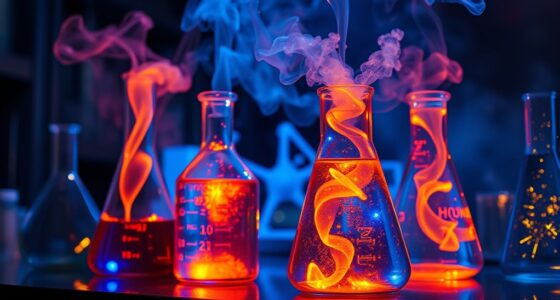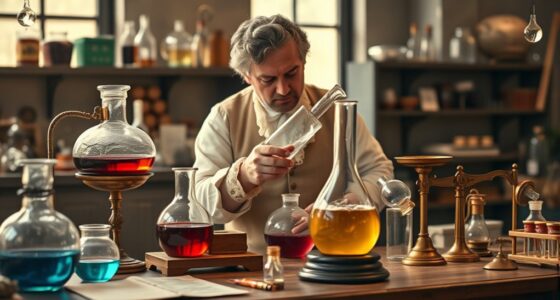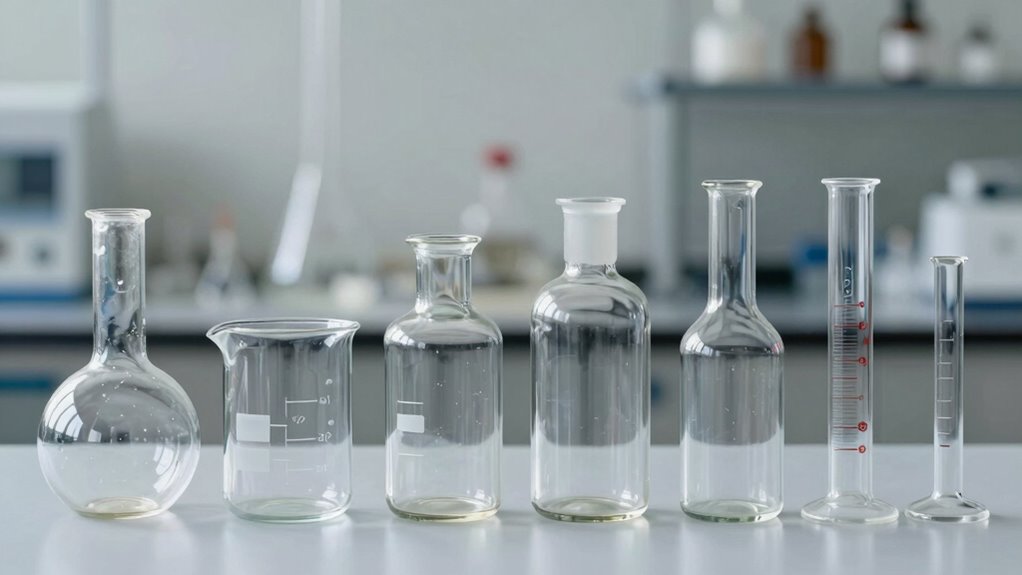

Laboratory glassware has evolved from handmade, inconsistent tools to highly standardized and durable equipment. Advances in manufacturing, like precision blowing and molding, guarantee uniformity and safety. Innovations such as borosilicate glass allow for high-temperature use and thermal shock resistance. Design features like beveled edges and etched markings improve safety and accuracy. This continuous development supports more reliable experiments and safer laboratories. Keep exploring to discover how these improvements shape modern scientific work.

Prime made for students and young adults
- Fast, free delivery for dorm and study essentials
- Prime Video and Amazon Music included
- Member-only deals
Key Takeaways
- Early glassware was handmade, resulting in inconsistencies, but advances in manufacturing improved uniformity and durability.
- Introduction of borosilicate glass enhanced high-temperature resistance and thermal shock tolerance.
- Modern techniques like precision blowing and molding enabled mass production and standardization.
- Safety features such as reinforced edges and etched markings reduced breakage risks and contamination.
- Continuous innovations have improved accuracy, safety, and reliability in laboratory practices over time.

The evolution of laboratory glassware reflects centuries of innovation driven by scientists’ need for safer, more accurate, and more versatile tools. Early glassware was often handmade, leading to inconsistencies in shape and thickness that could compromise experiments. Over time, advances in glass manufacturing transformed how these tools are produced, allowing for more uniform, durable, and reliable laboratory equipment. Modern techniques, such as precision blowing and molding, enabled the mass production of standardized glassware, ensuring consistency across different laboratories and experiments. The development of borosilicate glass, for example, marked a significant milestone. Its ability to withstand high temperatures and thermal shocks made laboratory glassware safer to use, reducing the risk of breakage and accidents during heating or cooling processes. This innovation has had a profound impact on the safety and reliability of laboratory practices. Additionally, improvements in manufacturing techniques have contributed to greater precision and quality control in glassware production. The emphasis on material properties such as thermal resistance and chemical durability has also driven the adoption of specialized glass types for different scientific purposes. Furthermore, ongoing research into glass composition continues to enhance the performance and safety features of laboratory glassware. Safety improvements have been a core focus throughout this evolution. As scientists understood the hazards associated with glass breakage and chemical exposure, manufacturers introduced features that enhance safety. Beveled edges, thicker walls, and reinforced bases help prevent accidental cuts and minimize breakage. Graduations and markings are now etched rather than painted, reducing the risk of chemical contamination and ensuring clear readings even after repeated washing. Additionally, the introduction of heat-resistant glassware allows for direct heating without the risk of shattering, which *considerably* improves safety during experiments involving high temperatures. This ongoing focus on safety features has helped make laboratory work more secure and reliable.
As an affiliate, we earn on qualifying purchases.
Frequently Asked Questions
What Materials Were Used in Early Laboratory Glassware?
In early laboratory settings, you’d find glassware made from materials like natural soda-lime glass, which was easy to shape using traditional techniques. Historical techniques involved heating and blowing glass to create simple containers. Over time, material innovations introduced borosilicate glass, offering better heat resistance and durability. These advances allowed scientists to perform more precise experiments, marking significant progress in laboratory glassware development.
How Did Safety Standards Influence Glassware Design?
Safety standards sparked significant shifts in glassware design, demanding durable, heat-resistant, and chemically inert instruments. You see, safety regulations push for design innovations that prevent breakage, spills, and accidents. This led to the development of shatterproof, thicker glass, and specialized shapes for stability. These improvements guarantee your lab work stays safer, more efficient, and compliant, highlighting how safety standards shape smarter, stronger, and safer laboratory glassware.
Who Were the Key Inventors Behind Modern Glassware?
You should know that key contributors like Michael Faraday and Leo Baekeland played significant roles in developing modern glassware. Their work on materials and manufacturing techniques marked vital historical innovations, leading to durable, heat-resistant, and chemically inert lab equipment. These inventors revolutionized glassware design, enabling more precise and safe scientific experiments. Their contributions laid the foundation for the advanced laboratory tools we rely on today.
How Has Automation Impacted Glassware Manufacturing?
They say “the devil is in the details,” and automation proves that true in glassware manufacturing. Automated production and precision manufacturing have revolutionized how glassware is made, boosting consistency and quality. You benefit from faster production, fewer errors, and safer, more reliable lab tools. Automation guarantees each piece meets strict standards, making modern glassware more durable and precise—saving time and resources while elevating scientific accuracy.
Are There Eco-Friendly Alternatives to Traditional Glassware?
You can find eco-friendly alternatives to traditional glassware by exploring recycling initiatives that repurpose used glass into new laboratory tools. Biodegradable materials, like plant-based plastics, also offer sustainable options, breaking down more easily in the environment. These innovations help reduce waste and energy consumption, making your laboratory more eco-conscious. Embracing these alternatives supports sustainability without compromising the quality or safety of your experiments.
laboratory glassware safety features
As an affiliate, we earn on qualifying purchases.
As an affiliate, we earn on qualifying purchases.
Conclusion
As you’ve seen, laboratory glassware has come a long way—from simple, hand-blown vessels to precision-engineered tools. This evolution reflects advances in science and technology, making experiments safer and more accurate. Did you know that today’s specialized glassware can withstand temperatures up to 1,200°C? It’s fascinating how innovation continues to shape the tools you use, ensuring your experiments are both reliable and efficient. The journey of glassware evolution is truly a proof of scientific progress.
precision molded laboratory test tubes
As an affiliate, we earn on qualifying purchases.
As an affiliate, we earn on qualifying purchases.
As an affiliate, we earn on qualifying purchases.
Fall Picks
fall essentials
As an affiliate, we earn on qualifying purchases.