Microplate readers speed up testing by allowing you to analyze hundreds of samples at once with automation and high-throughput features. They process data quickly, reducing hours or days of work to minutes, so you can make faster decisions. With standardized protocols and multiple detection modes, they guarantee consistent, accurate results every time. If you want to discover how these advanced tools transform your workflow, keep exploring the benefits they offer.

Prime made for students and young adults
- Fast, free delivery for dorm and study essentials
- Prime Video and Amazon Music included
- Member-only deals
Key Takeaways
- Microplate readers analyze hundreds of samples simultaneously, significantly reducing overall testing time.
- Automated protocols minimize manual handling, accelerating data collection and processing.
- High-speed detection modes enable rapid assay measurements, shortening experiment durations.
- Integrated software streamlines data analysis, enabling quick interpretation of large datasets.
- Versatile functionalities allow multiple assays to be performed in a single run, increasing testing efficiency.
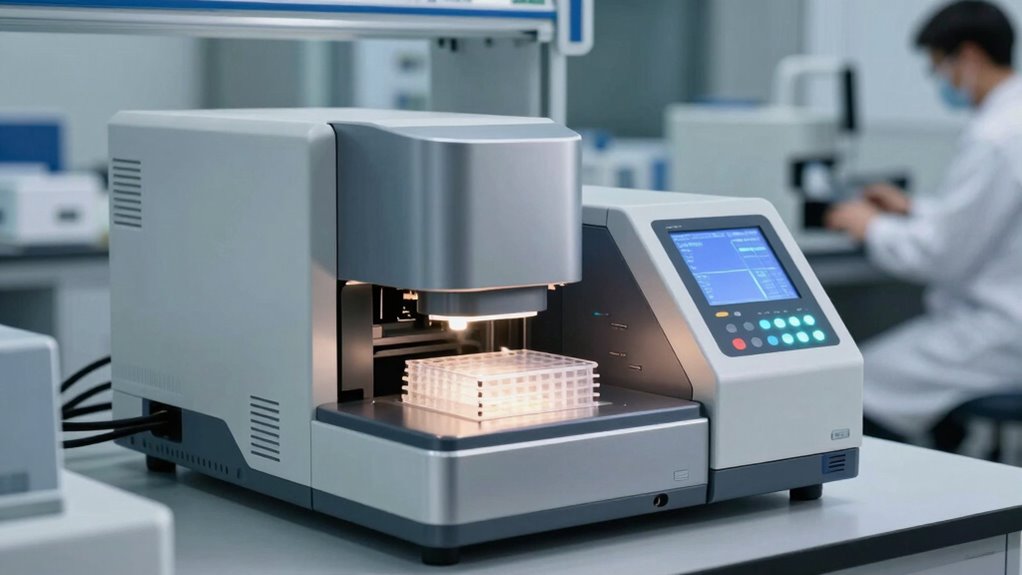
Have you ever wondered how scientists quickly analyze multiple samples simultaneously? The answer lies in the power of microplate readers. These sophisticated instruments have revolutionized laboratory testing by enabling high-throughput analysis, saving you time and boosting productivity. Microplate readers are designed to process hundreds of samples in a single run, which considerably enhances automation efficiency. Instead of manually measuring each sample, you can set up an experiment and let the machine do the work, freeing you to focus on data interpretation or other research tasks. This automation not only accelerates your workflow but also reduces human error, making your results more reliable.
One of the key advantages of using a microplate reader is its ability to improve data accuracy. When handling multiple samples, manual measurements can lead to inconsistencies, especially when different operators are involved or when measurements are taken over extended periods. Microplate readers standardize the process by applying precise, programmed protocols across all wells in a plate. This consistency ensures that your data is accurate and reproducible. Additionally, many models incorporate advanced features like temperature control, kinetic measurements, and multiple detection modes, further enhancing the reliability of your results. The integration of automated protocols with these features makes the testing process even more efficient and dependable. Moreover, understanding the underlying measurement techniques can help optimize your assay results and improve overall accuracy. Incorporating quality control measures is also essential to ensure consistent performance over time. Implementing these controls helps maintain the integrity of your data and supports compliance with industry standards.
The speed at which microplate readers operate is another game-changer. Traditional testing methods often require multiple steps—sample preparation, individual measurements, and data recording—that can take hours or even days. With a microplate reader, you can analyze hundreds of samples in just minutes. This rapid throughput is especially essential in clinical diagnostics, drug discovery, and research laboratories, where time is of the essence. The ability to quickly generate large datasets means you can make faster decisions, whether that’s identifying potential drug compounds or diagnosing diseases. This high-throughput screening capability accelerates research and development processes significantly. Furthermore, advancements in automation technology have made these instruments more user-friendly, allowing labs to maximize productivity with minimal training.
Moreover, microplate readers are versatile tools that can handle various assays, including absorbance, fluorescence, and luminescence measurements. This flexibility allows you to customize your testing protocols without needing multiple instruments, further streamlining your workflow. The integration of software solutions also makes data analysis more straightforward, helping you interpret results efficiently and accurately. All these factors combine to dramatically improve the speed and quality of your testing processes.
In essence, microplate readers accelerate your work by providing high-throughput, precise, and automated analysis. They help you achieve faster results without sacrificing accuracy, making your laboratory more efficient and your data more dependable. Whether you’re conducting research, diagnostics, or quality control, these instruments are indispensable tools that transform complex tasks into streamlined operations.
microplate reader for high-throughput analysis
As an affiliate, we earn on qualifying purchases.
As an affiliate, we earn on qualifying purchases.
Frequently Asked Questions
What Are the Main Types of Microplate Readers Available?
You’ll find several main types of microplate readers, including absorbance, fluorescence, luminescence, and time-resolved fluorescence readers. These devices streamline sample preparation and reduce manual steps, enhancing testing speed. Calibration procedures are essential to guarantee accuracy across each type, allowing you to obtain reliable results quickly. Depending on your specific needs, selecting the right reader type helps optimize your workflow and improves data quality efficiently.
How Do Microplate Readers Improve Data Accuracy?
Think of microplate readers as sharp-eyed detectives, catching every detail. They improve data accuracy by ensuring data precision through consistent, automated measurements, reducing human error. Their sensitive detection systems spot even tiny variations, so your results stay reliable. With error reduction built-in, you get clearer, more trustworthy data, allowing you to make confident decisions. This precision helps streamline research and diagnostics, saving you time and resources.
Can Microplate Readers Be Integrated With Laboratory Software?
Yes, microplate readers can be integrated with laboratory software. They support automation integration and are compatible with various software platforms, making data management seamless. You can connect them directly to your lab systems, enabling real-time data transfer and analysis. This integration reduces manual input, minimizes errors, and speeds up your workflow. Make certain your microplate reader is compatible with your existing software to maximize efficiency and streamline your testing processes.
What Maintenance Is Required for Microplate Readers?
You need to regularly perform calibration protocols to guarantee your microplate reader provides accurate results. Cleaning procedures are also essential; you should regularly wipe down surfaces and lenses with appropriate cleaning solutions to prevent contamination and maintain sensitivity. Follow manufacturer guidelines for both calibration and cleaning, and keep a maintenance log to track your routine checks. This way, your microplate reader stays in excellent condition, ensuring reliable testing outcomes.
Are Microplate Readers Suitable for All Assay Types?
Think of microplate readers as versatile tools in your lab toolbox. They’re suitable for many assay types, but not all. Their design promotes cost efficiency and often requires minimal user training, making them accessible for various experiments. However, for highly specialized assays, you might need specific equipment. Overall, they’re a flexible and efficient choice, saving you time and money on routine testing and broadening your research capabilities.
automated microplate reader with detection modes
As an affiliate, we earn on qualifying purchases.
As an affiliate, we earn on qualifying purchases.
Conclusion
Microplate readers revolutionize testing by turning complex laboratory processes into swift, efficient tasks. They’re your trusted allies, transforming hours into minutes and making precision look effortless. Imagine them as the beating heart of your research—pumping accuracy and speed through every well. In this symphony of science, microplate readers orchestrate harmony between speed and reliability, proving that innovation isn’t just a tool but a catalyst that propels your work forward—faster, smarter, better.
multi-sample microplate reader for labs
As an affiliate, we earn on qualifying purchases.
As an affiliate, we earn on qualifying purchases.
clinical diagnostics microplate reader
As an affiliate, we earn on qualifying purchases.
As an affiliate, we earn on qualifying purchases.
Evergreen bestsellers Picks
bestsellers
As an affiliate, we earn on qualifying purchases.