
TL;DR
Prebuilt AI workstations are now often more cost-effective and reliable than DIY builds due to component shortages and bulk buying. The choice hinges on your need for speed, control, and support. Weigh the tradeoffs carefully before deciding.
When it comes to setting up an AI workstation, the choice isn’t just about parts and prices anymore. It’s about speed, reliability, and control. In 2026, the old assumption that DIY always wins on cost no longer holds true, thanks to component shortages and bulk buying by major vendors.
This article breaks down the real-world tradeoffs between building your own machine or buying a prebuilt. Whether you’re racing against deadlines or chasing the perfect setup, understanding these differences can save you time, money, and headaches.
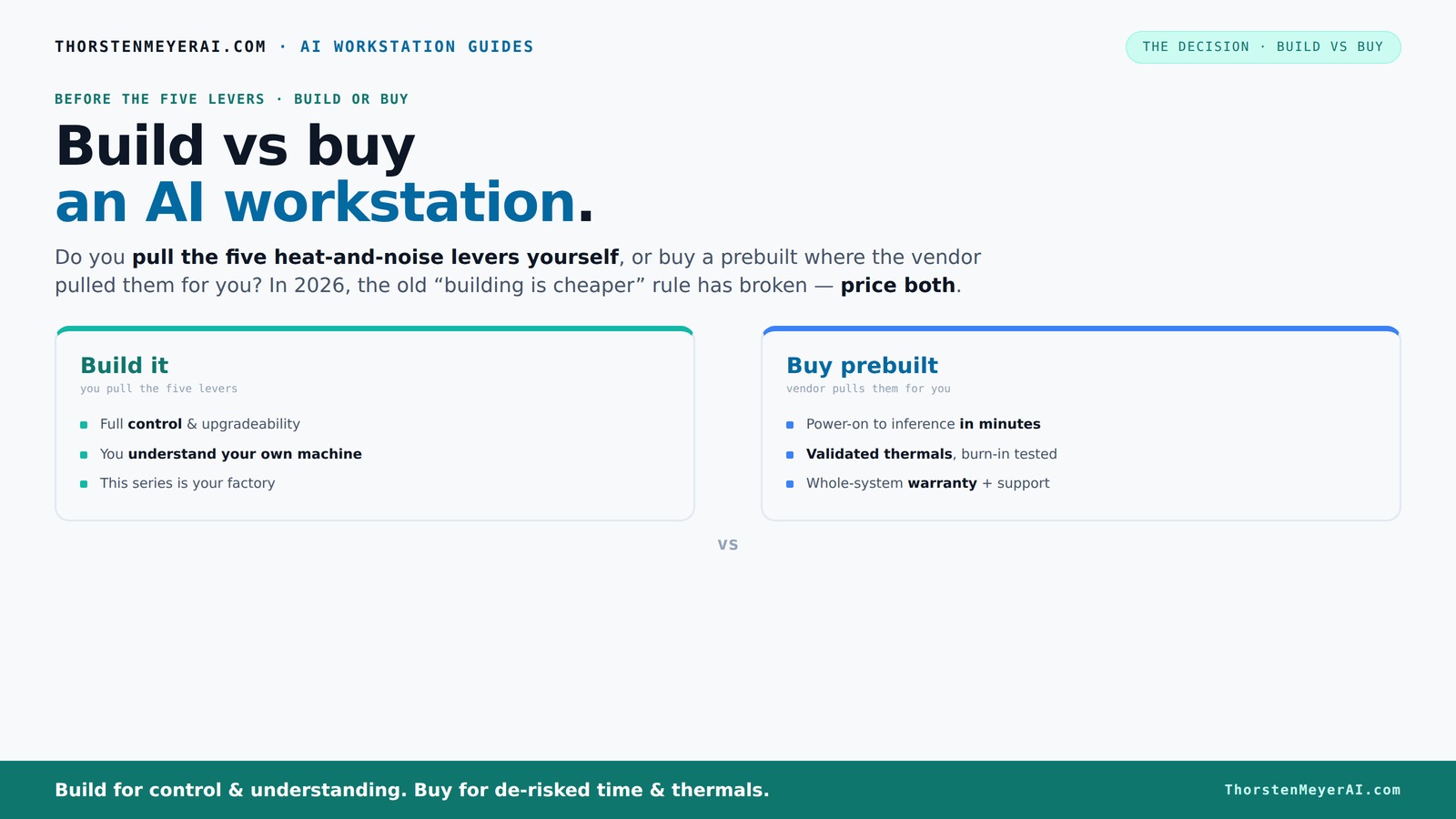
Build vs buy
an AI workstation.
The real question behind this whole series: do you pull the five heat-and-noise levers yourself, or buy a prebuilt where the vendor pulled them for you? And in 2026, the old “building is cheaper” rule has broken. Match your situation in Part 3.
Key Takeaways
- In 2026, prebuilt AI workstations often match or beat DIY builds on price due to bulk buying and component shortages.
- Choosing between build and buy hinges on your need for speed, control, and support—not just cost.
- Prebuilts offer validated thermals, warranties, and quick deployment—ideal for time-sensitive projects.
- DIY builds provide maximum customization, upgradeability, and learning opportunities, but require time and technical skill.
- Always compare specific configurations and consider future upgrade plans before deciding.
As an affiliate, we earn on qualifying purchases.
Why the old rule of thumb no longer applies in 2026
Building your AI workstation used to be the clear winner for saving money. But today, skyrocketing prices for GPUs, DDR5 RAM, and SSDs have flipped the script. For instance, a top-tier GPU like the NVIDIA RTX 4090, which once cost around $1,500, now frequently exceeds $2,000 due to supply constraints and demand spikes. This inflation makes DIY builds significantly more expensive than before. Additionally, the time and effort required to assemble, troubleshoot, and optimize these components often outweighs the initial savings.
Meanwhile, large vendors like Dell, HP, and specialized AI system builders bought components early during supply dips, allowing them to offer systems at prices that are now tough for DIYers to match. For example, a preconfigured AI workstation from Lambda with a high-end GPU, ample RAM, and enterprise-grade cooling can be priced similarly or even lower than assembling the same specs yourself, especially when factoring in the time and potential errors involved in DIY assembly. This shift means you need to compare both options for your specific setup—cost isn’t a given anymore and depends heavily on market conditions and your priorities.
Choosing wisely now involves considering not just immediate costs but also long-term implications like upgradeability, reliability, and the time investment required. For example, a DIY enthusiast might value the ability to upgrade a single component, like swapping out a GPU for a newer model, which could be more straightforward with a custom build. Conversely, a professional needing immediate, reliable performance might favor a prebuilt system with validated thermals and dedicated support, avoiding the pitfalls of compatibility issues or faulty components.
As an affiliate, we earn on qualifying purchases.
How market dynamics influence component prices and availability
The fluctuating landscape of component pricing and availability in 2026 is a critical factor in the build vs buy debate. During supply shortages, high demand for GPUs, especially AI-optimized models with large VRAM and tensor cores, causes prices to skyrocket. Learn more about component pricing and availability. This scarcity often leads to inflated costs for DIY builders who purchase components individually, often at retail prices far above previous years. Conversely, vendors who purchase in bulk early during dips can secure components at lower costs, enabling them to offer competitively priced prebuilt systems.
Moreover, the availability of components is unpredictable. Supply chain disruptions, geopolitical tensions, and manufacturing constraints mean that waiting for parts to restock can delay projects or force compromises on specifications. For instance, if a key GPU remains out of stock, a DIY builder might be forced to settle for a less powerful or more expensive alternative, impacting performance and budget. Prebuilt vendors, however, often have contracts and stockpiles that buffer against these shortages, providing more consistent access to critical components.
Understanding these market dynamics helps you strategize your purchase timing. For more insights, visit chemicalceo.com. If you can wait for supply to stabilize or prices to drop, DIY might become more attractive. But if immediate deployment is essential, prebuilt systems with guaranteed availability can save you time and reduce uncertainty. Ultimately, market fluctuations amplify the importance of flexibility and foresight in your decision-making process.
As an affiliate, we earn on qualifying purchases.
Defining the core tradeoffs: cost, control, and support
At the heart of the build vs buy decision are three key tradeoffs: cost, control, and support. Each factor influences your choice depending on your priorities. Building offers maximum control—customizing every component, optimizing thermals, and upgrading parts as needed. This flexibility is ideal for enthusiasts who want to learn, tinker, or tailor their system precisely to their workload.
However, this control often comes with higher complexity and potential troubleshooting. DIY builders need to be comfortable with hardware assembly, BIOS configuration, and diagnosing issues, which can be time-consuming and frustrating. The long-term benefit is future upgradeability; a custom build can evolve with your needs, swapping out components without restrictions.
Prebuilt systems, on the other hand, prioritize support and reliability. Vendors test and validate their systems, ensuring compatibility and optimized thermals, which reduces setup time and troubleshooting. Support services and warranties provide peace of mind, especially critical for professional environments where downtime costs money. The tradeoff is less customization—what you see is what you get—and sometimes proprietary parts that limit future upgrades.
Understanding these tradeoffs helps you align your choice with your operational needs. If you value learning and customization, a DIY build might be worth the extra effort. If you need immediate, reliable performance with minimal hassle, a prebuilt system is often the smarter choice.
As an affiliate, we earn on qualifying purchases.
Frequently Asked Questions
Is it cheaper to build or buy a prebuilt AI workstation?
It depends. Due to component shortages and bulk buying, prebuilts now often match or beat DIY costs in 2026. Always compare specific configurations, as market fluctuations can sway the balance.Will a prebuilt AI workstation have worse performance than a custom build?
Not necessarily. Many prebuilts are optimized for AI workloads, with validated thermals and hardware tuning. The key is choosing a reputable vendor that tailors systems for your specific needs. You can explore options at Build vs Buy a Prebuilt AI Workstation.What parts matter most for AI workloads: GPU, VRAM, RAM, CPU, storage, or NPU?
GPU and VRAM are king—large models need at least 24GB VRAM. RAM and fast storage are also vital, but for most AI tasks, a powerful GPU with AI-optimized features makes the biggest difference. For example, a researcher working with large language models will prioritize high VRAM and tensor cores, which are often better optimized in preconfigured systems from specialized vendors.Are AI-optimized prebuilts worth the premium?
If you need reliable, plug-and-play performance with validated thermals and support, then yes. The added cost often offsets time saved and reduces troubleshooting, especially for critical projects. For instance, a startup deploying AI in production can benefit from the stability and support offered by prebuilt systems designed specifically for AI workloads.Can I upgrade a prebuilt later, or will proprietary parts limit me?
It varies. Some prebuilts use proprietary components, making future upgrades tricky. For example, a system with custom motherboard or cooling solutions may restrict adding new GPUs or storage. Always check upgrade paths and compatibility before purchasing, especially if you anticipate future expansion or hardware refreshes.Conclusion
In 2026, the decision to build or buy a high-performance AI workstation is more nuanced than ever. If speed, support, and reliability top your list, a prebuilt might be your best move. But if customization and future upgrades matter most, building your own could still pay off.
Either way, don’t assume one size fits all. Carefully evaluate your workload, budget, and technical comfort. The right choice today can supercharge your AI projects tomorrow—and make the heat and noise just a little more bearable.