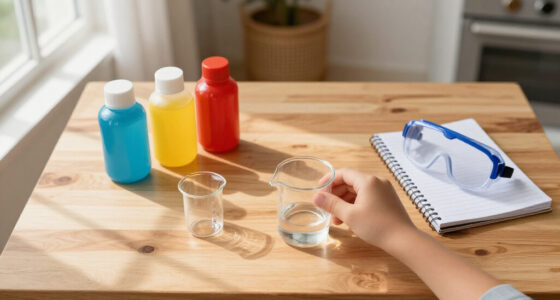

You can turn your kitchen into a fun science lab by trying safe, simple chemistry activities for all ages. Use common ingredients like baking soda and vinegar for fizzy reactions or cornstarch and water to create a non-Newtonian fluid. Always follow safety tips, such as wearing goggles and supervising kids, to guarantee a fun experience. If you want more ideas and tips, keep exploring how to make chemistry both safe and exciting at home.

Prime made for students and young adults
- Fast, free delivery for dorm and study essentials
- Prime Video and Amazon Music included
- Member-only deals
Key Takeaways
- Choose simple, non-toxic experiments like baking soda and vinegar reactions or cornstarch non-Newtonian fluids for safety and visual impact.
- Always supervise children, use protective gear, and conduct experiments in well-ventilated areas to ensure safety.
- Document observations with photos and notes to enhance scientific understanding and track experiment outcomes.
- Read and follow instructions carefully, avoiding hazardous chemicals and sharp tools during kitchen experiments.
- Encourage curiosity by modifying recipes, asking questions about molecular processes, and exploring different ingredient interactions.
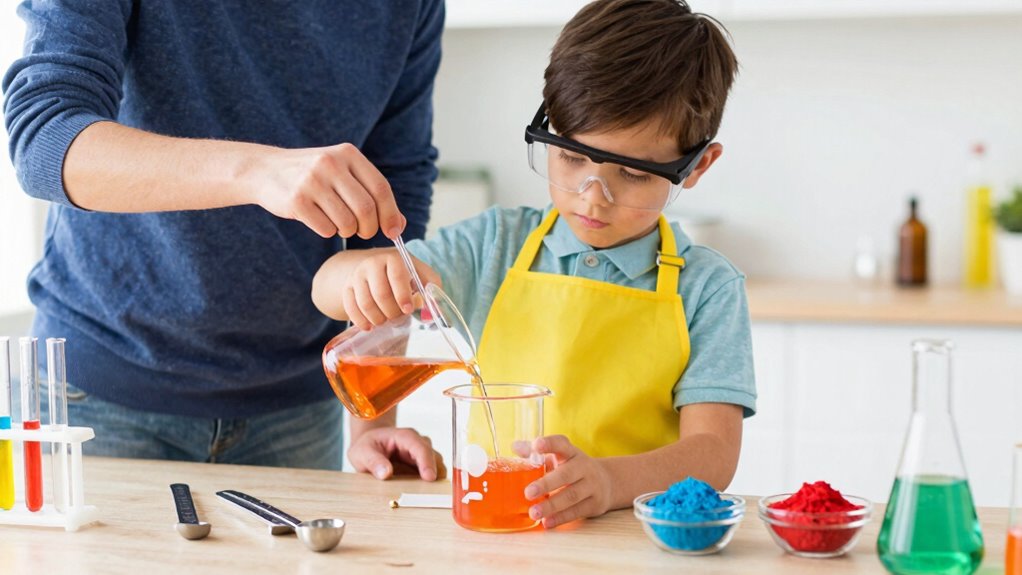
Have you ever wondered how you can explore chemistry right in your own kitchen without risking safety? The truth is, your kitchen is an excellent place to immerse yourself in the fascinating world of chemical reactions. By conducting simple kitchen experiments, you can see chemistry unfold right before your eyes. These activities are not only fun but also educational, offering a hands-on way to understand how matter interacts and transforms. With a few basic ingredients and a cautious approach, you can create engaging experiments that reveal the magic of chemistry safely.
When you start exploring chemical reactions in your kitchen, you’re fundamentally turning everyday ingredients into science tools. For example, mixing baking soda and vinegar produces a fizzy reaction that mimics volcanic eruptions, demonstrating acid-base interactions. Such kitchen experiments are safe, straightforward, and provide instant visual results, making them perfect for kids and adults alike. You can also experiment with cornstarch and water to make a non-Newtonian fluid that flows like a liquid but feels solid when pressed. These simple recipes help you observe how different substances behave under various conditions, deepening your understanding of physical and chemical changes. Additionally, understanding the contrast ratio helps explain why some projectors are better suited for different lighting conditions, which can be useful when setting up your own home theater. Exploring the chemical properties of common ingredients enhances your grasp of how they interact in different scenarios. Recognizing how chemical interactions occur in everyday life can also inspire new experiments and discoveries in your kitchen. Moreover, learning about reactions and how they are influenced by conditions allows for more precise experimentation and observation. Incorporating the concept of molecular structure can further deepen your understanding of why certain substances react the way they do.
Explore chemistry with simple kitchen experiments like baking soda and vinegar or cornstarch and water.
Safety is key when conducting kitchen experiments. Always read instructions carefully and avoid using hazardous chemicals or sharp tools. Remember, just because ingredients are common in your pantry doesn’t mean they’re completely safe to ingest or inhale in large quantities. Keep a supply of safety gear nearby, like gloves and goggles, especially when working with acids or other reactive substances. It’s also wise to conduct experiments in well-ventilated areas and to keep kids supervised at all times. By taking these precautions, you create a safe environment where curiosity can flourish without worry.
Document your kitchen experiments by taking photos or notes. This not only helps you track what works and what doesn’t but also adds an educational element to your activities. As you observe the chemical reactions, ask yourself questions about what’s happening at a molecular level. Why does the mixture fizz? What causes the color change? These questions deepen your engagement and help you connect practical observations with scientific principles. Over time, you can even modify recipes or combine different ingredients to see how they influence the reactions, turning your kitchen into a mini laboratory.
In reality, exploring chemistry through kitchen experiments offers a safe, accessible way to satisfy your curiosity. With simple ingredients and a cautious approach, you can witness chemical reactions firsthand and gain a greater appreciation for how everyday substances behave. Whether you’re a parent, teacher, or just a curious learner, your kitchen provides endless opportunities for safe, educational chemistry activities that delight and inform.
kids safety goggles for science experiments
As an affiliate, we earn on qualifying purchases.
As an affiliate, we earn on qualifying purchases.
Frequently Asked Questions
Are There Age Restrictions for Kitchen Chemistry Activities?
There are generally no strict age restrictions for kitchen chemistry activities, but you should consider age-appropriate experiments and safety guidelines. Younger kids need simple, supervised activities that avoid sharp tools or dangerous chemicals. Older children and adults can handle more complex experiments, but safety always comes first. Always supervise children, follow safety guidelines, and choose experiments suitable for their age to guarantee a fun, educational, and safe experience.
How Do I Ensure Proper Ventilation During Experiments?
You guarantee proper ventilation during experiments by opening windows and using exhaust fans to circulate fresh air. Employ ventilation techniques like fanning fumes away with a piece of cardboard or using a portable air purifier. Always wear safety equipment such as goggles and masks to protect yourself from fumes or splashes. These steps keep the air clean and minimize inhalation risks, making your kitchen chemistry activities safer and more enjoyable.
What Are Common Kitchen Chemicals to Avoid Using?
You should avoid using common hazards like bleach, ammonia, and drain cleaners because they can produce dangerous chemical reactions and toxic fumes. Stay away from acids like vinegar or citrus juice in large quantities, which might react unpredictably with other household substances. Always read labels and keep chemicals out of reach. By avoiding these common kitchen chemicals, you reduce the risk of accidents and guarantee a safer environment during your experiments.
How Can I Store Leftover Chemicals Safely?
You should store leftover chemicals in clearly labeled, airtight containers to prevent leaks and mix-ups. Keep them in a cool, dry place away from heat sources and direct sunlight. Follow safety precautions like wearing gloves and goggles when handling chemicals. Store incompatible chemicals separately to avoid dangerous reactions. Regularly check containers for leaks or deterioration, and dispose of leftovers properly according to local regulations to guarantee safety for everyone.
What Should I Do if a Chemical Gets on Skin?
Don’t wait for the worst to happen—if a chemical gets on your skin, act fast. Rinse the affected area with plenty of water for at least 15 minutes, then seek chemical burn treatment. Keep emergency contact information handy and call for help if pain persists or if you notice swelling or blistering. Quick action can make all the difference in preventing serious injury and ensuring proper care.
baking soda and vinegar science kit
As an affiliate, we earn on qualifying purchases.
As an affiliate, we earn on qualifying purchases.
Conclusion
Now you’re ready to turn your kitchen into a wild, wondrous science lab where explosions of color and bubbling potions are just part of the fun! With these safe activities, you’ll become a kitchen chemistry hero, impressing everyone with your mad scientist skills. Just remember, safety comes first—no crazy experiments without proper precautions! Get ready for epic, giggle-filled adventures that’ll make your kitchen the coolest science zone in the universe!
As an affiliate, we earn on qualifying purchases.
kitchen chemistry experiment supplies
As an affiliate, we earn on qualifying purchases.
As an affiliate, we earn on qualifying purchases.
Halloween Picks
halloween
As an affiliate, we earn on qualifying purchases.