TL;DR

Prime made for students and young adults
- Fast, free delivery for dorm and study essentials
- Prime Video and Amazon Music included
- Member-only deals
A study published in April 2026 in Nature Communications found that brain activity can travel in complex patterns, including outward-moving waves, converging waves and spirals. The patterns differed between verbal and spatial memory tasks, but the findings do not yet show that the waves cause the brain to perform those tasks.
A team studying electrical activity in awake human brains reported in April 2026 that traveling waves can form more varied patterns than the simple movements commonly described in earlier research. In a study in Nature Communications, the researchers observed outward-moving, converging and spiral-like waves, with different patterns associated with verbal and spatial memory tasks. The findings add evidence that waves may relate to how the cortex processes information, though they do not establish that the patterns cause particular mental operations.
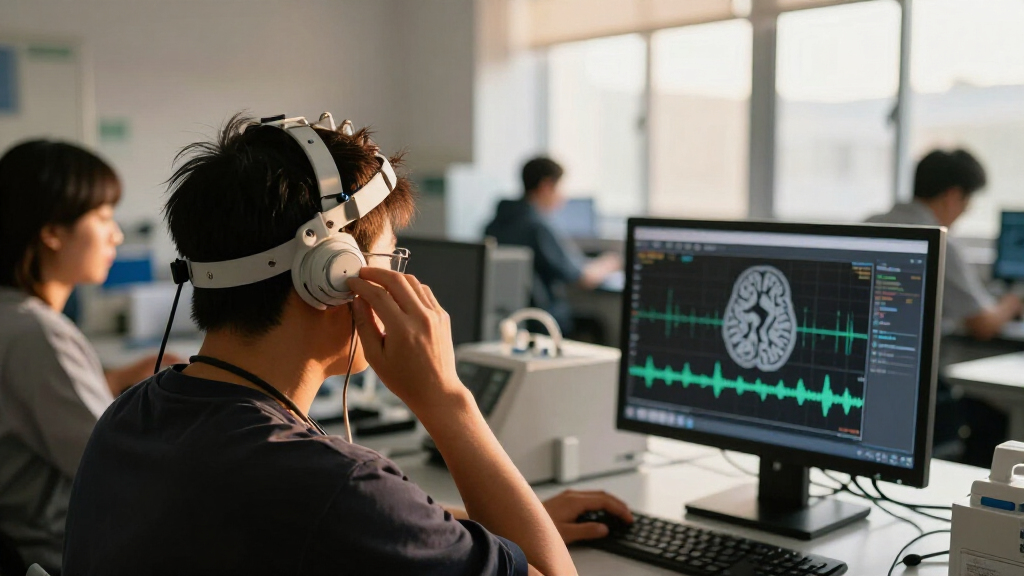
The researchers used intracranial electrodes to record activity at high resolution while participants completed two memory exercises. One asked them to recall words shown on a screen. The other involved moving through a virtual environment and remembering where objects were located. The team, including neuroscientists Joshua Jacobs and Anup Das of the University of Chicago, identified several forms of traveling activity across the cortex.
Some patterns appeared to spread outward from a point, resembling ripples on water; others converged toward a location, and some formed vortex-like spirals. The researchers reported that patterns varied with the behavioral task. The source account does not provide participant numbers, detailed effect sizes or a full account of how often each pattern occurred, so those details cannot be assessed here.
The work builds on earlier observations of waves moving across the cortex in opposite directions. In a 2024 study in Nature Human Behavior, Jacobs and collaborators described activity moving from the back of the brain toward the front, or in the reverse direction, during memory tasks. The 2026 study extends that picture by reporting more varied wave geometries, rather than only movement along a single broad axis.
How Wave Patterns May Support Memory
The results matter because they suggest that large-scale brain activity may be organized in more than one direction or shape as people carry out different tasks. If the patterns help coordinate activity across brain regions, they could offer researchers a way to study how the brain adapts rapidly, on the timescale of behavior, rather than relying only on slower changes in connections between individual neurons.
That interpretation remains a possibility, not a settled conclusion. Task-linked patterns do not prove causation: waves could help organize information, reflect other neural processes, or do both. Earl K. Miller, a cognitive neuroscientist at the Massachusetts Institute of Technology, described the broader shift in research as moving from asking whether waves are relevant to considering them a major feature of how the cortex processes information. That is an assessment of the emerging field, not a finding established by this one study.
Better knowledge of these patterns could also refine how scientists interpret recordings of brain activity. Rather than treating oscillations simply as a general sign that the brain is active, researchers may be able to examine their direction and form in relation to specific tasks. The present findings are basic research; the source does not report a diagnostic tool, treatment or clinical application.
As an affiliate, we earn on qualifying purchases.
From Simple Waves to Spirals
Researchers have recorded electrical rhythms in the brain for roughly a century. Electroencephalography (EEG), developed using electrodes placed on the scalp, made it possible to track broad oscillations associated with states such as attention, memory and sleep. But signals recorded outside the skull offer less detail about where activity occurs than recordings made directly from the brain.
Intracranial recordings can provide finer spatial and temporal information, but they are generally available in particular clinical settings. Jacobs’ research group used recordings from people with severe epilepsy who had electrodes implanted to help doctors locate seizure sources; the research was conducted with participants’ permission. Such recordings provide valuable data, but they are not equivalent to sampling the brains of a broad, healthy population.
In the 2024 memory study, researchers described waves traveling between visual areas at the back of the brain and areas toward the front associated with higher-level processing. Jacobs and collaborator Uma Mohan proposed that changing wave direction might relate to switching between encoding and recalling memories. The April 2026 study adds source, sink and spiral-like patterns to the set of observed activity, complicating a model based mainly on front-to-back or back-to-front movement.
“The work coming out is moving this from ‘Are they relevant?’ to ‘This is a major motif of how the cortex processes information.’”
— Earl K. Miller, cognitive neuroscientist at the Massachusetts Institute of Technology
As an affiliate, we earn on qualifying purchases.
What the Recordings Cannot Yet Show
The study found associations between memory tasks and wave patterns, but the reported evidence does not establish whether the waves actively organize processing or arise alongside it. It also remains unclear how common the different patterns are across people, brain regions and kinds of behavior. The source material does not specify the sample size or provide enough numerical detail to judge the strength and consistency of each association.
The recordings came from people undergoing monitoring for severe epilepsy, which limits how broadly the results can be generalized. The account also does not describe whether the same patterns occur in people without epilepsy or whether they appear during everyday behavior outside controlled tasks. Further research would be needed to test those questions and to determine whether wave shapes predict performance or simply accompany it.
As an affiliate, we earn on qualifying purchases.
Testing Waves Across More Tasks
The findings point to further work comparing wave patterns across participants, brain areas and types of behavior, and testing whether the patterns reliably change when task demands change. Researchers will also need to distinguish activity that merely tracks a task from activity that contributes to carrying it out.
No specific next study, timetable or clinical application is identified in the source material. For now, the reported result is a new description of complex traveling activity during memory tasks—not evidence that brain waves can already be used to diagnose or treat a condition.
As an affiliate, we earn on qualifying purchases.
Key Questions
What did the 2026 study find?
Researchers reported outward-moving, converging and spiral-like traveling waves in recordings from awake people doing verbal and spatial memory tasks. Different tasks were associated with different wave patterns.
Does the study prove that brain waves control memory?
No. It reports associations between task type and wave patterns. The findings do not establish whether waves cause or organize memory processing, or whether they reflect other activity occurring at the same time.
How were the waves recorded?
The team used electrodes placed inside the brain to record activity with higher spatial and temporal detail than typical scalp EEG. The recordings were obtained from people with severe epilepsy who had electrodes implanted for clinical monitoring.
How does this differ from earlier research?
A 2024 study described waves traveling broadly from the back of the cortex to the front, or in the opposite direction, during memory tasks. The 2026 report describes more varied forms, including waves that spread outward, converge or spiral.
Could the findings lead to a medical application?
The source reports no diagnostic or treatment application. The work is basic research, and additional studies would be needed to establish how broadly the patterns occur and whether they have clinical relevance.
Source: hn
Fall Picks
fall essentials
As an affiliate, we earn on qualifying purchases.