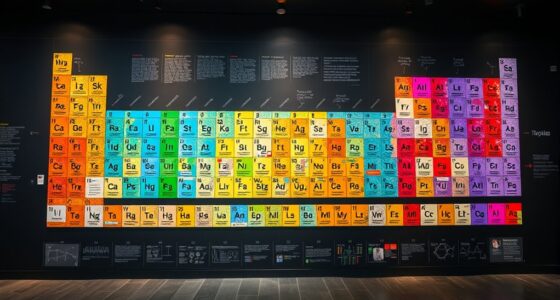
Alchemy began as a mystical quest to turn base metals into gold, driven by symbols like the philosopher’s stone. Over time, practitioners shifted their focus toExperimentation and evidence, gradually establishing scientific methods. The 16th and 17th centuries marked a move toward empirical chemistry, with discoveries like elements and chemical reactions replacing mystical ideas. This evolution laid the groundwork for modern chemistry, showing how curiosity and systematic study transformed ancient dreams into science. If you explore further, you’ll see how these changes shaped today’s scientific understanding.
Key Takeaways
- Alchemy aimed to transmute base metals into gold and was rooted in mystical beliefs and secret knowledge.
- The shift from mysticism to empiricism in the 16th and 17th centuries emphasized experimentation and reproducibility.
- Scientific figures like Robert Boyle promoted structured experiments, leading to the development of modern chemical methods.
- Discoveries by Antoine Lavoisier and others replaced mystical symbols with scientific terminology and understanding of elements.
- Modern chemistry evolved from alchemical roots, emphasizing evidence-based research, chemical reactions, and the periodic table.

The journey from alchemy to modern chemistry is a fascinating story of how human curiosity and experimentation evolved over centuries. During the Middle Ages, alchemy was driven by the quest to turn base metals into gold, a pursuit closely linked to the legendary philosopher’s stone. This mythical substance symbolized the ultimate goal of alchemists: transmutation. They believed that, through secret processes and mystical knowledge, they could transform common materials into precious ones, revealing the secrets of nature’s hidden powers. These transmutation experiments, though often rooted in mysticism, laid the groundwork for scientific exploration, pushing practitioners to refine their techniques and deepen their understanding of matter.
As you follow this progression, you see how alchemists began to shift from mystical pursuits to more empirical methods. They kept detailed records of their experiments, hoping to discover universal principles governing matter. While the philosopher’s stone remained a symbol of their ultimate achievement, many alchemists started focusing on chemical processes that could be replicated and tested. This gradual move toward experimentation made alchemy more systematic, even if still intertwined with symbolism and spiritual beliefs. The transmutation experiments, though mostly unsuccessful in their legendary goal, inspired a spirit of inquiry that would eventually lead to the development of modern chemistry.
By the 16th and 17th centuries, figures like Robert Boyle challenged traditional alchemical views, emphasizing observation and reproducibility. Boyle’s work on gases and chemical reactions marked a significant shift from mystical practices to scientific methodology. You see this evolution clearly in the way experiments became more structured, with a focus on understanding the properties of substances rather than chasing mystical transformations. The idea of transmutation persisted as a conceptual goal, but it gradually evolved into a scientific investigation into chemical reactions and element formation. The philosopher’s stone faded from scientific pursuits, replaced by the periodic table and the understanding of atomic structure.
Eventually, discoveries such as Antoine Lavoisier’s identification of elements and the development of chemical nomenclature cemented the shift from alchemy to chemistry. You now have a science grounded in evidence and systematic experimentation, far removed from the mysticism of alchemy. The spirit of curiosity that drove alchemists to seek the philosopher’s stone and perform transmutation experiments ultimately fueled scientific progress. Today’s chemistry continues to build on that foundation, transforming ancient dreams into modern understanding. The journey from mystical transmutations to precise chemical reactions exemplifies how human curiosity pushes us to explore, understand, and harness the natural world. Moreover, the evolution from alchemy to chemistry underscores the importance of scientific methodology in advancing human knowledge.

From Alchemy to Chemistry (Dover Science Books)
As an affiliate, we earn on qualifying purchases.
As an affiliate, we earn on qualifying purchases.
Frequently Asked Questions
How Did Alchemy Influence Early Scientific Methods?
You see, alchemy influenced early scientific methods by shaping medieval laboratory techniques and fostering a focus on experimentation. Alchemical philosophy encouraged you to observe, record, and refine processes, laying groundwork for systematic investigation. This approach helped shift from mystical beliefs to empirical methods, inspiring chemists to develop more precise tools and techniques. Ultimately, alchemy’s blend of philosophy and experimentation paved the way for modern scientific discoveries.
Which Alchemical Symbols Are Still Used Today?
You’ll notice that some alchemical symbols, like the circle with a dot for gold and the crescent for silver, are still used today. These symbols come from ancient meanings, representing elements or substances. Modern usage often keeps these symbols for scientific diagrams, astrology, or jewelry. Their enduring presence shows how ancient symbol meanings have persisted, bridging history and contemporary practices in a fascinating way.
What Were the Major Obstacles in Transitioning From Alchemy to Chemistry?
You might think the shift from alchemy to chemistry was smooth, but major obstacles like poor laboratory safety and standardization challenges stood in the way. Alchemists’ secretive practices hindered scientific progress, making it hard to share findings. As safety standards improved, the focus shifted from mystical pursuits to empirical evidence. Overcoming these hurdles eventually led to the precise, standardized science we recognize today, proving that progress often comes with a few setbacks.
How Did Cultural Beliefs Shape Alchemical Practices?
You see, cultural beliefs deeply influenced alchemical practices through cultural symbolism and historical perceptions. People believed in mystical symbols and spiritual meanings attached to materials and processes, shaping how alchemists approached their work. These perceptions often prioritized spiritual transformation over scientific accuracy, hindering progress. As a result, cultural beliefs both inspired and constrained alchemy, making it a blend of mysticism and proto-science that evolved over time into modern chemistry.
Who Were the Key Figures in This Scientific Evolution?
You should recognize that medieval alchemists like Geber and Roger Bacon laid the groundwork, blending mysticism with early experiments. Renaissance scientists such as Robert Boyle and Antoine Lavoisier advanced chemistry, emphasizing experimentation and scientific method. These key figures shifted the field from mystical practices to empirical science, shaping modern chemistry. Their contributions marked significant shifts, with medieval alchemists inspiring the curiosity and foundations that Renaissance scientists built upon to develop modern scientific understanding.

National Geographic Amazing Chemistry Set – Chemistry Kit with 100+ Science Experiments Including Crystal Growing and Reactions, Science Kit for Kids, STEM Gift for Boys and Girls (Amazon Exclusive)
OVER 100 EXCITING EXPERIMENTS – The science experiments in this kit let kids explore the wonders of hands-on…
As an affiliate, we earn on qualifying purchases.
As an affiliate, we earn on qualifying purchases.
Conclusion
As you’ve traveled through the evolution from alchemy to modern chemistry, you’ve seen how each discovery built upon the last like stones in a grand bridge. Today’s science stands firm on the foundations laid centuries ago, transforming mystical pursuits into precise experiments. Just as a river carves its path through the landscape, human curiosity and ingenuity continue to shape the course of chemical discovery. Embrace this journey, for it’s an ongoing adventure into the heart of matter itself.

Periodic Table of Elements Poster For Kids – LAMINATED – Science & Chemistry Chart for Classroom – (18" x 24")
Periodic Table of Elements Poster Chart
As an affiliate, we earn on qualifying purchases.
As an affiliate, we earn on qualifying purchases.

National Geographic Junior Chemistry Set – Complete Early Learning Lab Kit with 50 Science Experiments for Kids and 20+ Lab Tools, Chemistry Set, Science Experiments for Kids 4-6
A COMPLETE CHEMISTRY LAB FOR YOUNG SCIENTISTS – Perfectly crafted for budding scientists aged 4 and up, this…
As an affiliate, we earn on qualifying purchases.
As an affiliate, we earn on qualifying purchases.