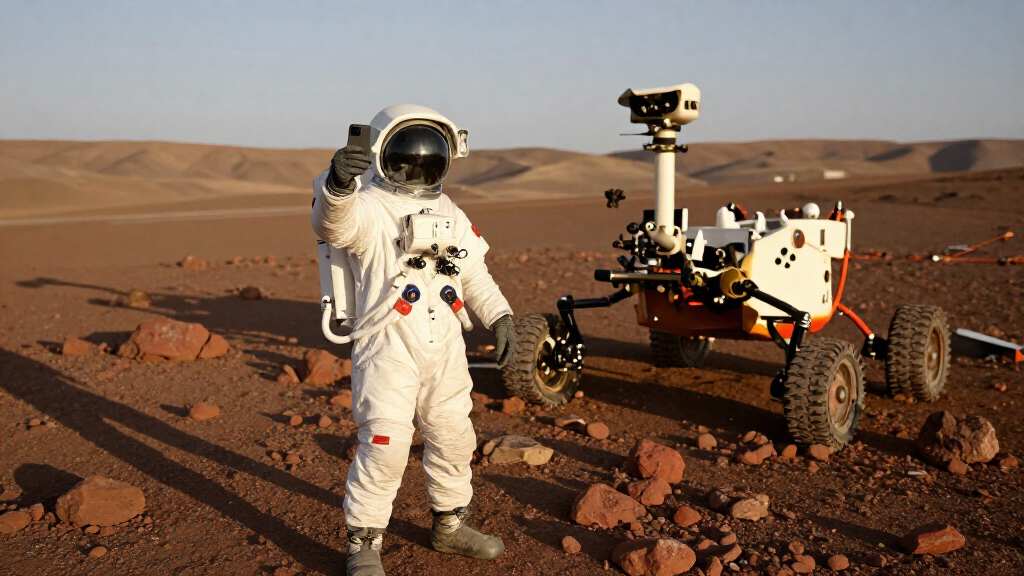

TL;DR

Get school and study supplies delivered free — and shop member deals
- Fast, free delivery on millions of items
- Access to Prime Big Deal Days deals on October 6–7
- Prime Video, Amazon Music and more included
NASA’s Astronomy Picture of the Day for Oct. 3, 2026, features a Curiosity rover selfie recorded at Vera Rubin Ridge on Jan. 23, 2018. The 360-degree panorama combines 61 images, while the accompanying NASA description notes that Curiosity reached a total elevation gain of 1 kilometer on Mount Sharp on Aug. 26, 2026.
NASA’s Astronomy Picture of the Day for Oct. 3, 2026, features a panoramic selfie of the Curiosity rover at the south rim of Vera Rubin Ridge on Mars, captured on Jan. 23, 2018. The image is a stitched composition of 61 exposures, and NASA’s description adds a later update: Curiosity had recorded a total elevation gain of 1 kilometer during its trek up Mount Sharp by Aug. 26, 2026.
The photograph was taken on mission sol 1943, the rover’s 1,943rd Martian day of exploration. NASA explains that a sol is a Martian solar day, about 40 minutes longer than an Earth day; sol 1943 corresponds to Jan. 23, 2018, on Earth. The image therefore shows the rover at a point in its mission more than eight years before the 2026 APOD publication.
The panorama combines 61 exposures made with Curiosity’s Mars Hand Lens Imager, or MAHLI. Frames showing the camera’s arm were edited out of the composite. The extended background came from images captured by the rover’s Mastcam on sol 1903, according to the NASA APOD explanation. NASA also says the scene was composed as an interactive 360-degree virtual-reality panorama.
In the image, hardware atop Curiosity’s mast partly blocks a distant feature: the ChemCam housing, which fires a laser, obscures the peak of Mount Sharp. The rover’s location on Vera Rubin Ridge and the view of Mount Sharp place the picture within Curiosity’s ongoing exploration of the slopes inside Gale Crater. The APOD credits NASA, JPL-Caltech and MSSS for the image, and Andrew Bodrov for the panorama.
A Rover’s Climb in One Panorama
The image links a specific moment in Curiosity’s field work to a later measure of the rover’s route. The 2018 selfie records the rover at Vera Rubin Ridge; the APOD’s 2026 note says the mission had accumulated 1 kilometer of elevation gain on its trek from Gale Crater’s floor up Mount Sharp by Aug. 26, 2026. The two dates should not be confused: the elevation figure is a later mission milestone, not a measurement made when this selfie was taken.
For readers, the panorama offers a visual record of the rover and its surroundings, while the elevation update conveys the scale of its long-term traverse. NASA’s description does not say that the one-kilometer figure represents the rover’s total distance traveled or its present altitude above a defined datum. It describes total elevation gain along the climb, a different measure from distance on the ground or absolute elevation.
The technical details also show how a rover selfie is assembled. MAHLI exposures captured the rover and nearby scene, while Mastcam frames supplied the extended background. The result is a constructed panorama rather than one exposure from a single camera position. That approach lets the image show more of the scene, but the APOD description identifies which parts came from different capture times and notes that the imager’s arm was removed from the displayed frames.
As an affiliate, we earn on qualifying purchases.
From Sol 1943 to the 2026 APOD
NASA’s Astronomy Picture of the Day selects a different astronomical image or photograph each day and pairs it with an explanation written by a professional astronomer, according to the APOD page. The Oct. 3, 2026, entry revisits a Mars rover image from 2018 rather than reporting that the selfie was newly taken. Its publication date and the photograph’s Earth-equivalent date are separate points in the timeline.
Curiosity is described in the source as a small car-sized rover exploring Mars. Vera Rubin Ridge lies on the lower slopes of Mount Sharp, the mountain inside Gale Crater that the rover has been climbing. NASA’s account places this particular image at the ridge’s south rim. It also explains that the distant Mount Sharp peak is partly hidden by a component of the rover itself, a reminder that the panorama records a viewpoint from the vehicle, not an unobstructed landscape photograph.
The APOD credits the image to NASA, the Jet Propulsion Laboratory, the Malin Space Science Systems team and panorama creator Andrew Bodrov. The page lists Jerry Bonnell, Cecilia Chirenti, Robert Nemiroff and Keighley Rockcliffe as authors and editors, and identifies the service with NASA’s Astrophysics Science Division, NASA Science Activation and Michigan Technological University.
As an affiliate, we earn on qualifying purchases.
What the Elevation Figure Measures
The source states that Curiosity had gained 1 kilometer in elevation by Aug. 26, 2026, but it does not provide a detailed calculation, the rover’s precise position on that date, or the distance traveled to achieve the gain. It also does not specify an absolute altitude reference. The stated figure should be read as cumulative elevation gain on the described climb, not as a claim that the rover had traveled one kilometer across the surface.
The APOD entry does not report new scientific findings from the image, describe the rover’s condition, or provide a forecast for its next route segment. It is a presentation of an earlier panorama paired with a later progress note. No additional mission update or new image-capture date is given in the supplied report.
As an affiliate, we earn on qualifying purchases.
Curiosity’s Continuing Mount Sharp Traverse
The immediate next development in this item is the continuation of Curiosity’s mission on Mount Sharp; the APOD page does not announce a specific upcoming waypoint, target, or date. Future progress updates may put the one-kilometer elevation milestone in context with the rover’s subsequent route, but no such figures are included here.
Readers can view the Oct. 3 APOD entry for the image and its accompanying explanation. NASA’s source also notes a change to the email address for APOD image submissions and directs users to the APOD Submissions page. That notice concerns image submissions, not Curiosity’s operations.
As an affiliate, we earn on qualifying purchases.
Key Questions
When did Curiosity take the Vera Rubin Ridge selfie?
The rover recorded it on sol 1943, which NASA maps to Jan. 23, 2018, on Earth.
How was the panorama made?
It combines 61 MAHLI exposures. NASA says frames containing the imager’s arm were edited out, and the extended background came from Mastcam images taken on sol 1903.
What does Curiosity’s one-kilometer milestone refer to?
NASA says that by Aug. 26, 2026, Curiosity had accumulated 1 kilometer of elevation gain while traveling from Gale Crater’s floor up Mount Sharp. The source does not describe this as the rover’s total driving distance or specify its absolute altitude.
Was the selfie taken in 2026?
No. The image dates to Jan. 23, 2018. Oct. 3, 2026, is the date NASA featured it as Astronomy Picture of the Day.
Source: primary
Fall Picks
fall essentials
As an affiliate, we earn on qualifying purchases.



![Competitive Programmer's Handbook (2018) [Pdf]](https://varietychem.com/wp-content/uploads/2026/10/competitive-programmer-s-handbook-2018-pdf-featured-260x140.jpg)