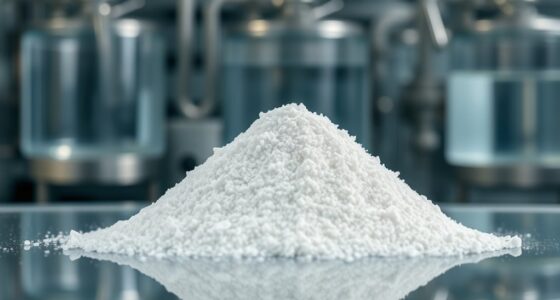
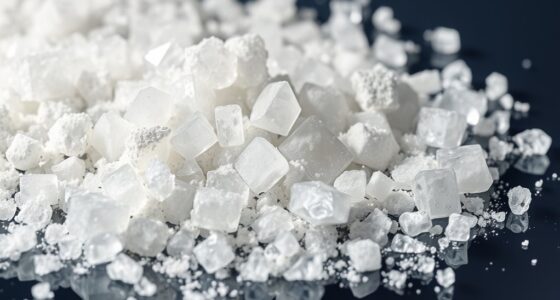
Calcium carbonate forms naturally over millions of years inside the Earth through processes like marine organism shells, coral reefs, and limestone deposits. Mines extract these rocks through quarrying, then crush and refine them for industrial use. It’s widely used in products like paper, paints, plastics, and construction materials. Its natural origins and versatility show how geology and industry connect, and exploring this further reveals the importance of responsible resource management and sustainable practices.
Key Takeaways
- Calcium carbonate forms naturally through marine sedimentation of shells, coral, and limestone over millions of years.
- It is extracted via quarrying and refined by crushing, separating impurities, and sometimes calcining.
- Processed calcium carbonate is used in industries like paper, paint, plastics, and construction materials.
- It has practical applications in water treatment, dietary supplements, and antacids due to its chemical stability and whiteness.
- Sustainable mining practices are essential to preserve natural resources and ensure ongoing industrial benefits.

Have you ever wondered what makes up the chalk in your classroom or the shells of marine animals? The answer is calcium carbonate, a mineral that forms through natural geological processes. It’s a compound with remarkable versatility, playing a crucial role in many industries. To access this resource, companies engage in mineral extraction, carefully mining deposits of calcite and aragonite. These deposits often develop over millions of years from the accumulation of marine organism shells, coral reefs, and limestone formations. Once extracted, calcium carbonate undergoes processing to meet specific industrial needs, but the journey from raw material to finished product is both intricate and vital.
Calcium carbonate, vital in industries, forms from natural geological deposits over millions of years.
In the realm of mineral extraction, you’re essentially tapping into the earth’s natural history. Quarrying limestone and other calcium carbonate-rich rocks is the primary way to gather raw material. Modern extraction techniques aim to maximize efficiency while minimizing environmental impact. Once mined, the raw material is crushed and refined. This process involves separating impurities, grinding it into fine powders, and sometimes calcining it—heating to produce calcium oxide, which can be further processed. This raw calcium carbonate then finds its way into a multitude of industrial applications, demonstrating its importance across sectors.
You’ll find calcium carbonate in many everyday products, from paper and paints to plastics and adhesives. In manufacturing paper, it’s used as a filler to improve brightness and surface quality. When incorporated into paints and coatings, it provides durability and a smooth finish. In plastics, calcium carbonate acts as a filler that enhances strength and reduces costs. Its applications extend to the construction industry as well, where it’s a key ingredient in cement and concrete. The mineral’s properties—such as whiteness, chemical stability, and affordability—make it indispensable across these industries.
Beyond industrial applications, calcium carbonate also plays a role in environmental and health-related fields. It’s used in water treatment to neutralize acidity and remove impurities. It’s also a common ingredient in dietary supplements and antacids. The widespread use of calcium carbonate underscores its importance, but it all begins with responsible mineral extraction. Extracting the mineral efficiently and sustainably guarantees that industries can continue to benefit from its properties without depleting natural resources or harming ecosystems.
In essence, calcium carbonate is a bridge between the earth’s geological history and modern industry. Its journey from mineral deposits to essential industrial applications highlights both the value of natural resources and the importance of sustainable practices. When you see chalk, shells, or even the white paint on walls, you’re witnessing the remarkable utility of this abundant mineral, shaped by nature and harnessed through human ingenuity.
Frequently Asked Questions
How Is Calcium Carbonate Mined Sustainably?
You can mine calcium carbonate sustainably by adopting eco-friendly mining practices that minimize environmental impact. Focus on reducing your carbon footprint through energy-efficient methods, recycling water, and restoring mined areas. Using technologies like precision extraction helps limit waste and habitat disruption. By prioritizing these strategies, you guarantee responsible resource use, support environmental health, and promote long-term sustainability in calcium carbonate production.
What Are Alternative Sources of Calcium Carbonate?
You can find alternative sources of calcium carbonate in marine deposits and biological sources. Marine deposits, like limestone formed under the sea, offer vast reserves. Biological sources include shells, corals, and algae that produce calcium carbonate naturally. By harvesting these materials responsibly, you diminish reliance on mined resources, promoting sustainability. Exploring these alternatives helps ensure a steady, eco-friendly supply of calcium carbonate for industrial applications.
How Does Calcium Carbonate Impact Environmental Health?
Think of calcium carbonate as a double-edged sword. It can brighten marine ecosystems by buffering ocean acidity, but when overused, it can harm air quality through dust emissions. When released into the environment, it influences marine life and contributes to air pollution. You should be mindful of how its industrial use affects ecosystems and air health, balancing benefits with potential environmental risks.
Can Calcium Carbonate Be Recycled or Reused?
Yes, you can recycle and reuse calcium carbonate through various recycling processes. You might find it in applications like construction materials, paper manufacturing, or as a filler in plastics. To reuse it, consider grinding or processing it for new uses, reducing waste and environmental impact. Recycling processes help extend its life and promote sustainable practices, making calcium carbonate a versatile resource in multiple industries.
What Are Future Innovations in Calcium Carbonate Applications?
You’ll likely see exciting innovations in calcium carbonate applications, such as nanotechnology enhancements that improve its strength and versatility, making it more adaptable for advanced materials. Bio-based synthesis offers a greener alternative, reducing environmental impact and opening doors for sustainable uses. These advancements could transform industries by creating eco-friendly products, where your role might involve adopting these new technologies to innovate further and promote sustainability in everyday applications.
Conclusion
So, now you see how calcium carbonate transforms from a natural mineral to a essential industrial resource. You understand its journey from geological formation to everyday application, from mining to manufacturing. You realize its versatility and importance across various industries, its role in shaping materials and products you use daily. You recognize its significance, its potential, and its impact. And with that knowledge, you’re better equipped to appreciate this remarkable compound’s journey and its influence on your world.