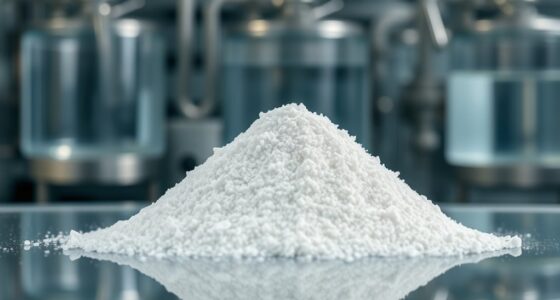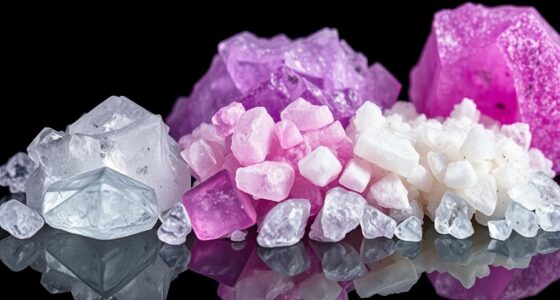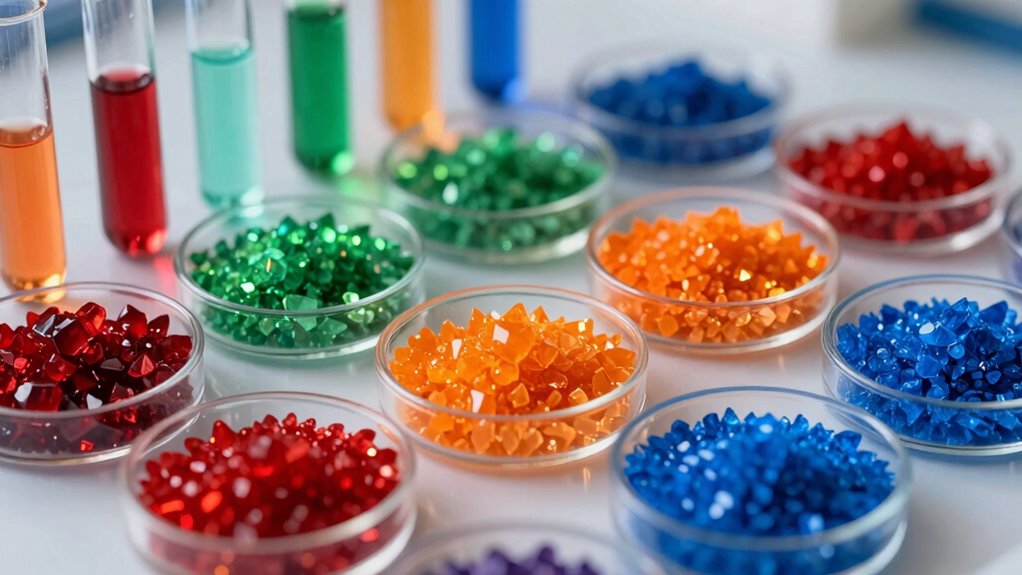

You’ll find that common inorganic salts like sodium chloride, copper sulfate, and potassium chloride are frequently used in flame tests for educational purposes. These salts produce characteristic flame colors—yellow, green, or violet—that help you identify metal ions visually. Factors like impurities and salt concentration influence the observed colors and emissions. By understanding these variations, you gain insight into electronic structures and spectra. Keep exploring further to discover how spectroscopic techniques complement flame testing for precise analysis.

Prime made for students and young adults
- Fast, free delivery for dorm and study essentials
- Prime Video and Amazon Music included
- Member-only deals
Key Takeaways
- Common inorganic salts like sodium chloride, copper sulfate, and potassium chloride are used to demonstrate characteristic flame colors.
- Flame tests visually illustrate electronic transitions and energy levels in metals, aiding in chemistry education.
- Impurities and concentration variations can affect observed flame colors, highlighting factors influencing spectral emissions.
- Spectroscopic analysis complements flame tests, providing precise identification of metal ions in inorganic salts.
- Flame tests serve as practical demonstrations for understanding electronic structure, emission spectra, and inorganic salt properties.
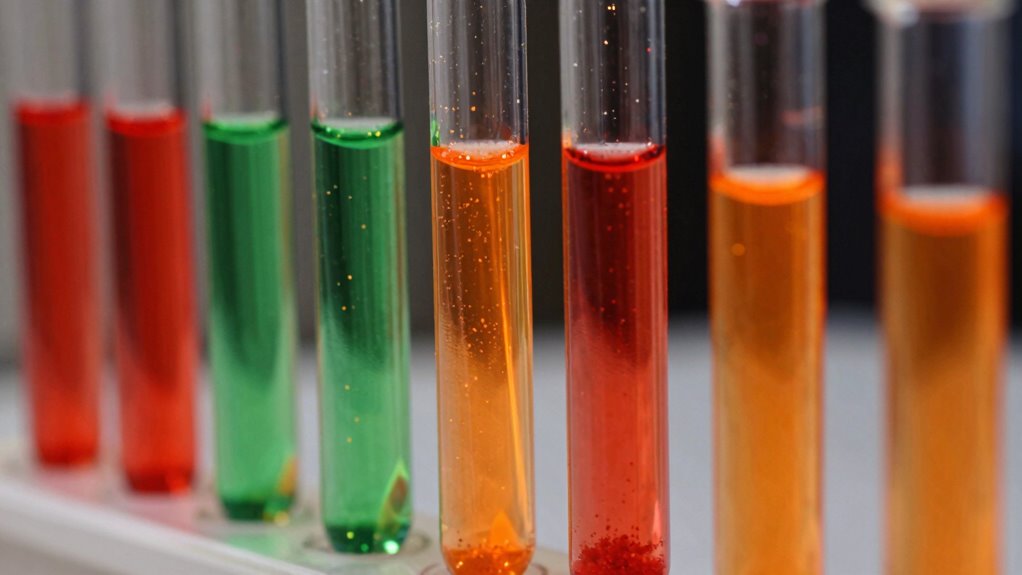
Have you ever wondered how scientists identify different inorganic salts? One of the most common methods involves flame tests, which reveal the presence of specific metal ions based on the color they produce when heated. When you perform a flame test, you’re essentially observing how different inorganic salts emit characteristic colors due to their unique electronic structures. These colors result from the excitation of electrons within the metal ions, which then release energy as visible light when they return to lower energy states. However, to confirm and analyze these observations more precisely, spectroscopic analysis becomes vital. Spectroscopy allows scientists to measure the wavelengths of light emitted or absorbed by the salts, providing detailed information that helps distinguish similar colors and identify salts with greater accuracy.
In the classroom or laboratory, understanding chemical property variations among inorganic salts is vital. Different salts, even of the same metal, can produce varying flame colors depending on factors like concentration, the presence of impurities, or the type of flame used. These variations make flame tests a valuable educational tool, as they demonstrate real-world applications of chemical principles. As you observe these differences, you learn that salts like sodium chloride produce a bright yellow flame, while copper salts may turn the flame green or blue. Such variations highlight how the chemical environment influences the emission spectra and, consequently, the observed flame color. Recognizing these properties helps you understand the underlying electron transitions that produce these colors, tying into broader concepts like electronic configurations and energy levels. Additionally, factors such as impurities in salts can further affect the flame colors and should be carefully controlled during experiments.
Furthermore, understanding the electron transitions involved in these emissions enriches your comprehension of atomic structure and spectra. Using spectroscopic techniques alongside flame tests offers a more thorough approach to identifying inorganic salts. For example, emission spectra obtained through atomic emission spectroscopy can confirm the presence of specific metal ions with high precision, especially when visual observation alone might be ambiguous. This combination of methods emphasizes the importance of understanding both the observable chemical property variations and the more detailed spectral data. As you become familiar with these analytical techniques, you gain a deeper appreciation of how scientists differentiate and analyze inorganic salts in research and education. Ultimately, mastering the interplay between flame test observations and spectroscopic analysis equips you with a robust toolkit for chemical identification, showcasing the scientific process in action and illuminating the fascinating world of inorganic chemistry.
As an affiliate, we earn on qualifying purchases.
Frequently Asked Questions
Are There Safety Precautions When Handling Inorganic Salts for Flame Tests?
Yes, you should take safety precautions when handling inorganic salts for flame tests. Always wear protective gear like gloves and safety goggles to prevent skin and eye contact. Conduct the tests in a well-ventilated area to avoid inhaling any fumes or dust. Keep a fire extinguisher nearby, and handle chemicals carefully to prevent accidents. Following these precautions guarantees your safety during flame testing procedures.
How Do Impurities Affect Flame Test Results?
Imagine trying to paint a clear picture; impurities are like smudges on your palette, distorting the true colors. They cause impurity interference, making flame colors less accurate and harder to interpret. This affects flame color accuracy, potentially leading you to misidentify elements. To get a true reading, you need pure salts, just like a clean brush helps you create a vivid, accurate masterpiece without unwanted distractions.
Can Inorganic Salts Be Reused After a Flame Test?
Inorganic salts generally aren’t suitable for reuse after a flame test because salt stability decreases with repeated heating, leading to decomposition or contamination. The high temperatures can alter the salt’s chemical structure, reducing its effectiveness in producing consistent flame colors. Consequently, while reuse potential exists in theory, practically, it’s better to use fresh samples for accurate results, ensuring reliable and vivid flame test outcomes.
What Are Alternative Methods to Identify Metal Ions?
Did you know that over 70% of laboratories rely on spectroscopic techniques for metal ion identification? You can use spectroscopic methods, like atomic absorption or emission spectroscopy, which offer precise results. Alternatively, pH indicator methods help identify metal ions based on color changes in solutions. These methods are safer and more accurate than flame tests, making them excellent choices for modern analytical chemistry.
Are Synthetic Inorganic Salts More Reliable Than Natural Samples?
Synthetic inorganic salts are generally more reliable than natural samples because they offer consistent synthetic reliability, reducing variability. Natural samples often have natural variability in composition, which can affect flame test results. When you use synthetic salts, you get a controlled, pure compound, leading to more accurate and reproducible results. This consistency makes synthetic salts preferable for educational demonstrations and precise analytical work.
metal ion flame test demonstration
As an affiliate, we earn on qualifying purchases.
As an affiliate, we earn on qualifying purchases.
Conclusion
So, next time you’re dazzled by a flame test’s colorful display, remember it’s not just some magical show. It’s the science of inorganic salts revealing their true colors—literally. Who knew that a simple dash of sodium chloride or copper sulfate could turn an ordinary flame into a vibrant spectacle? So go ahead, impress your friends with these “scientific” fireworks, and proudly claim you’re witnessing the world’s most colorful chemistry class—without ever leaving your backyard.
spectroscopy for inorganic salts
As an affiliate, we earn on qualifying purchases.
As an affiliate, we earn on qualifying purchases.
educational chemistry flame test set
As an affiliate, we earn on qualifying purchases.
As an affiliate, we earn on qualifying purchases.
Fall Picks
fall essentials
As an affiliate, we earn on qualifying purchases.