
Brassinosteroids are natural plant hormones that markedly boost crop yields by promoting growth, development, and stress resilience. You can apply them through natural extraction or genetic methods to improve plant elongation, vascular growth, and reproductive success. They also help plants tolerate drought, salinity, and temperature stress, leading to more resilient crops. Advances in research and application techniques mean you can optimize their use for better productivity. Exploring these tools further will show you how to harness their full potential in agriculture.
Key Takeaways
- Brassinosteroids enhance crop growth, development, and stress tolerance by activating cellular processes and gene regulation pathways.
- Advances in genetic engineering enable precise manipulation of brassinosteroid pathways for higher yields and crop resilience.
- Proper application strategies, such as foliar sprays and soil drenches, optimize brassinosteroid effectiveness in crop improvement.
- Sustainable use of brassinosteroids can increase crop productivity while minimizing environmental impacts.
- Overcoming regulatory and economic challenges is essential for widespread adoption of brassinosteroids in agriculture.
Understanding Brassinosteroids: Nature’s Plant Hormones

While they may not be as well-known as other plant hormones, brassinosteroids play a crucial role in plant development. You can access these hormones through natural extraction from plants or synthesize them via genetic modification techniques. Natural extraction involves isolating brassinosteroids from plant tissues like rice or brassica, providing a more traditional approach. Alternatively, genetic modification allows you to enhance or produce brassinosteroids in specific crops, boosting growth and stress resistance. Understanding these methods helps you harness brassinosteroids effectively, whether for research or agricultural improvement. Both approaches contribute to developing innovative strategies for crop yield enhancement, making brassinosteroids valuable tools in modern plant science. Their versatile production methods open new avenues for optimizing plant growth and resilience. AI-driven innovations are increasingly being integrated into plant science research to accelerate the development of resilient crop varieties, including the application of biotechnological techniques to improve hormone production and function. Additionally, fostering creative approaches in research can lead to unexpected breakthroughs in crop science.
Mechanisms of Action in Plant Growth and Development
Brassinosteroids influence plant growth and development by activating specific cellular processes that regulate cell expansion, division, and differentiation. They bind to receptor signaling components on the cell surface, triggering a cascade that ultimately influences gene regulation. This process guarantees that growth responses are finely tuned to environmental cues and developmental stages. As a result, brassinosteroids promote elongation, vascular differentiation, and reproductive development. Understanding these mechanisms helps you appreciate how brassinosteroids modulate plant architecture and productivity. receptor signaling initiates the brassinosteroid response, activating downstream kinases. Gene regulation involves turning on growth-related genes and suppressing inhibitors. Signal transduction pathways integrate environmental signals for adaptive growth. Cellular processes like cell wall loosening and division are directly influenced by these molecular events. Additionally, the hormonal balance within plants can influence the effectiveness of brassinosteroids, ensuring optimal growth responses under varying conditions.
Enhancing Stress Tolerance Through Brassinosteroid Application
Applying brassinosteroids enhances plant stress tolerance by activating molecular pathways that bolster defense mechanisms and stabilize cellular functions. When you use brassinosteroids, you help plants better cope with abiotic stresses like drought, salinity, and extreme temperatures. This application can work alongside genetic modification to develop crops with improved resilience. Additionally, research indicates that brassinosteroids can influence plant growth regulators, further supporting stress adaptation. Moreover, understanding the signaling pathways involved can help optimize application strategies for different crop species. However, consider the environmental impact, as excessive use might affect soil health or non-target organisms. By fine-tuning application methods, you can maximize benefits while minimizing risks. Brassinosteroids modulate antioxidant systems and osmolyte accumulation, strengthening plant defenses. This approach offers a sustainable way to improve crop performance under stressful conditions, ultimately supporting food security. Always evaluate the ecological consequences to guarantee responsible use aligned with environmental protection. Understanding the Vortex of personal growth can also inspire innovative approaches to sustainable agriculture.
Recent Advances in Brassinosteroid Research and Technology

Recent research in brassinosteroid technology has led to significant breakthroughs that deepen our understanding of how these hormones influence plant growth and resilience. Advances in genetic engineering now enable precise manipulation of brassinosteroid pathways, boosting crop performance. Researchers are also exploring crop biofortification, enhancing nutritional content through brassinosteroid modulation. These developments open new avenues for sustainable agriculture and food security. You can expect to see genetically engineered crops with optimized brassinosteroid responses, leading to increased yields and stress tolerance. Additionally, integrating these techniques helps reduce reliance on chemical inputs. Overall, these innovations are transforming brassinosteroid research from basic science into practical, impactful solutions for modern farming.
- Improving crop resilience via targeted genetic modifications
- Enhancing nutritional quality through biofortification
- Developing stress-tolerant, high-yield crop varieties
- Bridging research and field application for sustainable growth
Practical Strategies for Integrating Brassinosteroids in Agriculture
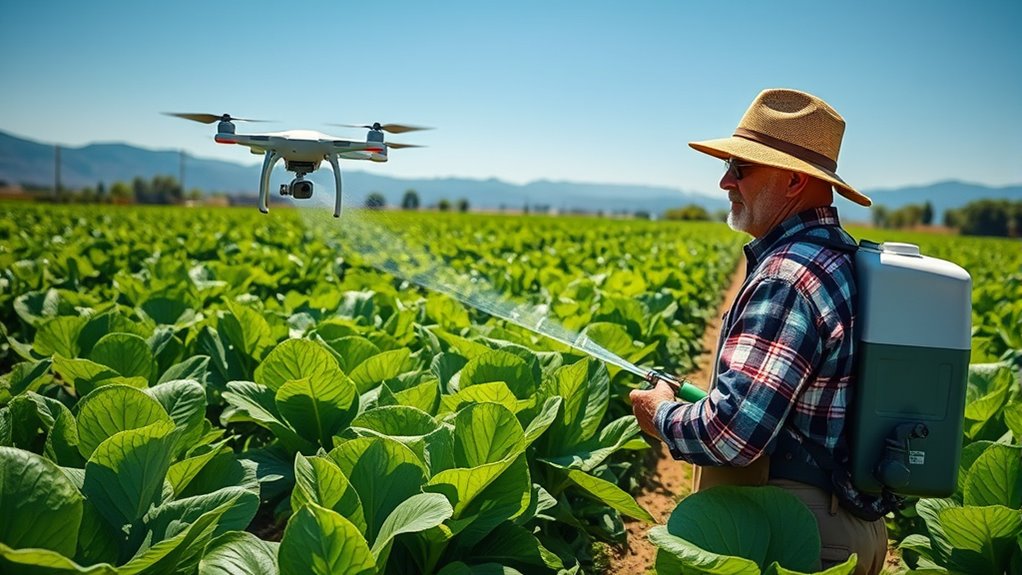
To effectively incorporate brassinosteroids into your farming practices, you need to focus on application techniques that maximize their benefits. Getting the timing and dosage right is vital to guarantee peak crop response without waste. By fine-tuning these strategies, you can boost crop growth and improve yields efficiently. Additionally, understanding the application methods used in plant growth regulators can help optimize their efficacy and ensure sustainable crop management.
Application Techniques Optimization
Optimizing the application techniques of brassinosteroids is vital for maximizing their benefits in agriculture. To achieve this, focus on the method of delivery, such as foliar spray or soil drenching, which influences absorption efficiency. Proper formulation and concentration are essential, guaranteeing the hormone reaches crops effectively without causing stress. Additionally, consider environmental factors like humidity and temperature, which impact uptake and efficacy. Consistent application ensures steady stimulation of growth processes. Remember, the goal is to enhance plant resilience and productivity with minimal waste.
- Select appropriate application methods based on crop type and growth stage
- Use proper equipment for uniform distribution
- Adjust concentrations for optimal absorption and minimal phytotoxicity
- Monitor environmental conditions to maximize effectiveness
Timing and Dosage Strategies
Timing and dosage are essential for maximizing the benefits of brassinosteroids in your crop management. Proper application timing ensures the hormones support critical growth stages, like early development or flowering, when plants are most responsive. You should carefully consider crop type, environmental conditions, and growth stage to determine ideal application timing. Additionally, understanding the application guidelines is crucial for effective use. Optimal timing can significantly influence the effectiveness of treatment and overall crop health. Applying brassinosteroids at the right growth stage can promote plant resilience and improve stress tolerance. Dosage optimization is equally important; applying too much can cause negative effects, while too little may be ineffective. Start with recommended rates and adjust based on plant response and field conditions. Regular monitoring helps you fine-tune both application timing and dosage, ensuring you get the best yield improvements. By carefully coordinating these strategies, you can enhance crop resilience, growth, and productivity using brassinosteroids effectively.
Future Perspectives and Challenges in Brassinosteroid Use
Despite the promising potential of brassinosteroids in enhancing crop productivity and stress tolerance, several challenges hinder their widespread application. Regulatory hurdles pose significant barriers, delaying approval processes and limiting commercialization. Additionally, economic feasibility remains a concern, as production costs can be high, affecting affordability for farmers. To realize their full benefits, you need to address these issues proactively. Advances in formulation and delivery methods could reduce costs and improve efficiency. Understanding long-term effects on ecosystems and crop genetics is vital. Furthermore, integrating brassinosteroids into existing agricultural practices requires farmer education and supportive policies. Developing sustainable application methods can also help mitigate environmental impacts and promote long-term adoption. Building farmer awareness and fostering effective communication among stakeholders will be essential for successful implementation. Developing sustainable application methods can also help mitigate environmental impacts and promote long-term adoption. Overcoming these challenges will be key to unleashing brassinosteroids’ potential as a sustainable crop enhancement tool.
Frequently Asked Questions
Are Brassinosteroids Cost-Effective for Large-Scale Farming?
You might wonder if brassinosteroids are cost-effective for large-scale farming. A thorough cost analysis shows that, while initial expenses can be high, improved crop yields and stress resistance often offset costs over time. However, it’s essential to take into account supply chain factors, like availability and distribution, which can influence overall affordability. When managed well, brassinosteroids could be a valuable investment, but you should evaluate these factors carefully.
How Do Brassinosteroids Compare to Traditional Growth Enhancers?
Did you know brassinosteroids can boost crop yields by up to 20%? Compared to traditional growth enhancers, they work through different mechanism differences, targeting plant cell elongation and stress resistance. You’ll find brassinosteroids often require specific application methods like foliar sprays or seed treatments, making them more precise. This targeted approach can lead to more sustainable growth improvements, giving you a strategic edge over conventional methods.
What Are Potential Environmental Risks of Brassinosteroid Use?
You might wonder about the environmental risks of brassinosteroid use. They could have ecological impacts, such as affecting non-target organisms or disrupting local ecosystems. Residue persistence is another concern, as these compounds may linger in soil or water, potentially harming wildlife or entering the food chain. Monitoring and managing their application carefully can help mitigate these risks and protect the environment while benefiting crop growth.
Can Brassinosteroids Be Combined With Other Crop Improvement Tools?
Oh, sure, because combining more tools is the secret to perfect crops, right? You can harness synergistic effects by carefully timing applications, boosting growth and resilience. Just imagine, coordinating brassinosteroids with fertilizers or biostimulants—what could possibly go wrong? When you synchronize their application timing, you maximize benefits without overloading plants. It’s a clever dance to elevate yields, proving that more tools, well-timed, can truly make a difference.
Are There Crop-Specific Responses to Brassinosteroid Application?
You’ll find that crop-specific responses to brassinosteroid application vary due to species specificity. Some plants respond strongly, while others show minimal effects. To maximize benefits, you need to optimize the dosage carefully for each crop. By understanding these differences, you can tailor treatment protocols, ensuring effective growth promotion without overstimulation or adverse effects, ultimately leading to better yield improvements tailored to each crop’s unique needs.
Conclusion
So, here you are, on the brink of revolutionizing your crops with brassinosteroids—nature’s hidden secret. You’ve learned how these tiny hormones can boost growth and stress tolerance, yet their full potential remains a puzzle. Ironically, the more we comprehend, the more we realize how little we truly control. Embrace the challenge, because in this game of crop improvement, brassinosteroids might just be your unexpected ace. Who knew tiny molecules could make such a big difference?