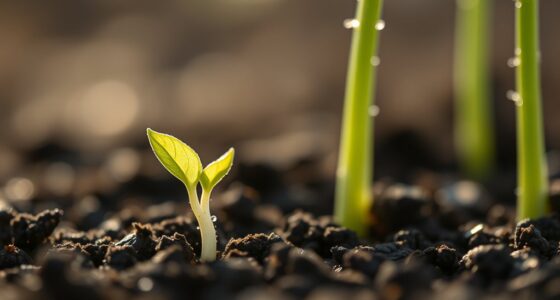

Plant growth regulators are natural hormones that control how plants grow and develop. They include auxins, cytokinins, gibberellins, abscisic acid, and ethylene, each affecting processes like seed germination, stem length, and fruit ripening. These PGRs are widely used in agriculture and horticulture to improve crop yield, promote rooting, or manage ripening. If you want to understand how these hormones work together to help plants adapt and thrive, keep exploring further.

Prime made for students and young adults
- Fast, free delivery for dorm and study essentials
- Prime Video and Amazon Music included
- Member-only deals
Key Takeaways
- Plant growth regulators (PGRs) are hormones that control various aspects of plant development.
- Main types include auxins, cytokinins, gibberellins, abscisic acid, and ethylene, each with specific roles.
- PGRs are used in agriculture to promote rooting, flowering, fruiting, and stress responses.
- They interact within complex hormonal networks to coordinate growth and adapt to environmental changes.
- Understanding PGR applications enhances crop management and improves plant resilience.

Have you ever wondered how plants control their growth and development? It might seem like plants just grow on their own, but in reality, they rely on a complex system of chemical signals known as plant growth regulators (PGRs). These naturally occurring hormones guide processes like seed germination, stem elongation, leaf expansion, flowering, and fruiting. By understanding how PGRs work, you can better appreciate how plants respond to their environment and how we can manipulate their growth for agricultural and horticultural benefits.
Plant growth regulators are small molecules that influence cellular activities, often by triggering specific responses. The main types include auxins, cytokinins, gibberellins, abscisic acid, and ethylene. Auxins, for instance, promote cell elongation and are essential for root initiation and directional growth. When you apply auxins to plants, you can encourage root formation or influence the way plants grow toward light. Cytokinins, on the other hand, stimulate cell division and promote shoot development, which can be useful in tissue culture or when trying to produce a bushier plant. Gibberellins are responsible for stimulating stem elongation, seed germination, and flowering. They’re often used to increase the size of fruits or to overcome dormancy in certain seeds.
Plant growth regulators like auxins, cytokinins, and gibberellins control growth and development processes in plants.
Abscisic acid mainly acts as a growth inhibitor, helping plants respond to stress conditions like drought by closing stomata and conserving water. Additionally, Hormonal interactions between PGRs enable plants to coordinate their responses to complex environmental cues. These interactions involve intricate hormonal networks that allow for fine-tuning growth and development based on internal and external signals. Ethylene is unique because it’s a gaseous hormone that regulates fruit ripening, leaf abscission, and response to mechanical stress. These hormones do not work in isolation; rather, they interact in complex networks that finely tune plant growth based on internal cues and external stimuli. These complex networks allow plants to adapt dynamically to changing environments, ensuring survival and reproductive success.
plant growth regulators for gardening
As an affiliate, we earn on qualifying purchases.
As an affiliate, we earn on qualifying purchases.
Frequently Asked Questions
How Do Plant Growth Regulators Differ From Fertilizers?
You might wonder how plant growth regulators differ from fertilizers. Growth regulators are hormones that influence specific processes like flowering or fruiting, controlling plant development. Fertilizers, on the other hand, supply essential nutrients like nitrogen, phosphorus, and potassium that support overall growth. While regulators modify growth patterns, fertilizers provide the nutrients the plant needs to thrive. Both are crucial, but they serve different roles in plant health and productivity.
Are Plant Growth Regulators Safe for Organic Farming?
Think of plant growth regulators as precision tools, like a scalpel instead of a hammer. In organic farming, their safety depends on the specific types used and adherence to organic standards. Generally, organic certification limits synthetic regulators, favoring natural alternatives. You should verify that the regulators meet organic guidelines, as improper use could jeopardize your farm’s organic integrity. Always choose approved products to ensure safety and compliance.
Can PGRS Be Used on All Plant Species?
You might wonder if PGRs can be used on all plant species. While many plants respond well, not every species reacts the same way. Some PGRs are specific to certain plants, and using them on incompatible species could cause harm or yield poor results. Always check the label and research the particular plant’s response before applying PGRs, ensuring safe and effective use tailored to each species.
What Are the Long-Term Environmental Impacts of PGRS?
Think of PGRs as tiny navigators guiding plant growth. Long-term, these regulators can accumulate in soil and water, potentially disrupting ecosystems and harming non-target organisms. You might unintentionally affect plant diversity or soil health, leading to unforeseen consequences. While PGRs can be beneficial, it’s essential to monitor their use carefully, ensuring that their influence doesn’t ripple negatively through the environment, like a stone causing ripples in a pond.
How Do I Determine the Correct PGR Dosage for My Plants?
To determine the correct PGR dosage for your plants, start by reading the product label carefully for recommended rates. Consider your plant’s species, age, and growth stage, as these influence how much PGR you should use. Test a small area first to observe the response. Adjust the dosage gradually if needed, and always follow safety guidelines to avoid over-application, which can harm your plants.
As an affiliate, we earn on qualifying purchases.
Conclusion
As you explore plant growth regulators, think of them as the unseen hands guiding nature’s dance. These tiny molecules act like gentle whispers, steering plants toward blossoming and fruitfulness. With each application, you’re nurturing a delicate balance—like tending a quiet garden at dawn, where every decision shapes a vibrant, thriving landscape. Embrace their power, and watch your plants flourish, turning simple seeds into lush, living tapestries painted by your mindful touch.
As an affiliate, we earn on qualifying purchases.
plant hormone products for horticulture
As an affiliate, we earn on qualifying purchases.
As an affiliate, we earn on qualifying purchases.
Fall Picks
fall essentials
As an affiliate, we earn on qualifying purchases.