Based on the latest expert reviews, the top two cooled CMOS astro cameras for deep sky imaging in 2025 are the Astromania SGCMOS Series and the SVBONY SV605CC. Both offer high sensor sensitivity, up to 80% QE, and efficient cooling systems that cut thermal noise profoundly. They also boast excellent software compatibility and robust build quality. Keep going to discover why these models stand out and how they can elevate your astrophotography.
Key Takeaways
- Look for models with high QE (up to 80%) and 9 Megapixels for detailed deep sky imaging in 2025.
- Prioritize cameras with efficient TEC cooling systems reducing sensor temperature by 30°C or more.
- Ensure compatibility with USB 3.0+ interfaces and software like ASCOM, NINA, or SharpCap for seamless control.
- Consider size, weight, and mount compatibility to suit portable setups and telescope integration.
- Evaluate overall value based on sensor quality, cooling performance, and future-proof features within your budget.
Astromania SGCMOS Series Telescope CMOS Camera
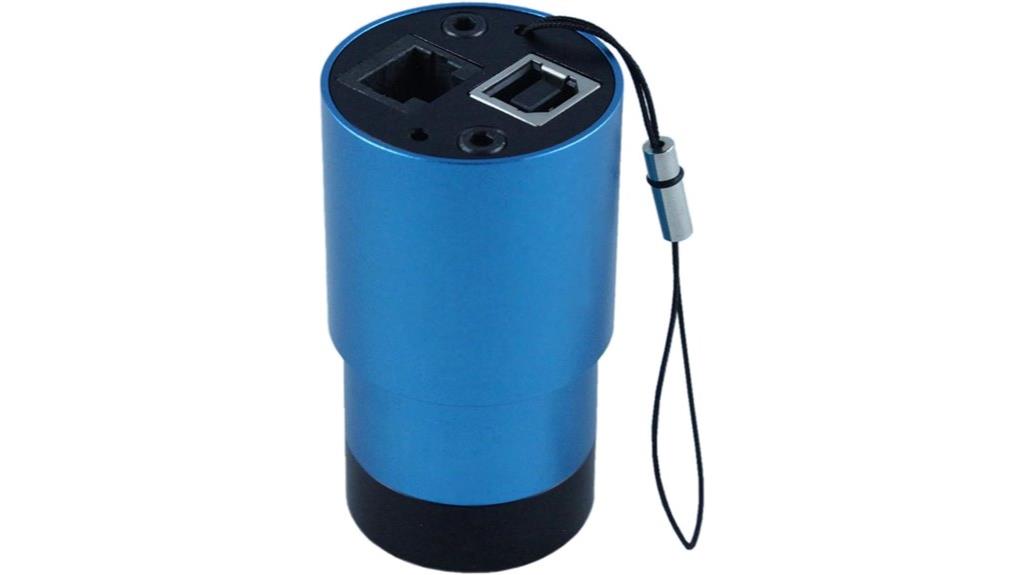
If you’re serious about astrophotography or auto-guiding, the Astromania SGCMOS Series Telescope CMOS Camera is an excellent choice because it combines high sensitivity with fast frame rates. I’ve found it perfect for capturing deep-sky objects and guiding accurately. Its high-sensitivity sensor supports long exposures, while the aluminum CNC housing guarantees durability and efficient heat dissipation. The camera’s standard 1.25-inch interface and C-mount provide versatility for eyepieces and industrial lenses. With built-in ST4 auto guider port and dedicated software, it’s straightforward to set up and operate. Overall, it’s a reliable tool that enhances your astrophotography experience.
Best For: amateur and professional astrophotographers or auto-guiders seeking a high-sensitivity, versatile camera for deep-sky imaging and guiding.
Pros:
- High sensitivity sensor supports long exposures for detailed astrophotography
- Fast frame rates ideal for capturing dynamic celestial events and auto-guiding
- Durable aluminum CNC housing with efficient heat dissipation enhances longevity and performance
Cons:
- Slightly heavy at approximately 10.5 ounces, which may impact mounting ease
- Rated 3.5 out of 5 stars, indicating mixed customer experiences
- Limited to USB 2.0 interface, which may be slower compared to newer USB standards
SVBONY SV605CC Cooled Astrophotography Camera
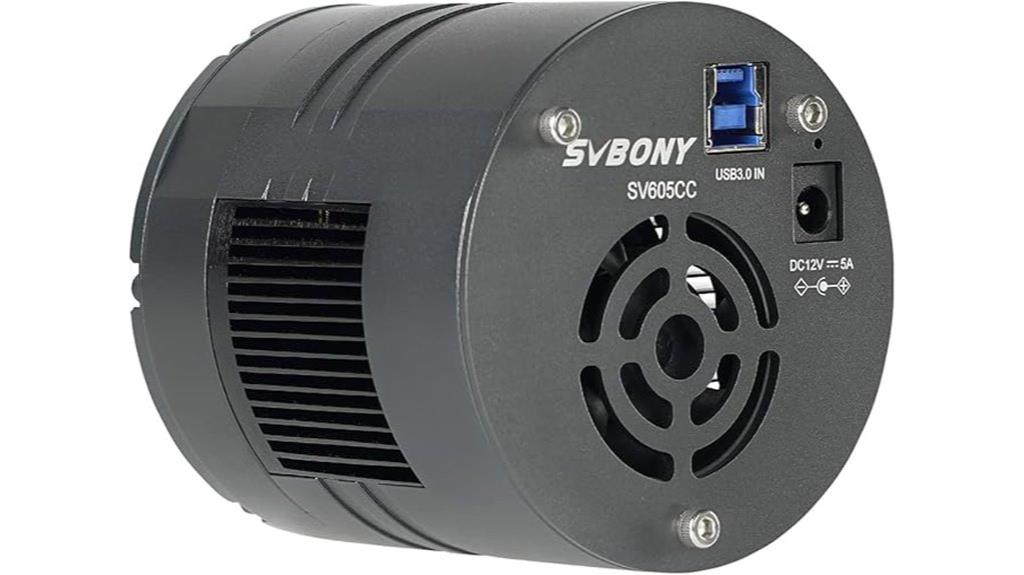
The SVBONY SV605CC cooled astrophotography camera stands out as an excellent choice for deep sky imaging enthusiasts who need high sensitivity and low noise. It features the IMX533 1-inch CMOS sensor with 9 Megapixels, offering up to 80% quantum efficiency for better light capture. The camera’s cooling system reduces temperature by 30°C below ambient, minimizing thermal noise and enhancing image clarity. Its 3.76μm pixels deliver detailed shots even with fast mirror systems. With USB 3.0 support, data transfer is quick, making it perfect for panoramic and lucky imaging. Overall, the SV605CC combines advanced features to produce sharp, noise-free astrophotos.
Best For: deep sky astrophotographers seeking high sensitivity, low noise, and detailed imaging with fast data transfer capabilities.
Pros:
- High quantum efficiency of up to 80% for enhanced light sensitivity
- Effective cooling system reducing temperature by 30°C below ambient to minimize thermal noise
- High-resolution 9 Megapixels sensor with 3.76μm pixels for detailed imaging
Cons:
- May require additional adapters or mounts for optimal setup
- Cooled system might increase overall cost compared to uncooled cameras
- Potential for residual CMOS glow affecting some images without proper processing
Factors to Consider When Choosing Cooled CMOS Astro Cameras for Deep Sky Imaging
When selecting a cooled CMOS astro camera for deep sky imaging, I focus on key factors like sensor sensitivity and quantum efficiency, which affect image quality. Cooling efficiency and noise reduction are vital to capture clear, detailed shots without interference. Additionally, I consider resolution, data transfer speed, and software compatibility to guarantee smooth operation and high-quality results.
Sensor Sensitivity and QE
Sensor sensitivity and quantum efficiency (QE) are essential factors in selecting a cooled CMOS astro camera for deep sky imaging because they directly impact how well the camera detects faint light from distant objects. High sensor sensitivity means the camera captures more light efficiently, resulting in brighter, more detailed images. QE measures the percentage of incident photons converted into measurable electrical signals; higher QE, often up to 80%, greatly boosts low-light detection. A sensor with high sensitivity and QE reduces the exposure time needed, allowing for quicker imaging sessions and less noise. These factors are critical for deep sky astrophotography, where capturing faint signals makes the difference between a good and a great image. Prioritizing sensors with high sensitivity and QE ensures better performance in low-light conditions.
Cooling Efficiency and Noise
Choosing a cooled CMOS astro camera hinges markedly on its cooling efficiency, since effective cooling systems like TEC refrigeration directly reduce thermal noise that can obscure faint celestial details. When the sensor is cooled about 30°C below ambient, thermal noise drops markedly, improving the signal-to-noise ratio and revealing more subtle features. Higher cooling efficiency minimizes residual thermal noise, which is essential for capturing faint deep sky objects without noise artifacts. Some models feature double-layer semiconductor refrigeration, enhancing cooling stability and extending the temperature range. This ensures consistent performance during long exposures. Ultimately, good cooling performance is indispensable for producing clear, detailed astrophotographs with minimal noise, allowing for more precise and beautiful deep sky imaging.
Resolution and Pixel Size
Opting for a cooled CMOS astro camera with higher resolution lets you capture more intricate details of distant deep sky objects. Higher resolution means more pixels, which translates to finer image detail. Smaller pixel sizes, like 3.76μm, allow for sharper images and better performance with fast optical systems, revealing subtle features in galaxies and nebulae. However, larger pixels can improve the signal-to-noise ratio, especially in low-light conditions, but may reduce overall image resolution. Finding the right balance depends on your specific targets and optical setup. If you want to resolve tiny structures, higher resolution with smaller pixels is ideal. Conversely, for capturing faint, extended objects, larger pixels might be more effective. Your choice should align with your imaging goals and equipment.
Data Transfer Speed
When selecting a cooled CMOS astro camera for deep sky imaging, consider the data transfer speed, as it directly impacts your imaging efficiency. Faster data transfer, such as USB 3.0 or higher, reduces lag and allows for quicker image acquisition, which is essential during long imaging sessions. High-speed interfaces are vital for handling large, high-resolution image files, minimizing bottlenecks that can slow down workflows. A robust transfer technology ensures seamless integration with processing software, making data management more efficient. Additionally, reliable, high-bandwidth connections help prevent data corruption or loss when transferring sizable datasets. Overall, choosing a camera with rapid data transfer capabilities enhances your ability to capture, process, and analyze deep sky images effectively, saving time and improving image quality.
Compatibility With Software
Ensuring your cooled CMOS astro camera is compatible with the right software is essential for smooth deep sky imaging. I always check if the camera works with popular programs like ASCOM, NINA, or SharpCap, which simplifies control and data collection. Supporting standard driver protocols like WDM or native drivers guarantees broad compatibility and easy integration with other equipment. I also verify that the camera’s software interface allows for long exposures, frame rate adjustments, and image parameter settings—crucial features for deep sky work. Additionally, I look for a camera whose SDK or API is available, enabling custom software development or integration. Regular firmware and driver updates from the manufacturer are crucial, ensuring ongoing compatibility with evolving astrophotography software and maintaining performance reliability.
Power and Cooling Needs
Choosing a cooled CMOS astro camera requires careful attention to its power and cooling needs, as these factors directly impact performance and image quality. These cameras typically use thermoelectric cooling (TEC) systems to lower sensor temperatures by 30°C or more, reducing thermal noise during long exposures. Adequate power supplies are essential to support the TEC’s energy demands, which vary depending on the cooling capacity and design. Proper thermal management, including heat sinks or aluminum housings, helps maintain stable sensor temperatures. However, aggressive cooling can cause condensation or frosting if humidity isn’t controlled or the camera isn’t properly sealed. Additionally, cooled cameras often consume more power than uncooled models, so robust power sources like dedicated supplies or external batteries are necessary for extended imaging sessions.
Size and Mount Compatibility
Selecting a cooled CMOS astro camera that fits your setup involves paying close attention to its size and mount compatibility. First, verify the camera’s mount type—such as 1.25-inch or C-mount—matches your telescope or accessories for secure attachment. Check the physical dimensions to confirm it fits within your available space and mounting hardware. It’s also essential to confirm the camera’s weight against your telescope’s mounting capacity to avoid strain or instability during imaging. Consider the sensor size relative to your telescope’s focal length to preserve the desired field of view and image scale. Ultimately, make sure the camera’s mounting interface and hardware are compatible with your existing gear, ensuring smooth integration and hassle-free setup.
Price and Value
When evaluating cooled CMOS astro cameras for deep sky imaging, price often reflects a combination of sensor quality, cooling efficiency, and additional features. Higher-priced models typically have advanced sensors, improved cooling systems, and better image processing, offering greater value for dedicated astrophotographers. The cost can vary markedly depending on resolution, cooling performance, and extras like fast data transfer or specialized filters. Investing more upfront often means longer-lasting performance and better compatibility with future upgrades. However, budget options can still be suitable, especially for beginners or casual users, even if they sacrifice some image quality or cooling power. Ultimately, it’s crucial to compare features and performance against the price to find a camera that meets your specific deep sky imaging needs without overspending.
Frequently Asked Questions
How Does Cooling Impact Image Noise in CMOS Astro Cameras?
Cooling markedly reduces image noise in CMOS astro cameras by lowering the sensor’s temperature, which minimizes thermal noise generated during long exposures. When I cool my camera, I notice clearer, more detailed images with less graininess, especially in deep-sky astrophotography. It’s like giving the sensor a break from heat, allowing it to perform at ideal levels and resulting in cleaner, more accurate captures of faint celestial objects.
What Connectivity Options Are Available for These Cooled CMOS Cameras?
Connectivity options for cooled CMOS astro cameras are like a Swiss Army knife—versatile and essential. Most models offer USB 3.0 or USB-C for fast data transfer, ensuring smooth imaging sessions. Some also include Ethernet ports for remote operation, and a few have Wi-Fi for wireless control. I find that having multiple options makes setup flexible, so you can connect your camera effortlessly to your preferred system and start capturing stunning deep sky images.
Can These Cameras Be Used With Multiple Telescope Mounts?
Yes, these cooled CMOS astro cameras can generally be used with multiple telescope mounts. I’ve found they’re compatible with standard adapters and mounting systems, making it easy to switch between different setups. Just guarantee the mount has the appropriate connection port or compatibility, and you’re good to go. I always double-check the camera’s specifications to confirm it’ll work seamlessly with my various mounts, ensuring flexibility for different observing sessions.
What Is the Typical Lifespan of Cooled CMOS Sensors?
Cooled CMOS sensors typically last around 5 to 10 years with proper use, which is impressive considering they endure thousands of hours of exposure. I’ve found that their lifespan depends on factors like cooling efficiency, handling, and operating conditions. Regular maintenance and avoiding thermal stress can extend their life. So, if you care for your gear, these sensors can serve you well through many deep sky sessions.
Are Software Updates Necessary for Optimal Camera Performance?
Yes, software updates are essential for peak camera performance. They often include bug fixes, improvements in image processing, and new features that enhance your imaging experience. I always make sure to keep my camera’s firmware and associated software up to date because it guarantees compatibility with the latest operating systems and maximizes sensor efficiency. Regular updates help me achieve the best possible images and troubleshoot issues quickly.
Conclusion
When choosing a cooled CMOS astro camera, it’s easy to get caught up in specs and price. But remember, the perfect camera isn’t just about cutting-edge features; it’s about how well it fits your needs. Just like a powerful telescope is useless without clear skies, a top-tier camera won’t shine without proper use. Ultimately, balancing performance with compatibility guarantees your deep sky images truly stand out.