
If you’re aiming to perfect your astrophotography in 2025, choosing the right field flattener for your refractor telescope is key. I recommend considering options like the SVBONY SV503 with built-in flatteners, the 102mm SV503 for broader views, and HOTECH’s SCA 2-inch model for versatile correction. Each offers excellent edge-to-edge sharpness and quality. To find the perfect match for your setup, pay attention to compatibility and optical quality—more details will help you make an informed choice.
Key Takeaways
- The SVBONY SV503 and HOTECH SCA 2 Inch are top-rated flatteners compatible with f/5 to f/8 refractors for sharp, flat images.
- High-quality multi-coated lenses reduce aberrations, improve contrast, and ensure edge-to-edge sharpness in astrophotography.
- Compatibility with standard filter threads and camera adapters simplifies integration with various imaging setups.
- Proper focal ratio matching (f/5–f/8) is essential to prevent vignetting and distortion, maximizing image quality.
- Durable construction, positive user ratings, and ease of installation make these flatteners reliable choices for 2025 astrophotography.

SVBONY SV503 Portable Telescope Tube, 70ED F6 Extra Low Dispersion Optical Tube, Micro-Reduction Rap Focuser, for Astrophotography and Visul Astronomy
Quality Optics; SV503 Telescope’s objective lens features an S-FPL51 extra-low dispersion glass ED element; which virtually eliminates chromatic...
As an affiliate, we earn on qualifying purchases.
SVBONY SV503 Portable Telescope Tube with 70ED F6 Optical Tube for Astrophotography and Astronomy
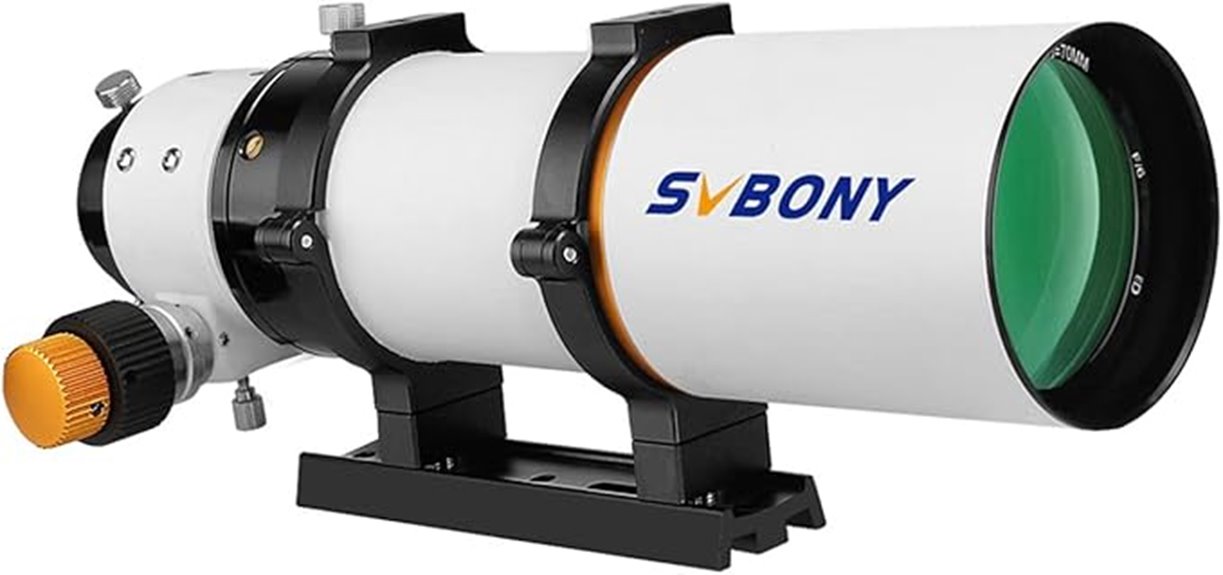
If you’re looking for a portable telescope that delivers high-quality images without the hassle of chromatic aberration, the SVBONY SV503 is an excellent choice. Its 70ED F6 optical system uses ED glass to virtually eliminate chromatic aberration, providing sharp, high-contrast images of the moon, nebulae, or galaxies. Designed for travel and outdoor use, it features a sturdy 2-inch focuser capable of supporting heavy photographic accessories. Whether you’re an experienced astronomer or a beginner, this lightweight, compact tube offers versatility for astrophotography and visual observation. Its reliable optics and portability make it a favorite for those who want quality on the go.
Best For: amateur astronomers and astrophotographers seeking a portable, high-quality telescope with minimal chromatic aberration for both visual and photographic purposes.
Pros:
- Virtually eliminates chromatic aberration thanks to ED glass, ensuring sharp, high-contrast images.
- Lightweight and compact design ideal for travel and outdoor use.
- Supports heavy photographic accessories with a sturdy 2-inch focuser, making it versatile for astrophotography and observation.
Cons:
- May be less suitable for deep-sky astrophotography requiring larger apertures.
- Focal length and aperture size limit the field of view for very wide-angle observations.
- As a portable tube, it may have fewer advanced features compared to larger, more specialized telescopes.

SVBONY SV193 Focal Reducer 2 Inch 0.8X Field Flattener Telescope Accessory for SV503 80mm F7 ED Telescope
Focal reducer and field flattener is one of the essential accessories for astrophotography; SV193 2 inch 0.8x focal...
As an affiliate, we earn on qualifying purchases.
SVBONY SV193 Focal Reducer for SV503 Telescope

The SVBONY SV193 Focal Reducer for the SV503 Telescope stands out as an excellent choice for astrophotographers seeking sharper images and shorter exposure times. This 2-inch, 0.8x focal reducer minimizes star point distortion at the edges, producing cleaner, more detailed celestial photos. Compatible with the SV503 80mm F7 ED refractor, it shortens the focal length, making imaging faster and more efficient. Its design supports full-frame cameras and includes a filter thread for light pollution filters. Weighing just over 10 ounces, it’s a compact, reliable tool praised for its quality, ease of use, and impact on astrophotography results.
Best For: astrophotographers using SV503 80mm F7 ED refractor telescopes seeking to improve image sharpness and reduce exposure times.
Pros:
- Minimizes star point distortion at the edges for clearer celestial images
- Supports full-frame cameras and 2-inch filters for versatile astrophotography
- Compact, lightweight design (just over 10 ounces) for easy handling and installation
Cons:
- Compatible only with specific telescope models like the SV503, limiting versatility
- Requires additional accessories (e.g., filter, camera) for full use, which may increase overall cost
- Slightly higher cost compared to basic focal reducers, though justified by quality

SVBONY SV503 Refractor Telescope with Built-in Field Flattener and SV305C Pro Telescope Camera
Outstanding flat-field correction; built-in field flattener of SVBONY SV503 telescope eliminates field curvature; offering a flat; wide view;...
As an affiliate, we earn on qualifying purchases.
SVBONY SV503 Refractor Telescope with Built-in Field Flattener and SV305C Pro Telescope Camera
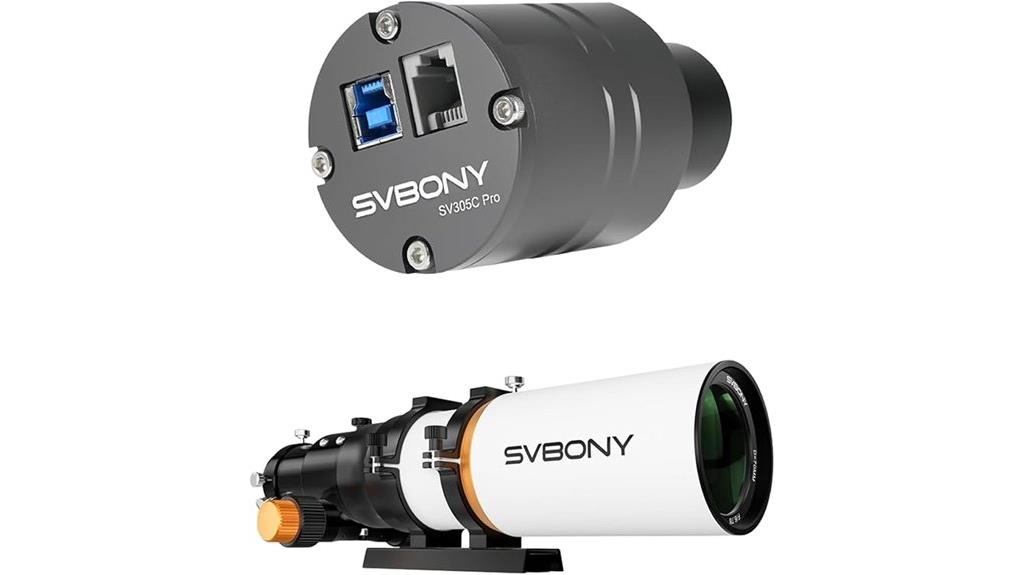
For amateur astronomers seeking sharp, wide-field images without the hassle of additional accessories, the SVBONY SV503 Refractor Telescope with its built-in field flattener stands out as an excellent choice. Its flat-field design eliminates field curvature, ensuring edge-to-edge sharpness, while ED glass reduces chromatic aberration for true-to-life colors. The 70mm aperture and F/6.78 focal ratio produce bright, detailed images of deep-sky objects. Paired with the SV305C Pro Telescope Camera, it offers high sensitivity, low noise, and rapid frame rates, perfect for capturing sharp planetary and astrophotography images. This integrated system simplifies setup and delivers excellent clarity and color fidelity.
Best For: amateur astronomers and astrophotographers seeking high-quality, wide-field imaging with minimal setup hassle.
Pros:
- Built-in field flattener ensures edge-to-edge sharpness and flat-field correction.
- ED glass optics reduce chromatic aberration for true-to-life colors.
- Paired with the SV305C Pro camera, it offers high sensitivity, low noise, and fast frame rates for detailed planetary and deep-sky imaging.
Cons:
- Limited aperture size may restrict deep-sky object brightness compared to larger telescopes.
- The integrated system may have less flexibility for custom upgrades or modifications.
- Suitable primarily for beginners and intermediate users; advanced astrophotographers might seek more specialized equipment.

SVBONY SV503 Telescope for Adults High Powered, 102mm F7 Extra Low Dispersion Achromatic Refractor OTA, Dual-Speed Focuser, Refractor Telescope for Planets Deep Sky Astrophotography&Visual Observation
Superior Optics: This telescope for adults features 102mm aperture, 714mm (f/7) focal length, equipped with FMC coating to...
As an affiliate, we earn on qualifying purchases.
SVBONY SV503 Refractor Telescope with 102mm Aperture and F7 Focal Ratio
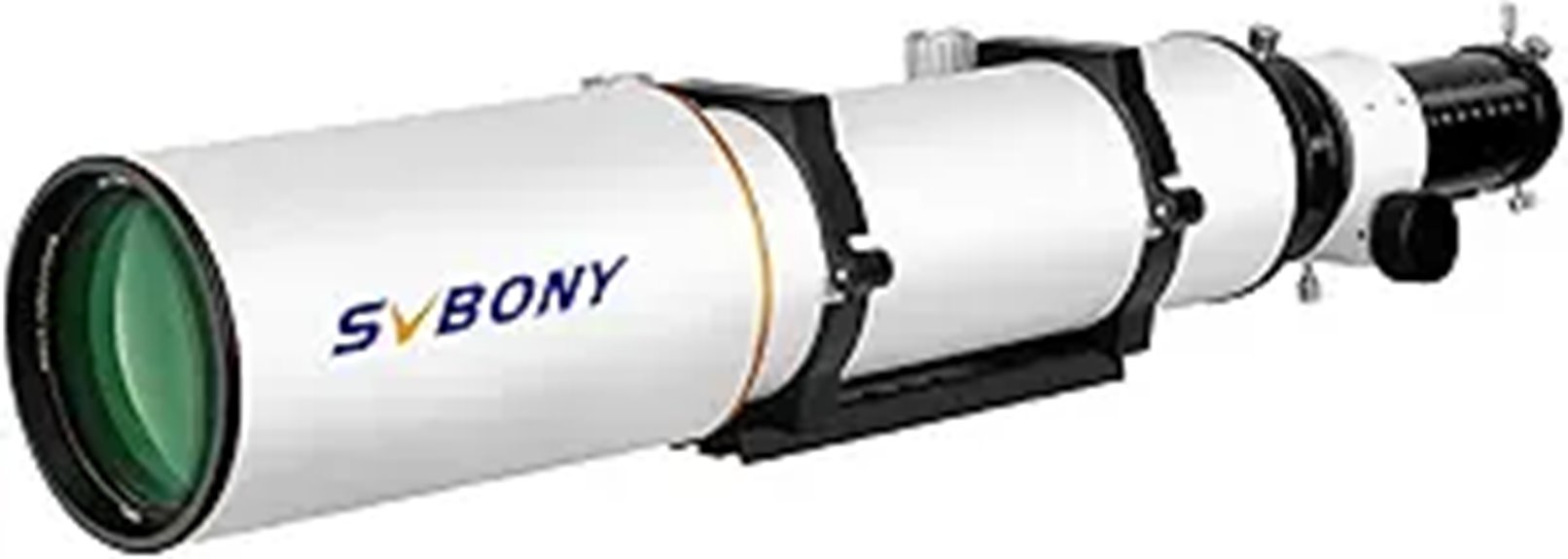
Astrophotographers and serious amateurs seeking crisp, distortion-free images will appreciate the SVBONY SV503 Refractor Telescope’s high-quality optical design, especially its 102mm aperture and F7 focal ratio. Its doublet air-spaced achromatic lens with S-FPL51 ED glass minimizes chromatic aberration, delivering accurate, vibrant images. Fully multi-coated optics maximize light transmission, resulting in brighter, detailed views. The 90mm back focus offers flexible accessory mounting, while the retractable 133mm lens hood reduces stray light and protects the lens. With a dual-speed rack and pinion focuser and 360° field rotator, this telescope provides precise focusing and seamless framing for astrophotography.
Best For: Amateur astronomers and astrophotographers seeking high-quality, versatile refractor telescope for detailed planetary and deep sky imaging.
Pros:
- High-quality doublet air-spaced achromatic lens with S-FPL51 ED glass minimizes chromatic aberration for accurate, vibrant images
- Fully multi-coated optics enhance light transmission, brightness, and contrast for detailed viewing
- 360° field rotator and dual-speed rack and pinion focuser facilitate precise framing and sharp focusing
Cons:
- May be less suitable for extremely deep sky imaging compared to larger aperture telescopes
- Requires proper handling and calibration for optimal performance, especially during astrophotography
- Slightly compact design might limit maximum field of view for some large objects
HOTECH SCA 2 Inch Field Flattener for Refractor Telescopes

If you’re seeking a reliable field flattener that guarantees sharp, flat images across your refractor telescope’s entire field, the HOTECH SCA 2 Inch Field Flattener stands out. Designed for f5 to f8 refractors, it features a fully multi-coated two-element lens that ensures efficient light transmission without sacrificing brightness. The built-in 2” filter thread and T-ring compatibility make it versatile for various cameras. Its center-loading T-adapter with a compression ring ensures precise camera alignment, essential for high-quality astrophotography. Rated 4.4 stars, this flattener consistently delivers bright, sharp, and flat images, making it a top choice for serious imagers.
Best For: astrophotographers using f5 to f8 refractor telescopes seeking sharp, flat, and well-aligned images for high-quality astrophotography.
Pros:
- Fully multi-coated two-element lens provides efficient light transmission and bright, sharp images.
- Built-in 2” filter thread and T-ring compatibility for versatile camera use.
- Center-loading T-adapter with compression ring ensures precise camera alignment for optimal image quality.
Cons:
- Designed specifically for f5 to f8 refractors, limiting compatibility with other telescope types.
- May require additional accessories like filters and T-rings for full functionality.
- Slightly higher cost compared to simpler or single-element flatteners.
Factors to Consider When Choosing Field Flatteners for Refractor Telescopes

When selecting a field flattener, I consider how well it matches my telescope’s focal ratio to guarantee ideal performance. I also look at image flatness and sharpness, along with coating quality and light transmission, to get the clearest views. Additionally, I check for filter thread support and how easy it is to install, so I can enjoy hassle-free setup and high-quality results.
Compatibility With Telescope Focal Ratio
Choosing a field flattener that matches your refractor telescope’s focal ratio is essential for capturing sharp, distortion-free images. Most flatteners are designed for specific focal ratios, typically between f/5 and f/8, to ensure proper correction across the entire field. Using a flattener outside its recommended focal ratio range can cause vignetting, edge distortion, or uneven sharpness, compromising your image quality. Many flatteners specify compatible focal ratio ranges, so selecting one within that range helps maintain ideal performance and minimizes aberrations. Avoid forcing a flattener to work outside its intended ratio, as this can introduce unwanted optical artifacts. Ensuring compatibility with your telescope’s focal ratio is a key step toward achieving flat, clear images in your astrophotography.
Image Flatness and Sharpness
To achieve truly sharp and flat images across the entire field of view, it’s vital to select a field flattener with high-quality optical elements. Well-made flatteners use multi-coated lenses, often with two elements, to correct the inherent curvature of the image plane. This correction minimizes edge distortion and star elongation, giving you clearer, more detailed astrophotos. The optical quality directly impacts how flat and sharp your images appear, especially at the edges. Choosing a flattener that matches your telescope’s focal length and specifications ensures consistent focus and maximum image quality. Regular maintenance and proper alignment also play key roles in preserving flatness and sharpness, helping you achieve stunning, professional-looking astrophotos every session.
Coating and Light Transmission
High-quality field flatteners rely on fully multi-coated lenses to deliver maximum light transmission and minimize reflections throughout the entire optical path. These coatings are essential because they enhance image brightness, contrast, and color fidelity by reducing light loss and glare. Effective coatings also help maintain consistent optical performance across the entire field of view, ensuring sharpness from center to edge. When choosing a flattener, consider how its coatings influence overall efficiency, as better coatings can reduce exposure times and improve image quality. Well-coated flatteners are vital for achieving bright, detailed, and distortion-free images with minimal chromatic aberration. Ultimately, high-quality coatings directly impact the clarity and accuracy of your astrophotography, making them a key factor in your selection process.
Filter Thread Support
Supporting the filter thread size of your field flattener is essential for seamless integration with your astrophotography setup. Make sure it supports standard sizes like 2-inch or M48 threads, which are common for filters. An integrated filter thread allows you to attach light pollution or narrowband filters directly, without extra adapters, simplifying your workflow. Check if the thread supports full-frame filters, crucial for maintaining image quality across larger sensors. Compatibility with your camera’s threads is critical; mismatched threads can cause vignetting or attachment issues. Also, consider if the flattener can accommodate different thread standards, offering flexibility for various equipment configurations. Proper filter thread support not only guarantees a secure fit but also preserves image quality and reduces potential complications during imaging sessions.
Ease of Installation
Choosing a field flattener that’s easy to install can save you time and frustration during setup. Look for one with compatible mounting threads or connection types that fit your refractor telescope without extra adapters. Clear, detailed instructions or diagrams are essential—they make aligning and attaching much simpler. An adjustable or center-loading design, such as compression rings, can help you easily position the flattener precisely. Consider its weight and size to ensure it doesn’t require additional support or modifications. Additionally, compatibility with your camera or accessory adapters, like T-ring or filter threads, streamlines the process further. All these factors contribute to a hassle-free setup, letting you focus more on capturing stunning images rather than wrestling with equipment.
Build Quality and Durability
When selecting a field flattener, paying attention to build quality and durability can make a significant difference in your imaging experience. High-quality flatteners are made from fully multi-coated optical glass, guaranteeing durability and ideal light transmission. A robust metal housing with precise threading adds resistance to wear, corrosion, and mechanical damage, extending the device’s lifespan. Well-constructed flatteners keep lens elements securely centered, maintaining alignment over time and preventing image distortion. Weather-resistant coatings or sealed components help protect against environmental factors during outdoor use. Overall, a solid build enhances stability and longevity, which are vital for consistent, high-quality astrophotography results. Investing in durable materials and precise craftsmanship ensures your field flattener remains reliable through many imaging sessions.
Frequently Asked Questions
How Do Field Flatteners Impact Image Contrast and Color Fidelity?
Field flatteners can improve image contrast and color fidelity by reducing optical distortions and aberrations across the entire field of view. I’ve noticed that a good flattener minimizes edge softness and chromatic issues, making stars appear sharper and colors more accurate. This enhancement allows me to capture clearer, more vibrant astrophotos, especially when shooting wide fields. Ultimately, a quality flattener elevates the overall quality of my images, making them more professional-looking.
Can Field Flatteners Be Used With Astrophotography Cameras Other Than Dedicated Ones?
Absolutely, you can use field flatteners with various astrophotography cameras, not just dedicated ones. Think of it like fitting a universal adapter—most flatteners are designed to work with different camera types, as long as the mount and back focus are compatible. I’ve used mine with DSLR and mirrorless cameras, and the results are fantastic—sharp, flat images that bring the universe right to your lens.
What Maintenance Is Required to Keep a Field Flattener Optimal?
To keep a field flattener ideal, I regularly clean the glass surfaces with a soft, lint-free cloth and a gentle lens cleaner to prevent dust and smudges. I also check the alignment periodically and ensure the mounting screws are tight but not overtightened. Storing it in a dry, dust-free environment helps prevent damage. Routine maintenance keeps my images sharp and ensures the flattener performs at its best.
Are There Compatibility Issues Between Field Flatteners and Different Telescope Brands?
Yes, compatibility can be an issue between field flatteners and different telescope brands. I’ve found that some flatteners are designed specifically for certain models or optical configurations, so using them across brands may cause vignetting or uneven focus. To avoid problems, I always check the manufacturer‘s compatibility list and consider adapters or custom fittings. Doing this guarantees my astrophotography remains sharp and free of distortions.
How Do I Determine the Correct Back Focus Distance for My Setup?
To find the right back focus distance, I start by checking my telescope and flattener specs. I measure from the focuser’s end to the camera’s sensor, ensuring I match the recommended distance in the manuals. I use a field flattener with adjustable spacing if needed, and I fine-tune by taking test images, adjusting until stars are pinpoint across the frame. This process guarantees sharp, flat images.
Conclusion
Did you know that using the right field flattener can improve image sharpness by up to 50%? Choosing the perfect one for your refractor telescope can truly elevate your astrophotography game. Whether you’re aiming for crisp planetary shots or stunning deep-sky images, the right tool makes all the difference. Take your time, consider your needs, and enjoy capturing the cosmos with clarity and precision. Happy stargazing!