If you’re looking for the best organic chemistry books to study alone in 2025, I recommend a mix of beginner-friendly guides and detailed references. Resources like *Organic Chemistry I For Dummies* and *QuickStudy Laminated Guide* are great for quick reviews and foundational understanding. More advanced students might prefer *Clayden’s Organic Chemistry* or the *Student Study Guide* for deeper insights. Keep exploring these options to find the one that fits your goals perfectly.
Key Takeaways
- Look for textbooks emphasizing clear explanations, detailed reaction mechanisms, and recent scientific advances like stereoselectivity and asymmetric catalysis.
- Prioritize resources that balance theory with practice, offering comprehensive exercises and solutions aligned with current research trends.
- Consider engaging, visually-rich books that simplify complex concepts, such as “Organic Chemistry I For Dummies” or “Big Fat Notebook.”
- Choose comprehensive reference texts like Clayden’s Organic Chemistry for in-depth understanding and modern reaction coverage.
- Review expert recommendations focusing on clarity, up-to-date content, and materials suitable for self-study at various proficiency levels.

Organic Chemistry I For Dummies (For Dummies (Math & Science))
As an affiliate, we earn on qualifying purchases.
Organic Chemistry I For Dummies (For Dummies (Math & Science))
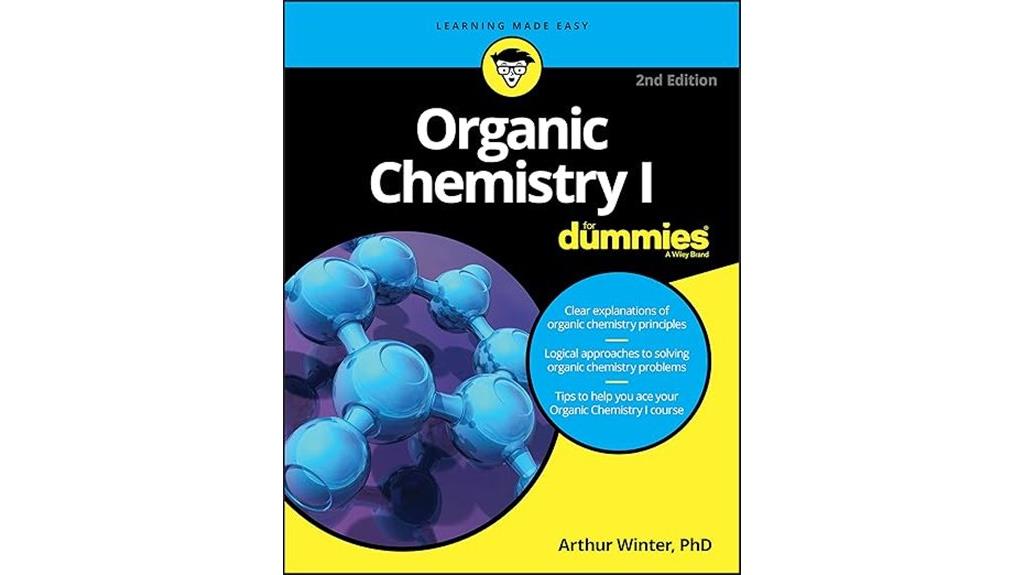
If you’re new to organic chemistry or find traditional textbooks overwhelming, Organic Chemistry I For Dummies is an excellent choice. I appreciate how it’s well-written, clear, and designed for beginners, making complex concepts accessible. The book uses simple explanations, real-life analogies, and visual aids to help you grasp reactions, mechanisms, and key rules without drowning in jargon. It’s perfect for students, parents, and anyone needing a solid review or supplement. While it doesn’t cover every advanced topic, it offers a practical, affordable resource that boosts confidence and understanding, especially during exams or initial learning stages.
Best For: students, parents, and beginners seeking a clear, accessible, and affordable introduction to organic chemistry concepts and review.
Pros:
- Well-written and easy to understand, ideal for beginners and those struggling with traditional textbooks
- Uses real-life analogies and visual aids to simplify complex topics and boost comprehension
- Affordable alternative to expensive textbooks, making organic chemistry more accessible
Cons:
- Does not cover all advanced topics or detailed mechanisms, limiting depth for advanced learners
- Focuses more on broad explanations rather than exhaustive technical details
- Less suitable for those needing in-depth mastery or preparing for highly specialized courses

Chemistry Made Easy: An Illustrated Study Guide For Students To Easily Learn Chemistry
As an affiliate, we earn on qualifying purchases.
Chemistry Made Easy Study Guide
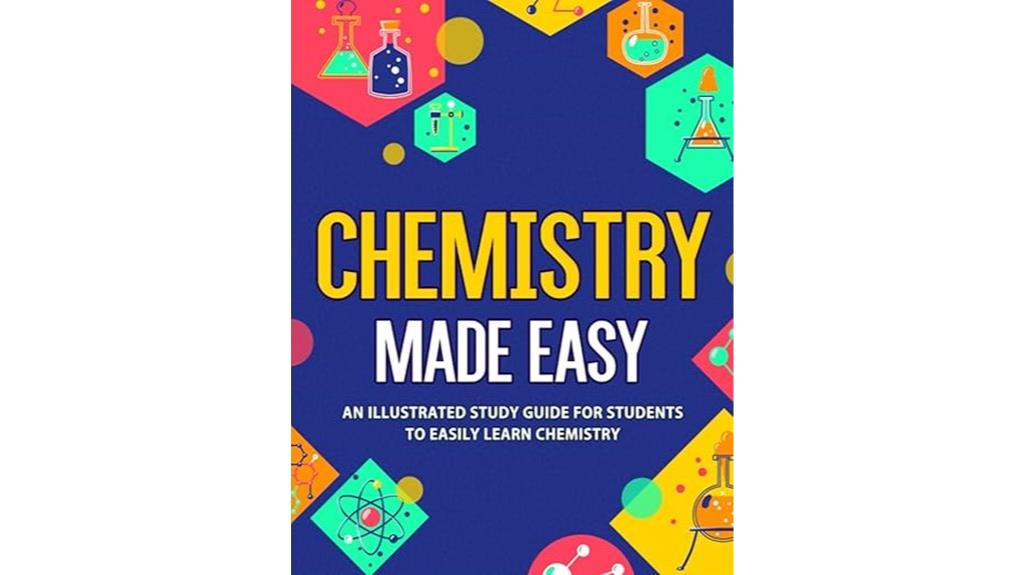
Chemistry Made Easy: An Illustrated Study Guide stands out as an excellent resource for students and adult learners seeking a straightforward introduction to chemistry. I appreciate its simple language and clear layout, which makes complex ideas accessible. The frequent illustrations help visual learners grasp concepts quickly, making it perfect for beginners or those needing a refresher. I’ve found it effective for quick study sessions, boosting confidence in understanding foundational chemistry. While it has minor typos and some outdated info, overall, it’s a practical, user-friendly guide that simplifies learning and helps improve grades or understanding. It’s a solid starting point for self-study.
Best For: beginners, adult learners, and students needing a quick, clear introduction or refresher in chemistry.
Pros:
- Simple language and clear layout make complex concepts easy to understand
- Frequent illustrations enhance visual learning and comprehension
- Effective for quick study sessions and boosting confidence in foundational chemistry
Cons:
- Contains minor typos that can be distracting
- Some outdated information, such as the periodic table referencing 2021
- Limited detailed diagrams, which may not be sufficient for in-depth understanding
Amazon Product 0198503466
As an affiliate, we earn on qualifying purchases.
Organic Chemistry
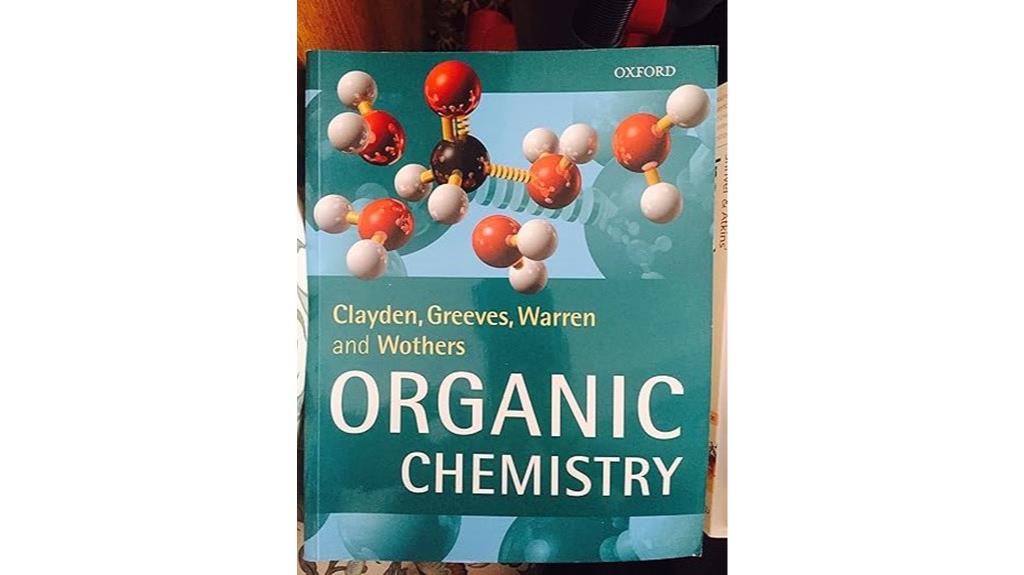
Are you looking for an organic chemistry textbook that combines clarity, modern content, and thorough explanations? Clayden’s Organic Chemistry fits that need perfectly. It’s accessible, engaging, and covers fundamental concepts like reaction mechanisms, stereochemistry, and biological chemistry, making complex topics easier to grasp. Its detailed discussions include modern trends like organometallics and retrosynthesis, with a personal approach that speaks directly to students. While a bit heavy and visually busy, it’s an excellent resource for both learning and reference. Many users praise its clarity, depth, and engaging style, making it a top choice for self-study and advanced understanding in 2025.
Best For: students and professionals seeking a clear, modern, and comprehensive organic chemistry textbook that effectively combines fundamental concepts with advanced topics.
Pros:
- Clear writing style with detailed explanations and illustrative examples
- Covers contemporary reactions, mechanisms, and trends like organometallics and retrosynthesis
- Serves as both a learning tool and an extensive reference for students and professionals
Cons:
- The book is heavy and bulky, making portability challenging
- Excessive use of red color and side notes can be visually distracting
- Limited number of end-of-section problems may hinder practice and exam preparation

Organic Chemistry Fundamentals: QuickStudy Laminated Reference Guide (QuickStudy Academic)
As an affiliate, we earn on qualifying purchases.
Organic Chemistry Fundamentals QuickStudy Laminated Reference Guide
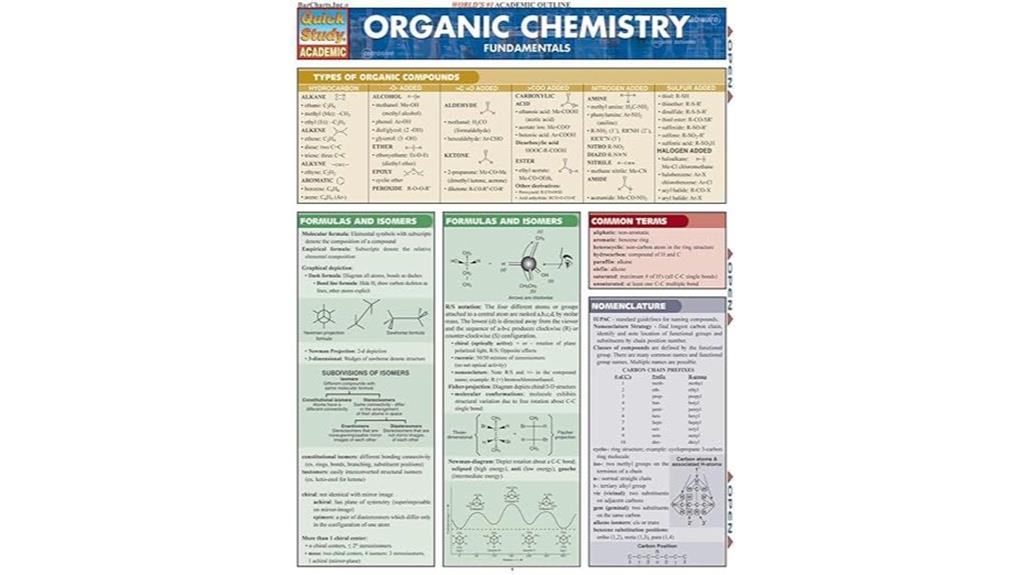
The Organic Chemistry Fundamentals QuickStudy Laminated Reference Guide stands out as an essential tool for students who need quick, reliable access to core concepts. Its durable, laminated design makes it perfect for frequent handling and on-the-go study. The guide simplifies complex topics into clear, digestible sections, ideal for review before exams or during coursework. Whether you’re a nursing student, returning learner, or just need a quick refresher, this guide offers all-encompassing coverage of essential organic chemistry topics. Its well-organized layout and affordability—under 8 euros—make it a practical, invaluable resource for mastering organic chemistry fundamentals efficiently.
Best For: students needing a quick, reliable reference to core organic chemistry concepts for review, exam prep, or on-the-go study.
Pros:
- Durable laminated design for lasting use and frequent handling
- Clear, well-organized layout simplifies complex topics
- Affordable price point under 8 euros, making it accessible for students
Cons:
- Some minor issues like a sliver of paper stuck in the lamination have been noted
- May lack in-depth explanations for advanced topics beyond fundamentals
- Limited to essential topics, so not suitable for comprehensive in-depth study
Student Study Guide and Solutions Manual for Organic Chemistry
If you’re looking for a study aid that truly complements Dr. Klein’s textbook, the Student Study Guide and Solutions Manual is invaluable. It provides answers to all problems, including skillbuilders and review questions, with clear, detailed solutions. This manual helps verify your answers, review key concepts, and practice problem-solving, especially when the textbook lacks solutions. Though some multiple-choice explanations are brief, the overall quality is excellent. It’s perfect for self-study, exam prep, and gaining confidence in organic chemistry. The manual’s exhaustive content makes complex topics more accessible, making it an essential resource for serious students aiming to master the subject.
Best For: serious organic chemistry students seeking comprehensive solutions, practice problems, and confidence-building resources to supplement Dr. Klein’s textbook.
Pros:
- Provides detailed, clear solutions for all textbook problems, including skillbuilders and review questions.
- Enhances understanding of complex concepts and improves problem-solving skills.
- Ideal for self-study, exam preparation, and verifying answers independently.
Cons:
- Some multiple-choice explanations are brief and lack detailed reasoning.
- The manual is large and heavy, making it less portable for on-the-go study.
- Occasional minor typos throughout the book, which do not significantly impact usability.
Workman Publishing Company – To Ace Chemistry in One Big Fat Notebook

Workman Publishing’s “To Ace Chemistry in One Big Fat Notebook” stands out as an ideal resource for students who prefer a colorful, engaging, and easy-to-understand review of chemistry fundamentals. This book offers thorough coverage with a student-like note format, featuring highlighted key points, diagrams, trivia, and illustrations that make learning enjoyable. Its manageable chapters, mnemonic devices, and practice questions help reinforce concepts, making it perfect for self-study or review. Visual learners especially benefit from its bright titles and boxed texts. Overall, it simplifies chemistry, making complex topics accessible and motivating students to grasp key ideas confidently.
Best For: students seeking a colorful, engaging, and easy-to-understand review of chemistry fundamentals that boosts confidence and motivation.
Pros:
- Engaging, colorful format that appeals to visual learners
- Clear explanations with mnemonics and practice questions for reinforcement
- Portable and user-friendly, ideal for self-study or review
Cons:
- May not provide all detailed answers or in-depth explanations
- Slightly limited coverage for advanced or highly specialized topics
- Some users might need supplementary resources for comprehensive understanding
Organic Chemistry

Students and researchers looking for a thorough, modern approach to organic chemistry will find the best textbooks invaluable. This textbook emphasizes mechanistic understanding, using curved arrow notation to explain reactions, and covers recent advances like asymmetric catalysis and stereoselectivity. It includes detailed mechanisms for Nobel-winning processes like Suzuki and Buchwald-Hartwig couplings, linking theory to industry and research. The book also explores physical organic chemistry and spectroscopy, making it suitable from beginner to advanced levels. Its engaging style, boxed key concepts, and real-world examples help connect classroom concepts to practical applications, ensuring a comprehensive grasp of organic chemistry’s role in modern science and everyday life.
Best For: students and researchers seeking a comprehensive, modern, and mechanistically focused organic chemistry textbook that connects theory to real-world applications across various levels of expertise.
Pros:
- Emphasizes mechanistic understanding with curved arrow notation and detailed reaction mechanisms
- Covers recent advances such as asymmetric catalysis, stereoselectivity, and Nobel Prize-winning reactions
- Includes real-world examples linking organic chemistry to drugs, industry, and everyday life
Cons:
- Occasional errors in diagrams and equations, which may cause confusion
- Some editions lack practice problems or omit content like the Eyring equation
- Variability in packaging and online access issues reported by users
Ingredients: The Strange Chemistry of What We Put in Us and on Us

Ingredients: The Strange Chemistry of What We Put in Us and on Us stands out for anyone curious about the science behind everyday substances, especially those who enjoy a humorous, accessible approach to complex topics. I discovered George Zaidan’s work through his YouTube series and found his book both informative and entertaining. It breaks down processed foods, sunscreens, and health claims, teaching you how to critically evaluate scientific studies. His casual style makes chemistry engaging, while emphasizing scientific literacy. Despite some coarse language, the book’s practical insights help demystify what’s in our products and how science shapes our understanding of health, making it a compelling read for curious minds.
Best For: readers curious about the science behind everyday products and health claims who enjoy an engaging, humorous, and accessible approach to learning.
Pros:
- Highly informative with research-backed insights that clarify complex scientific topics
- Engaging and humorous writing style that makes learning enjoyable
- Promotes critical thinking and scientific literacy through practical explanations
Cons:
- Excessive use of coarse language may be off-putting for some readers
- Lack of clear definition for “highly processed foods” can lead to ambiguity
- The final chapter on prayer studies feels out of place and less relevant to the main topics
Chemistry: Concepts and Problems: A Self-Teaching Guide

“Chemistry: Concepts and Problems: A Self-Teaching Guide” is an ideal choice for beginners, high school students, and anyone needing a solid foundation or quick review of basic chemistry concepts. I find it straightforward, with clear, repetitive language that helps retention. It covers atomic structure, periodic table, bonding, chemical equations, and basic states of matter. While it’s perfect for self-study or exam prep, it doesn’t explore into advanced topics like thermochemistry or quantum mechanics. I recommend using it alongside practice tests and supplementary materials for more extensive understanding. Overall, it’s an affordable, accessible resource that builds confidence in foundational chemistry.
Best For: beginners, high school students, and those seeking a straightforward review of foundational chemistry concepts.
Pros:
- Clear, simple language that enhances understanding and retention
- Covers essential topics like atomic structure, bonding, and chemical equations effectively
- Affordable and accessible, ideal for self-study and quick review
Cons:
- Lacks in-depth coverage of advanced topics such as thermochemistry and quantum mechanics
- Limited practice problems for reinforcement and mastery
- Some users report missing or simplified sections, especially in digital versions
Factors to Consider When Choosing an Organic Chemistry Textbook for Self‑Study

When selecting an organic chemistry textbook for self-study, I focus on clarity and simplicity to guarantee concepts are easy to grasp. Visual learning aids like diagrams and charts help me understand complex reactions, while the depth of content should match my current knowledge level. Additionally, I check if the book offers enough practice exercises and is up-to-date with recent advances to solidify my understanding effectively.
Clarity and Simplicity
Have you ever struggled to understand complex organic chemistry concepts because the textbook’s language was too dense or confusing? A clear and simple textbook uses straightforward language and avoids excessive jargon, making tough ideas easier to grasp. Visual aids like diagrams, flowcharts, and illustrations play a key role in clarifying mechanisms and processes. An organized layout with logical progression and concise explanations reduces mental overload and helps you retain information better. Simplified examples and analogies connect abstract concepts to everyday situations, enhancing understanding. Additionally, a user-friendly design with highlighted key points and minimal clutter makes learning more efficient and allows quick review. Prioritizing clarity and simplicity guarantees your self-study journey is more effective and less frustrating.
Visual Learning Aids
Are visual learning aids essential when choosing an organic chemistry textbook for self-study? Absolutely. Effective visual aids like detailed diagrams, reaction mechanisms, and color-coded structures help clarify complex processes. Incorporating stereochemistry models and conformational diagrams boosts spatial understanding of molecules and reactions, making abstract concepts more concrete. Well-designed charts and flowcharts simplify multi-step synthesis pathways, aiding in step-by-step comprehension. Visual aids that include real-world analogies or simplified models make challenging ideas more tangible and relatable. Additionally, high-quality, clear images with consistent labeling markedly enhance understanding, especially for visual learners. These tools not only improve retention but also make studying more engaging and less intimidating. Prioritizing textbooks with strong visual learning aids is a smart move for effective self-study.
Depth of Content
Choosing the right organic chemistry textbook hinges on its depth of content, which should match your current knowledge and learning goals. I look for thorough coverage of fundamental topics like mechanisms, stereochemistry, and synthesis strategies, as well as advanced concepts. It’s important that explanations align with my skill level, whether I need a solid overview or detailed mechanistic insights. I also consider if the book includes modern reactions, recent discoveries, and real-world applications to stay relevant. A good textbook balances theory with practical problem-solving, helping reinforce understanding. Clarity is key—I want explanations that are accessible without oversimplifying or becoming too technical. The right depth ensures I can learn effectively and build confidence at my own pace.
Practice and Exercises
When selecting an organic chemistry textbook for self-study, I pay close attention to the practice problems it offers. I look for books with a variety of questions that challenge different skill levels, helping reinforce concepts effectively. Detailed solutions or answer keys are essential, as they allow me to assess my progress and pinpoint areas needing improvement. I prioritize resources that include exercises on mechanisms, stereochemistry, and reaction predictions, since these are vital for practical understanding. It’s also important that the problems mimic real exam questions or common problem formats used in coursework, so I can prepare efficiently. Finally, I prefer textbooks with diverse question types—multiple-choice, short answer, and drawing mechanisms—to build well-rounded problem-solving skills.
Up-to-Date Material
Staying current with the latest developments in organic chemistry is essential when selecting a textbook for self-study. A good up-to-date book includes recent research, reactions, and mechanisms that mirror current trends in medicinal chemistry and industry. It covers modern catalytic processes like Suzuki, Heck, and Buchwald-Hartwig couplings, which are now standard in synthesis. I look for textbooks that reference Nobel Prize-winning discoveries and feature contemporary examples, guaranteeing relevance to cutting-edge advancements. Clear, accurate reaction mechanisms with proper arrow-pushing notation are also crucial. Additionally, the best texts incorporate recent progress in stereochemistry, organometallics, and biological chemistry, offering a thorough view of where the field is today. Staying informed guarantees my learning stays relevant and aligned with current scientific standards.
Supplementary Resources
Have you considered how supplementary resources can substantially boost your self-study in organic chemistry? Using solution manuals, online tutorials, and practice problem sets can deepen your understanding and give you extra chances to apply concepts. Multimedia tools like videos, interactive simulations, and molecular modeling software help you visualize complex mechanisms and structures, making them easier to grasp. Review guides, flashcards, and quick-reference sheets can improve memorization and help you recall key concepts quickly. Engaging in online forums, study groups, or instructor-led webinars offers clarification, diverse perspectives, and motivation. Combining multiple resources fills gaps left by a single textbook, creating a more all-encompassing learning experience. These tools make self-study more effective, engaging, and adaptable to your specific needs.
Frequently Asked Questions
Which Textbooks Are Best Suited for Visual Learners in Organic Chemistry?
You’re asking about the best textbooks for visual learners in organic chemistry. I recommend ones with lots of diagrams, color-coded mechanisms, and clear illustrations. Books like “Organic Chemistry” by Solomons and Frye have excellent visuals that make complex concepts easier to grasp. I find that visual aids help me understand reaction pathways and structures better, so look for textbooks that emphasize diagrams and visual explanations to enhance your learning experience.
How Do I Choose a Book That Balances Theory and Practical Applications?
Imagine you’re steering a river, seeking the perfect balance between calm waters and exciting rapids. When choosing an organic chemistry book, look for one that offers clear explanations (calm waters) alongside real-world applications (rapids). I recommend checking reviews or previewing chapters to see if it balances theory with practical examples. This way, you’ll stay engaged and truly understand how concepts apply beyond the classroom.
Are There Specific Resources Recommended for Advanced Organic Chemistry Topics?
When exploring advanced organic chemistry topics, I recommend diving into specialized resources like Clayden’s “Organic Chemistry” for in-depth theory, or Solomon’s “Organic Chemistry as a Second Language” for clear explanations. I also find journal articles and research papers invaluable for staying current with cutting-edge developments. Combining these with online courses and problem sets helps me deepen my understanding. Don’t forget to join discussion groups for collaborative learning!
Which Textbooks Include Multimedia or Online Supplementary Materials?
You’re curious about textbooks with multimedia or online supplements. I suggest looking into “Organic Chemistry” by David R. Klein, which offers online quizzes and videos. Also, “McMurry Organic Chemistry” provides access to online resources, including animations and practice questions. These materials make learning more interactive and help me grasp complex concepts faster. Always check the publisher’s website for the latest digital extras—they’re invaluable for self-study.
How Can I Assess the Difficulty Level of an Organic Chemistry Textbook Before Purchasing?
To assess a textbook’s difficulty before buying, I look at the table of contents and sample pages online. I also check reviews from students at similar levels and see if the explanations match my understanding. Sometimes, I preview chapters to gauge the complexity and see if the problem sets challenge me appropriately. This way, I verify the book suits my current knowledge and helps me progress smoothly.
Conclusion
Choosing the right organic chemistry textbook is like selecting a compass for a journey through a labyrinth. Each book is a guiding star, illuminating your path amid complex concepts. As you navigate this intricate maze, remember that your understanding is the treasure hidden within. Trust your instincts, embrace the challenge, and let these resources be your lantern—brightening your way toward mastery in 2025 and beyond.