
TL;DR

Prime made for students and young adults
- Fast, free delivery for dorm and study essentials
- Prime Video and Amazon Music included
- Member-only deals
Archaeologists have discovered a previously unknown city with an ancient church beneath Egypt’s desert. The find offers new evidence of early Christian settlements in the region. Details are still emerging about the site’s full extent and significance.
Archaeologists have announced the discovery of a lost city beneath Egypt’s desert, which includes the remains of an ancient church. The find was made during recent excavation efforts and is considered one of the most significant archaeological discoveries in the region in recent years. This discovery sheds new light on early Christian history in Egypt and has potential implications for understanding regional ancient civilizations.
The discovery was made by an international team of archaeologists working in the Western Desert of Egypt. The site includes well-preserved structures such as a church, residential buildings, and artifacts dating back to the 4th or 5th century CE, according to preliminary dating. The church appears to be one of the earliest Christian structures found in the area, suggesting a thriving Christian community during that period.
Egyptian authorities confirmed the find but have not yet released detailed descriptions of the site or its full extent. The excavation is ongoing, and experts are conducting carbon dating and other analyses to establish the precise age and cultural context of the structures. The site was uncovered after a series of surveys and remote sensing techniques indicated the presence of buried structures beneath the desert sands.
Implications for Early Christian History in Egypt
This discovery is significant because it provides tangible evidence of early Christian settlements in Egypt, a region known for its rich religious history. The presence of an ancient church suggests that Christianity had established a substantial community in this area by the 4th century CE, which could reshape existing narratives about the spread of Christianity in North Africa. The site may also contain inscriptions, manuscripts, or artifacts that could offer new insights into religious practices and daily life during that period.
Furthermore, the find could attract increased archaeological interest and tourism to the region, potentially boosting Egypt’s efforts to preserve its ancient heritage. It also highlights the ongoing importance of archaeological exploration in revealing lost civilizations and understanding historical religious movements.
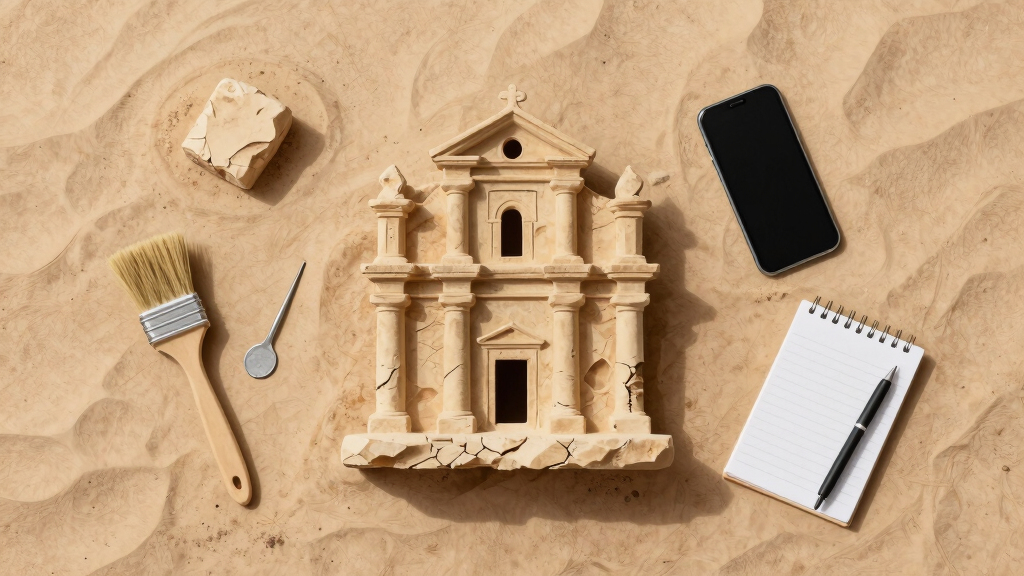
ancient Christian church replica model
As an affiliate, we earn on qualifying purchases.
As an affiliate, we earn on qualifying purchases.
Recent Discoveries and the Region’s Historical Significance
Egypt has a long history of archaeological discoveries, from the pyramids and tombs of pharaohs to Christian monasteries and early churches. Prior to this find, notable discoveries include the Monastery of Saint Anthony, one of the oldest Christian monasteries, and various papyri and artifacts from early Christian periods. The Western Desert has been less explored compared to other regions, making this recent discovery particularly noteworthy.
Experts have long suspected that there are undiscovered sites beneath the desert sands that could reveal more about Egypt’s diverse history—from its Pharaonic past to its Christian and Islamic eras. The use of modern remote sensing and excavation techniques has increased the likelihood of uncovering such hidden sites in recent years.
“This is one of the most exciting discoveries of our careers. The site’s preservation and the presence of the church provide invaluable insights into early Christian communities in Egypt.”
— Dr. Ahmed El-Sayed, lead archaeologist
Egyptian archaeological excavation tools
As an affiliate, we earn on qualifying purchases.
As an affiliate, we earn on qualifying purchases.
Details About the Site’s Full Extent and Age Still Unclear
While preliminary dating suggests the site dates to the 4th or 5th century CE, exact age, size, and the full extent of the city remain unknown. Researchers are still analyzing artifacts and conducting further excavations, so many details are yet to be confirmed.
It is also unclear whether the site was a major urban center or a smaller religious community, and what other structures or artifacts may be present beneath the sands.
As an affiliate, we earn on qualifying purchases.
Ongoing Excavations and Expected Discoveries
Researchers plan to continue excavations at the site over the coming months, with hopes of uncovering inscriptions, manuscripts, and additional structures. Further analysis will aim to establish the precise timeline and cultural context of the city and church. The findings could lead to publication of detailed reports and potentially open new avenues for understanding early Christian Egypt.
historical artifact preservation kit
As an affiliate, we earn on qualifying purchases.
As an affiliate, we earn on qualifying purchases.
Key Questions
How old is the discovered city and church?
Preliminary estimates date the site to the 4th or 5th century CE, but exact dating is still underway.
What makes this discovery significant?
It provides new evidence of early Christian settlements in Egypt, potentially reshaping historical narratives about Christianity’s spread in North Africa.
Are there any artifacts or inscriptions found so far?
Initial reports mention artifacts and structural remains, but detailed findings are still being analyzed.
Will this site become a tourist attraction?
Potentially, once excavations are complete and the site is preserved, it could become an important archaeological and tourist destination.
When will more details be available?
Further excavations and analyses are expected to continue over the next few months, with detailed reports likely to be published afterward.
Source: hn
Halloween Picks
halloween
As an affiliate, we earn on qualifying purchases.