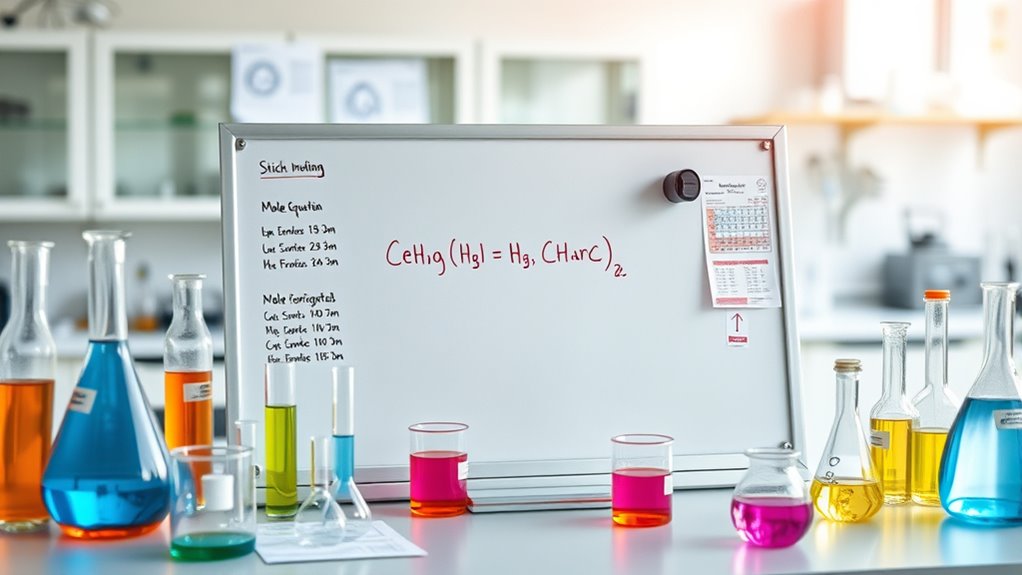

In stoichiometry, balancing chemical equations ensures the law of conservation of mass is maintained by matching atoms on both sides. You then use mole calculations and mole ratios from the balanced equation to determine how much of each reactant is needed or how much product will form. Accurate measurements of reactants are vital for correct predictions and identifying limiting reagents. Keep exploring, and you’ll gain a deeper understanding of how to perform these essential calculations effectively.
Key Takeaways
- Balanced equations show the mole ratios of reactants and products, essential for accurate calculations.
- Mole calculations involve converting grams to moles using molar mass to determine reactant and product amounts.
- Identifying the limiting reagent requires comparing initial moles with the reaction’s mole ratios.
- Use mole ratios from the balanced equation to find the maximum product yield from limiting reagents.
- Precise measurements ensure correct balancing, accurate mole calculations, and reliable reaction outcomes.
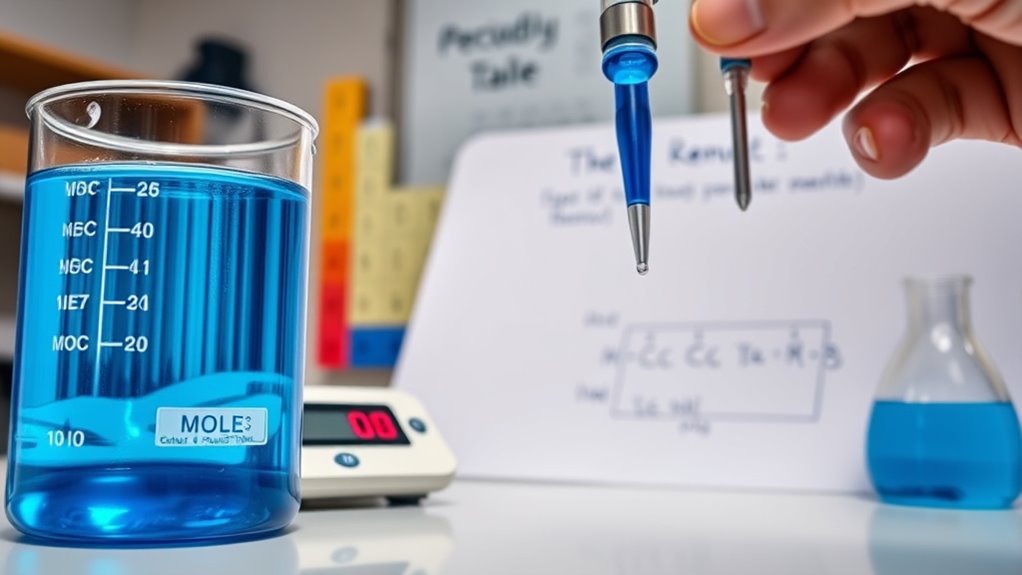
Have you ever wondered how scientists determine the exact amounts of reactants and products involved in a chemical reaction? It all comes down to understanding the concept of mole ratios and the role of limiting reagents. When you look at a balanced chemical equation, you’ll notice coefficients that represent the relative number of moles of each substance involved. These coefficients are known as mole ratios, and they serve as a conversion factor between reactants and products. For example, if a reaction shows 2 moles of substance A reacting with 3 moles of substance B, the mole ratio of A to B is 2:3. This ratio allows you to predict how much of each reactant you need or will produce, based on the amount you start with.
Knowing the mole ratios is vital in stoichiometry because they guide you in converting between different substances in a reaction. Once you have the amount of one reactant or product, you can use the mole ratio to find the amount of others. But beware: not all reactants are used up completely. Some are called limiting reagents because they determine the maximum amount of product that can be formed. The limiting reagent is the substance that gets fully consumed first, halting the reaction. Identifying this reagent is essential because it tells you the theoretical yield of your products. To find the limiting reagent, you compare the mole ratios of what you actually have to what the balanced equation requires. You calculate how many moles of each reactant are needed for the reaction, based on your initial amounts. The reagent that falls short compared to these needs is your limiting reagent. Accurate measurement of reactants is crucial for precise calculations and successful reactions.
Once you’ve pinpointed the limiting reagent, you can determine the maximum amount of product that can be formed. This involves converting the moles of the limiting reagent into moles of the desired product, using the mole ratios from the balanced equation. From there, you can convert moles into grams or other units if needed. This process is key in practical chemistry, whether you’re working in a lab or scaling up reactions for manufacturing. It helps you avoid waste by knowing exactly how much reactant to use, and it guarantees that your calculations for yields are accurate.

Bonvoisin Digital Lab Scale 600g x 0.01g Precision Electronic Scale LCD Display Analytical Balance Jewelry Scale Scientific Scale 0.01g Accuracy
- High Precision Sensor: Accurate and fast response with 600g capacity
- Multiple Unit Conversion: Switch between 6 measurement units easily
- Dual Power Options: Operates via AC adapter or batteries
As an affiliate, we earn on qualifying purchases.
As an affiliate, we earn on qualifying purchases.
Frequently Asked Questions
How Do I Handle Complex Reactions With Multiple Steps?
When handling complex reactions with multiple steps, you should analyze the reaction mechanisms carefully. Break the overall process into individual steps, identifying reaction intermediates and how they transform. Focus on each step’s stoichiometry, and keep track of intermediate species. This approach helps you understand how the reaction progresses, ensuring accurate calculations and better insight into the mechanisms driving the entire process.
What Are Common Mistakes When Balancing Equations?
When balancing equations, you often make errors in coefficient adjustments, so double-check your work. Common mistakes include neglecting to balance all elements or changing coefficients after they’ve been set. To avoid errors, identify where the equation isn’t balanced, then carefully adjust coefficients, ensuring they’re the smallest whole numbers possible. Always recheck the atom count for each element to catch errors before finalizing your balanced equation.
How Can I Convert Grams to Moles Accurately?
To convert grams to moles accurately, you need to use the molecular weight of the substance. Find the molar mass from the periodic table, then divide the grams by this molar mass for the molar conversion. Make certain your units are consistent and double-check your calculation. This method ensures precise conversion from grams to moles, which is essential for correct stoichiometry and chemical calculations.
What Tools Assist in Stoichiometry Calculations?
Think of tools like molecular models and stoichiometry software as your chemical compass, guiding you through complex calculations. Molecular models let you visualize atoms and molecules, making abstract concepts tangible. Meanwhile, stoichiometry software acts as a digital calculator, swiftly crunching numbers and balancing equations. These tools help you navigate the chemistry landscape with confidence, transforming tricky problems into manageable puzzles you’ll enjoy solving.
How Does Limiting Reactant Affect Yield Calculations?
You need to identify the limiting reactant because it directly affects your yield prediction. When one reactant is in excess, it doesn’t determine the amount of product formed. Instead, the limiting reactant does. By knowing the limiting reactant, you can accurately calculate the maximum theoretical yield, ensuring your expectations match what’s actually possible, and avoid overestimating product amounts based on excess reactants.

Upgraded Body Mass Indexes Wheel Calculator Single Side Easy Operate Suitable for 20 Aboves Adult 150mm Diameter Wheel Calculator
- Weight Class Selection: Fat or health weight options
- Ideal Gift: Great for overweight friends or family
- BMI Calculation: Aligns height and weight for BMI
As an affiliate, we earn on qualifying purchases.
As an affiliate, we earn on qualifying purchases.
Conclusion
Now you’re all set to master stoichiometry, whether you’re balancing equations or doing mole calculations. Remember, it’s like finding your way through a maze in the 21st century — a bit tricky at first, but rewarding when you get it right. Keep practicing, stay curious, and don’t be afraid to channel your inner scientist. Before you know it, you’ll be solving chemical mysteries faster than you can say “Great Scott!”

Innovating Science Introduction to Chemical Equations – Explore Chemical Reactions, Learn to Write Balanced Chemical Reaction Equations – Small Group Learning – Experiment Kit
- Chemical Reaction Types: Explore various chemical reactions
- Balanced Equation Practice: Learn to write balanced equations
- Interactive Experiment: Conduct reactions for observation
As an affiliate, we earn on qualifying purchases.
As an affiliate, we earn on qualifying purchases.

Calculated Industries 8030 ConversionCalc Plus Conversion Calculator
- Unit Conversion Capacity: Convert over 70 units including US, metric
- Extensive Conversion Options: Over 500 conversion combinations
- Easy Measurement Conversion: Switch between formats with one key
As an affiliate, we earn on qualifying purchases.
As an affiliate, we earn on qualifying purchases.
![Paxos Made Simple (2001) [Pdf]](https://varietychem.com/wp-content/uploads/2026/07/paxos-made-simple-2001-pdf-featured-560x300.jpg)